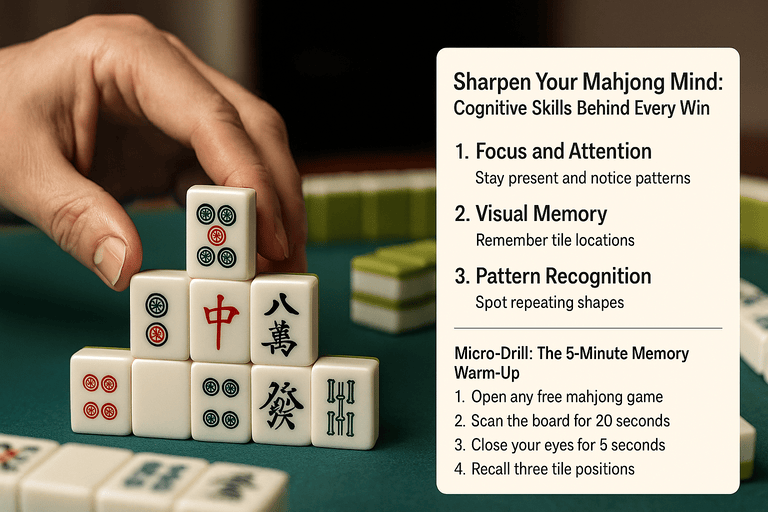
Sharpen Your Mahjong Mind: Cognitive Skills Behind Every Win
I still remember my first truly focused game of Mahjong solitaire. For the first time, I wasn’t just matching tiles — I was seeing patterns, anticipating moves, and reacting instantly. The tiles seemed to move slower, the board clearer. That’s when it clicked: Mahjong isn’t only about luck or memory — it’s a workout for the brain. Have you ever noticed how the more you play, the sharper you feel?
Let’s explore the mental skills that separate casual players from true masters — and how you can train them deliberately.
The Mental Muscles of Mahjong
1. Focus and Attention
Every successful hand starts with awareness. Advanced players stay present, noticing small tile shifts and possible patterns. Losing focus for even five seconds can mean missing a perfect match.
Try playing a Timer Mahjong session where you deliberately maintain full attention — no distractions, no autopilot.
2. Visual Memory
Mahjong requires remembering tile positions, especially those that just disappeared. Training your visual recall helps you anticipate what’s still buried beneath the layers.
You can build this skill with short exercises in mahjong 3D online— the spatial depth strengthens mental mapping naturally.
3. Pattern Recognition
The brain loves order. Spotting repeating shapes, pairs, and color groups speeds up decision-making. That’s why experienced players often “feel” where a match should be even before consciously seeing it.
For practice, load Turtle Mahjong and try predicting your next three moves in advance — no guessing, just observation.
Micro-Drill: The 5-Minute Memory Warm-Up
This simple routine strengthens short-term recall and focus before a session:
- Open any free mahjong game.
- Spend 20 seconds scanning the board without clicking.
- Close your eyes for 5 seconds and visualize three tiles and their positions.
- Open your eyes and check if you remembered correctly.
- Repeat 5 times.
After a week, you’ll notice you’re not only faster — you’ll make fewer random clicks because your brain is pre-loading the board subconsciously.
Flow: The Secret of Consistent Performance
When players talk about being “in the zone,” they’re describing flow — that perfect balance between challenge and skill. In Mahjong, flow appears when your mind is alert but relaxed, moves feel effortless, and the outside world disappears.
Want to trigger it more often?
- Play in quiet, well-lit surroundings.
- Choose a rhythmically satisfying layout like relaxing mahjong puzzle.
- Set a moderate goal (e.g., clear 70% of tiles without hint).
Flow is where focus turns into joy — and that joy turns into improvement.
Why Cognitive Training Matters
Mahjong isn’t just entertainment; it’s mental cross-training. Studies have shown that regular play enhances:
- Working memory
- Spatial reasoning
- Visual processing speed
- Decision control under pressure
And unlike other brain exercises, Mahjong adds emotional reward — that satisfying click when the last tile disappears.
To test how sharp your concentration really is, check your consistency across sessions on the Mahjong leaderboard — your progress is the best proof of a trained mind.
Final Thoughts
Sharpening your Mahjong mind means embracing the game as both art and science. Every tile matched strengthens attention, memory, and perception.
👉 Next time you start a mahjong game, treat it as a five-minute brain gym — one where strategy meets serenity.
How focused can you stay when the tiles start to blur? Your next session might surprise you.