

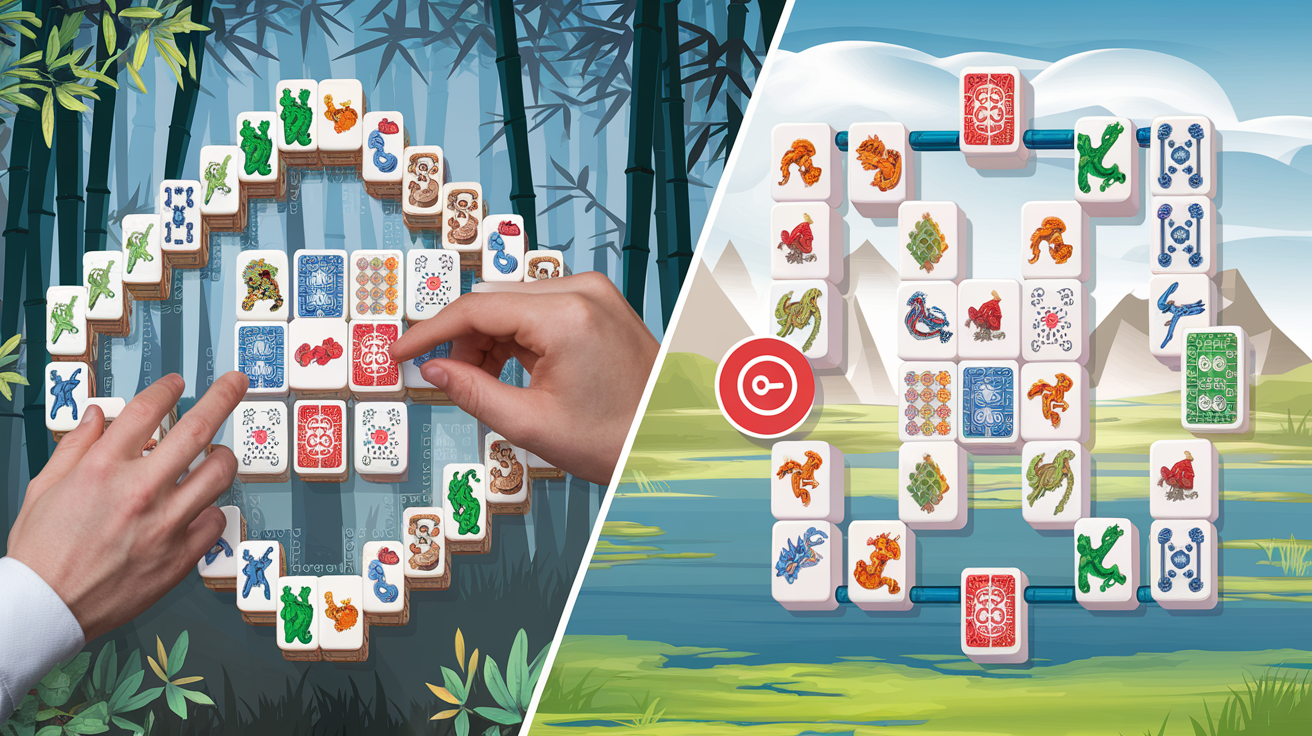
The Great Mahjong Solitaire Undo Debate: Learning Tool or Game-Breaking Feature?
Walk into any mahjong solitaire forum or Discord community, and you'll eventually encounter a recurring tension that rarely surfaces in mainstream gaming discourse: the question of whether undo should exist at all. It's a debate that separates players into two seemingly incompatible camps—those who see undo as essential to the game's educational value, and purists who argue it fundamentally undermines mahjong solitaire's core challenge.
Unlike debates about difficulty settings or assistance modes in other games, this discussion cuts to something deeper: what is mahjong solitaire actually testing? Is it a puzzle game where learning from failure matters more than the score, or is it a game of consequential decision-making where every choice must stand?
The Case for Unlimited Undo: "Mistakes Are How We Learn"
Advocates for generous undo functionality present a compelling pedagogical argument. Mahjong solitaire's core challenge isn't reflexes or speed—it's reading the board, understanding tile accessibility, and planning several moves ahead. When a player makes a seemingly small error ten moves back, it can cascade into an unwinnable position twenty moves later.
Without undo, players face a cruel dilemma: either restart the entire game after a single critical mistake, or continue playing with the knowledge that they've already lost. Proponents argue this creates frustration rather than learning.
"How can I improve if I never get to see the consequences play out?" one experienced player posed in a popular mahjong community. "If I make a mistake and have to restart from move one, I haven't learned anything except 'I failed.' But if I can undo and see why that move was wrong, I've actually absorbed a strategic lesson."
This perspective views mahjong solitaire as fundamentally a puzzle—not unlike Sudoku or crosswords. In those domains, the ability to revise your work is considered standard. The satisfaction comes from solving the puzzle, not from solving it perfectly on the first attempt.
Themahjong.io's implementation exemplifies this philosophy: unlimited undo with a simple keystroke or button click. The platform trusts players to engage with the feature as a learning tool rather than a crutch. Many players report that as they improve, they use undo less frequently—not because the feature is restricted, but because their decision-making becomes more deliberate.
From this perspective, undo isn't cheating—it's scaffolding that can eventually be removed as skill improves.
The Purist Position: "Constraints Create Meaning"
The opposing view deserves equal consideration, though it's often dismissed too quickly by casual players.
Purists argue that removing consequences from decisions fundamentally changes what game you're playing. Mahjong solitaire becomes something else entirely when players can reverse every mistake: it becomes a pure pattern-recognition puzzle rather than a game requiring judgment under uncertainty.
"If I can undo, I'm not actually playing the game," one longtime player explained. "I'm solving it. That's different. In a real game, you have to make decisions with incomplete information and live with them."
This camp points to how other digital games handle similar situations. Chess engines allow you to take back moves, but competitive chess absolutely does not. Roguelike games (Hades, Slay the Spire) make their reputation partly on permanent consequences. Even Solitaire, mahjong solitaire's spiritual cousin, traditionally offers no undo function.
The purist argument has historical weight. Traditional mahjong, which inspired solitaire variants, is fundamentally about commitment—once you discard a tile, it's gone. The psychological weight of that decision is central to the game.
Moreover, purists contend that unlimited undo creates a different skill set. With undo, the challenge becomes: "Can I find any solution?" Without it, the challenge becomes: "Can I find a solution while making wise decisions in real-time?" These are legitimately different games, and the second arguably requires more sophisticated skill.
Some platforms have attempted compromise positions: a limited number of undos (3-5), undo only within the last few moves, or undo disabled after a certain number of moves. These represent attempts to preserve the tension of consequence while still offering some safety net.
How Different Platforms Approach the Question
The fragmentation of mahjong solitaire implementations reveals just how contested this question is:
TheMahjong.io embraces unlimited undo completely, making it a core feature of their player experience. This positions learning and accessibility as primary values.
Some mobile apps restrict undo to 3-5 uses per game, forcing strategic thinking about when to use your safety net.
Classic digital implementations (like older Windows versions) often had no undo at all, treating each game as a test of real-time judgment.
Modern casual platforms often gate undo behind premium subscriptions or charge in-game currency for each undo, monetizing the feature itself.
Each choice reflects different philosophical assumptions about what the game should reward.
Finding the Nuance
This debate resists easy resolution because both sides are genuinely right about different things.
Purists are correct that unlimited undo changes the game's nature. It does remove certain pressures that alter strategy and skill requirements. A player with infinite undos plays differently than one without them, and that difference is real.
Advocates for undo are equally correct that without it, the game becomes primarily about avoiding mistakes rather than solving puzzles. Frustration often exceeds satisfaction, especially for intermediate players.
The resolution may lie in player agency. The ideal design might be: unlimited undo is available, but players can choose to play "Iron Mode" where it's disabled. This respects both philosophies and allows players to calibrate their own experience based on their goals.
Our Position
For a general-purpose platform like themahjong.io, unlimited undo is the right call. Here's why:
Mahjong solitaire's primary value lies in being accessible, engaging pattern-recognition practice. Most players aren't competing for tournaments or high scores—they're looking for an enjoyable challenge. For that population, removing undo creates unnecessary friction that benefits almost no one.
Players who want the purist experience can simply choose not to use undo. The availability of a feature doesn't mandate its use. But players who want to learn and enjoy themselves without punishment can access that experience too.
Moreover, the data supports this: games with accessible undo features see higher engagement, longer play sessions, and players who report better learning outcomes. The feature literally works as intended.
That said, we respect the purist position. Mahjong solitaire would benefit from an "Iron Mode" toggle where undo is disabled for players seeking that specific challenge. Until then, we're confident that unlimited undo serves the broadest range of players while still allowing traditionalists to self-impose their preferred constraints.
The debate itself matters more than its resolution. It keeps the community thinking deeply about what mahjong solitaire actually is and what it should reward. That's healthy.
