

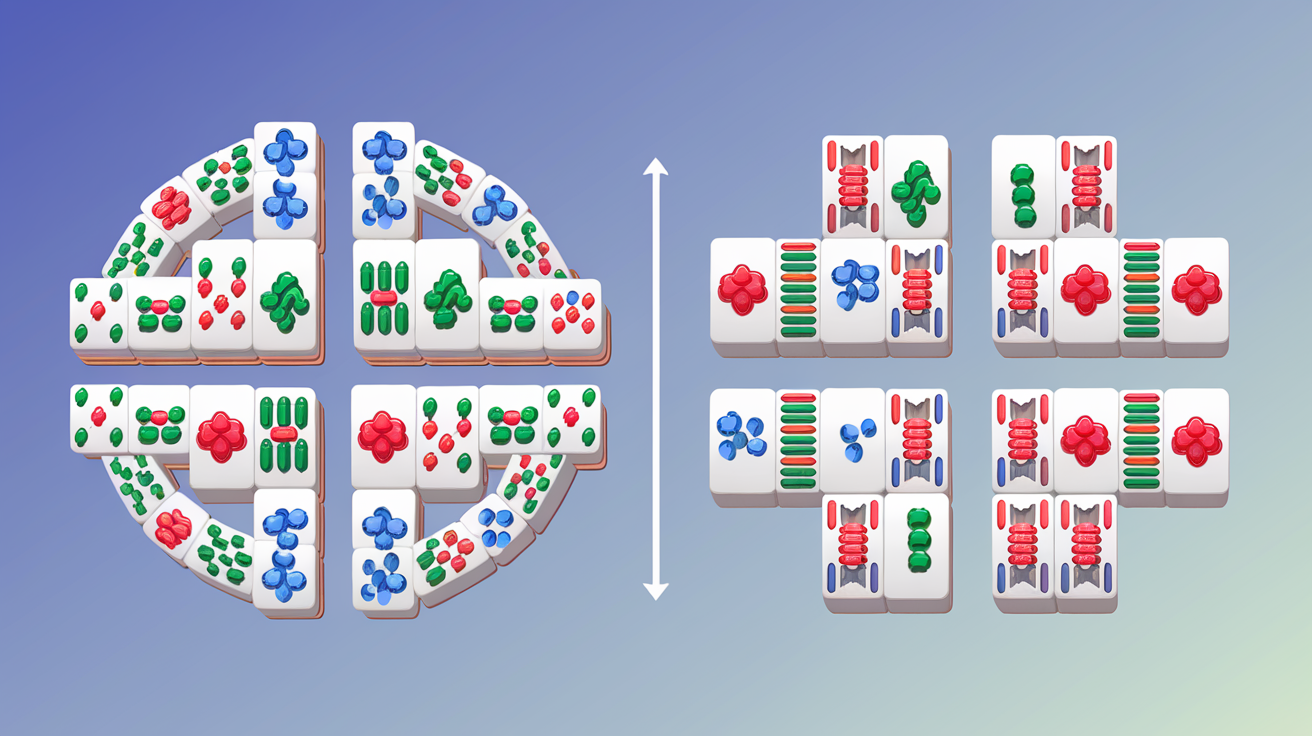
Mahjong Solitaire vs. Traditional Mahjong: Understanding Two Different Games
If you've played mahjong solitaire on themahjong.io, you might assume you're playing the same game that's been enjoyed in Asia for centuries. The truth is more interesting—and more nuanced—than that. While both games feature the iconic mahjong tiles, they are fundamentally different experiences with distinct origins, rules, and strategic elements.
What They Share: The Tiles and Aesthetics
Let's start with what connects these two games. Both traditional mahjong and mahjong solitaire use the same beautiful tile sets: bamboos, circles, characters, honors (winds and dragons), and often flowers and seasons. The visual language is identical, and both games have a meditative, contemplative quality that draws players in.
This shared aesthetic is important. It's why the naming confusion is so understandable, and why many new players to solitaire assume they're learning something centuries-old. The tiles carry cultural weight and history, and that's genuinely true—just not the history of the solitaire version.
Traditional Mahjong: A Four-Player Strategy Game
Traditional Chinese mahjong is a four-player game with roots going back centuries (exact origins are debated by historians, but the modern form solidified in the 19th century). It's a complex game of strategy, probability, and social play.
In traditional mahjong:
- Four players compete simultaneously, each with their own hand
- Tiles are drawn and discarded in a specific order
- Melds are formed (sets of three matching or sequential tiles)
- Winners complete a specific hand pattern (usually a combination of melds plus a pair)
- Strategy involves reading opponents, managing risk, and adapting to available tiles
- Social and psychological elements are central—bluffing, betting, and table dynamics matter
- Games typically last 30 minutes to an hour and involve real-time decision-making under pressure
Traditional mahjong requires learning hand rankings, understanding tile values, managing your discards strategically, and reading opponents' play. It's genuinely complex—many players spend years mastering regional variants (Cantonese, Japanese, American, and others all have different rules).
Mahjong Solitaire: A Tile-Matching Puzzle Game
Now we come to a fascinating piece of digital history. In 1981, Brodie Lockard, a computer programmer, created a computer game called Mah-Jongg. Lockard's game was fundamentally different from traditional mahjong: it was a single-player puzzle game focused on matching tiles.
In mahjong solitaire:
- One player works alone against the puzzle (not against opponents)
- Tiles are arranged on the screen in predetermined layouts (often called "boards")
- The goal is to match and remove pairs of identical or related tiles
- Tiles can only be matched if they're "free"—meaning they have at least one side exposed (no tile covering them completely)
- Strategy involves spatial reasoning and lookahead, not opponent psychology
- The game has a clear win/lose condition based on clearing all tiles
- Games typically last 5-15 minutes per board, with no time pressure from other players
Lockard's creation was brilliant precisely because it adapted the aesthetic and symbolism of mahjong tiles into an entirely new game mechanic. It wasn't meant to replicate traditional mahjong—it created something new using a familiar visual language.
How Solitaire Became "Shanghai"
The spread of mahjong solitaire is largely a story of Microsoft. In the 1990s, Microsoft bundled a digital mahjong solitaire game with Windows operating systems under the name "Shanghai." (The name came from an earlier arcade version.) This was a watershed moment: millions of people encountered mahjong solitaire, many believing they were playing authentic mahjong.
Microsoft's decision wasn't intentional deception—it was simply following an established game name. But it did cement the naming confusion that persists today. When people now say "I play mahjong," they might mean either game, and context determines which.
Key Strategic Differences
Beyond rules, the strategic thinking required differs dramatically:
Traditional Mahjong Strategy:
- Probability assessment (which tiles remain in the wall?)
- Opponent modeling (what hand is my opponent pursuing?)
- Risk management (is this winning hand worth the cost?)
- Bluffing and psychological play
- Adaptive strategy based on changing table dynamics
Mahjong Solitaire Strategy:
- Spatial reasoning (which tiles can I actually access?)
- Planning ahead (if I remove this pair, can I access the tiles I need?)
- Pattern recognition (which layouts force dead ends?)
- Puzzle optimization (can this board be solved from this position?)
- Logical deduction (if I can't win from here, backtrack and try differently)
These are genuinely different cognitive challenges.
Why The Confusion Persists—And Why It's Okay
The naming overlap exists for historical reasons that make perfect sense. Lockard wasn't wrong to use mahjong tiles. The tiles themselves are beautiful and meaningful. And Microsoft wasn't trying to deceive anyone—they were just continuing a name.
What matters is this: if you enjoy mahjong solitaire, you're enjoying a game with its own legitimate history (going back to 1981, which is itself historically significant in computer game development). You're not playing a "wrong version" of anything. You're playing a game that respectfully uses mahjong's visual language to create a puzzle experience.
Conversely, if you're interested in traditional mahjong, you're exploring a game with genuine centuries-old roots, rich cultural context, and incredible strategic depth.
The Takeaway
Both games deserve respect for what they are. Mahjong solitaire is an elegant puzzle game with a fascinating origin story in early computer gaming. Traditional mahjong is a complex social game with profound cultural significance. They share tiles and names, but they are distinct pursuits.
Understanding this difference enriches your appreciation for both. And if you've been playing mahjong solitaire thinking it was something else, that's entirely understandable—but now you know the real, interesting story.
