

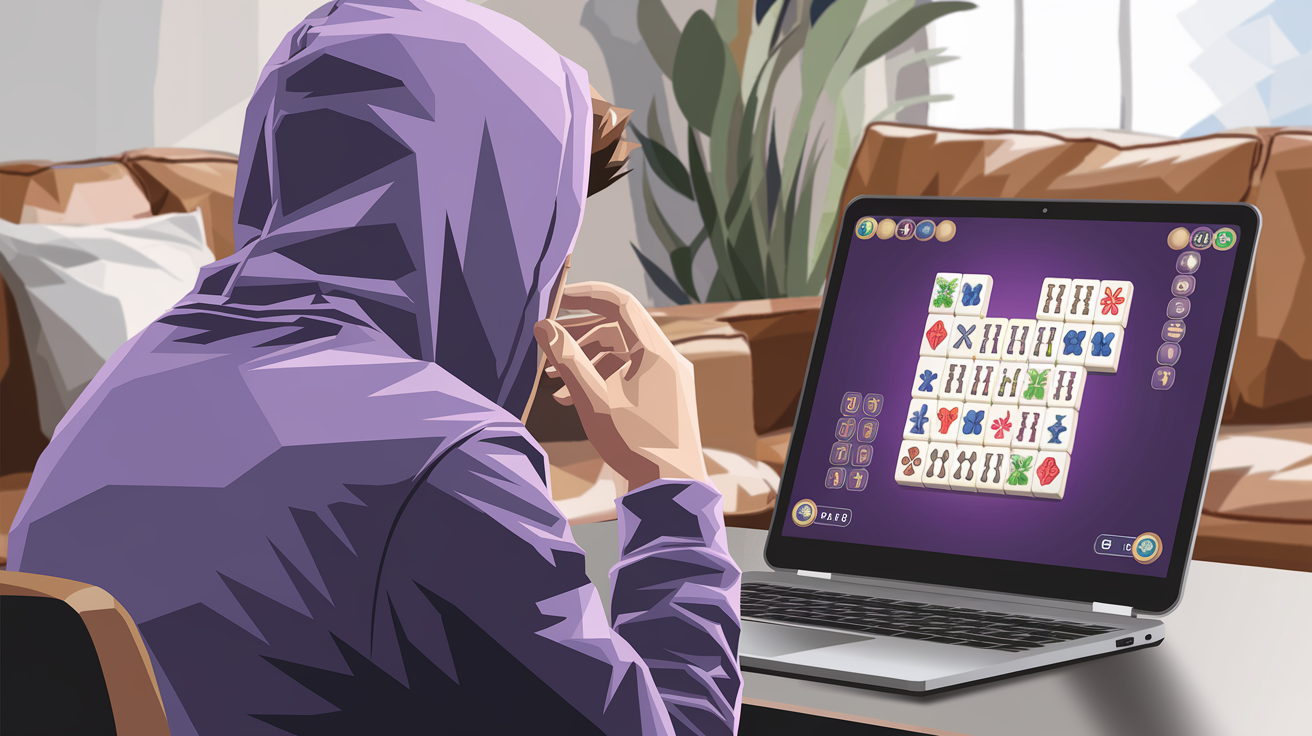
Mahjong Solitaire Hints: When to Use Them and When to Trust Your Instincts
The Seductive Problem with Hints
When you first encounter the hint button in online mahjong solitaire, it feels like a gift. You're stuck on a puzzle, the tiles seem impossibly tangled, and one click reveals a playable pair. Relief washes over you. The game continues. Problem solved.
But here's what I learned through hundreds of hours grinding mahjong: that moment of relief is actually a moment of arrested development.
I remember my early days with mahjong, desperately clicking hints whenever I felt even a whisper of uncertainty. A game that should have taken fifteen minutes to complete—with actual problem-solving—became a five-minute procession of hint-tapping. I wasn't playing mahjong. I was watching mahjong happen to me.
The consequences came later, when I tried playing on harder difficulty levels without hints. My tile recognition was weak. My board-reading instincts hadn't developed. I had no memory of move sequences because I'd never had to think through them. The hints had been a crutch so comfortable that I'd forgotten how to walk on my own.
What Hints Actually Do to Your Brain
Let's be honest about the neuroscience here. Every time you use a hint before attempting to solve the puzzle yourself, you're outsourcing the pattern-recognition work that develops expertise. Your brain doesn't get to build those neural pathways.
Mahjong solitaire, at its core, is about three things:
- Tile recognition – Quickly identifying suits, numbers, and honors without hesitation
- Board spatial reasoning – Understanding how tiles block and unlock one another
- Strategic sequencing – Recognizing that move A opens up moves B and C, while move X creates a dead-end
When you hit "hint" instead of working through these challenges, you skip the cognitive struggle that builds competence. You're essentially asking the game, "Can you do the thinking for me?" And the game, politely, says yes.
The problem? Struggle is where learning lives.
When Hints Actually Help
This doesn't mean hints are always harmful. There's a crucial difference between strategic hint use and reflexive hint use.
Hints genuinely serve learning when you use them in these scenarios:
True Dead-Ends: You've genuinely exhausted the visible playable pairs and your board reading is solid, but you're still stuck. A hint here teaches you that you missed a tile arrangement—valuable feedback.
Learning New Patterns: When facing a board arrangement you've never encountered before, a hint can illuminate how certain tiles interact. You can then apply that knowledge to future games.
Breaking Tilt: After multiple failures on the same board, a hint can restore morale and let you observe how to progress, essentially teaching through example.
Understanding Board Cascades: Occasionally, using a hint and then continuing without hints for the rest of the game teaches you how one decision unlocks subsequent moves—the flow of strategic play.
The key in each case: you're using the hint as information for learning, not as an escape button.
The Hint Budget Framework
Here's what actually works: treat hints like currency you have limited amounts of per session.
Beginner Framework (Learning Difficulty 1-3):
- Budget: 2 hints per game
- Strategy: Use them only after genuinely trying for 2+ minutes
- Goal: Build fast recognition and basic board reading
Intermediate Framework (Learning Difficulty 4-6):
- Budget: 1 hint per game
- Strategy: Reserve it for true dead-ends after 5+ minutes of analysis
- Goal: Develop independent problem-solving and pattern memory
Advanced Framework (Learning Difficulty 7+):
- Budget: 0 hints during gameplay
- Strategy: Use hints only after completion to review alternative solutions
- Goal: Maximum skill development and mastery
This framework works because it creates healthy constraints. You can't spam hints. Each one becomes precious. You think before clicking.
Some sessions, you'll finish a game without using any hints and realize you've improved. That's the real reward—not the game completion, but the capability upgrade.
Implementing This at TheMahjong.io
One reason I recommend themahjong.io is that their hint system respects this philosophy. Rather than aggressively pushing hints or making them feel like the default solution, they present hints as a tool available when needed, not as the expected way to play.
Their interface shows your hint count remaining, which creates exactly this psychological constraint—when you can see "Hints: 1 remaining," you suddenly become more intentional about using it.
Their hint system also doesn't just reveal any playable pair; it reveals a specific strategic pair that actually progresses the game meaningfully. This turns hints into mini-lessons rather than shortcuts. You're not just getting unstuck; you're seeing how strong players approach unsnarling complex boards.
The Path to Genuine Mastery
Mastery in mahjong doesn't come from playing more games. It comes from playing games where you're genuinely engaged in solving them.
Hints can support that—or they can replace it. The difference is intentionality.
Start by setting your hint budget for your next session. Maybe it's 2 hints. Maybe it's 1. The number doesn't matter as much as the decision you make beforehand. You're not reacting to difficulty; you're managing your learning.
Then, when you encounter a stuck position, pause. Don't instantly click. Spend two minutes really looking. Where are the blocked tiles? What would a good player do? Can you see a move you missed?
Only then, if you're genuinely stuck and if your budget allows, use your hint.
You'll notice something within weeks: boards that once seemed impossible become solvable. Your recognition gets faster. You start seeing tile arrangements in ways you couldn't before. This isn't because you've played more. It's because you've thought more.
That's the difference between using hints as a learning tool versus using them as an avoidance strategy.
The button will always be there if you need it. But the real win is trusting yourself enough to not need it quite as often.
Final Thought
Mahjong is beautiful precisely because it requires you to see something others miss. When you use hints reflexively, you're outsourcing that seeing. When you use them strategically—with intention and limits—you're borrowing a hint to improve your own vision.
Choose the latter. Your future skill will thank you.
