

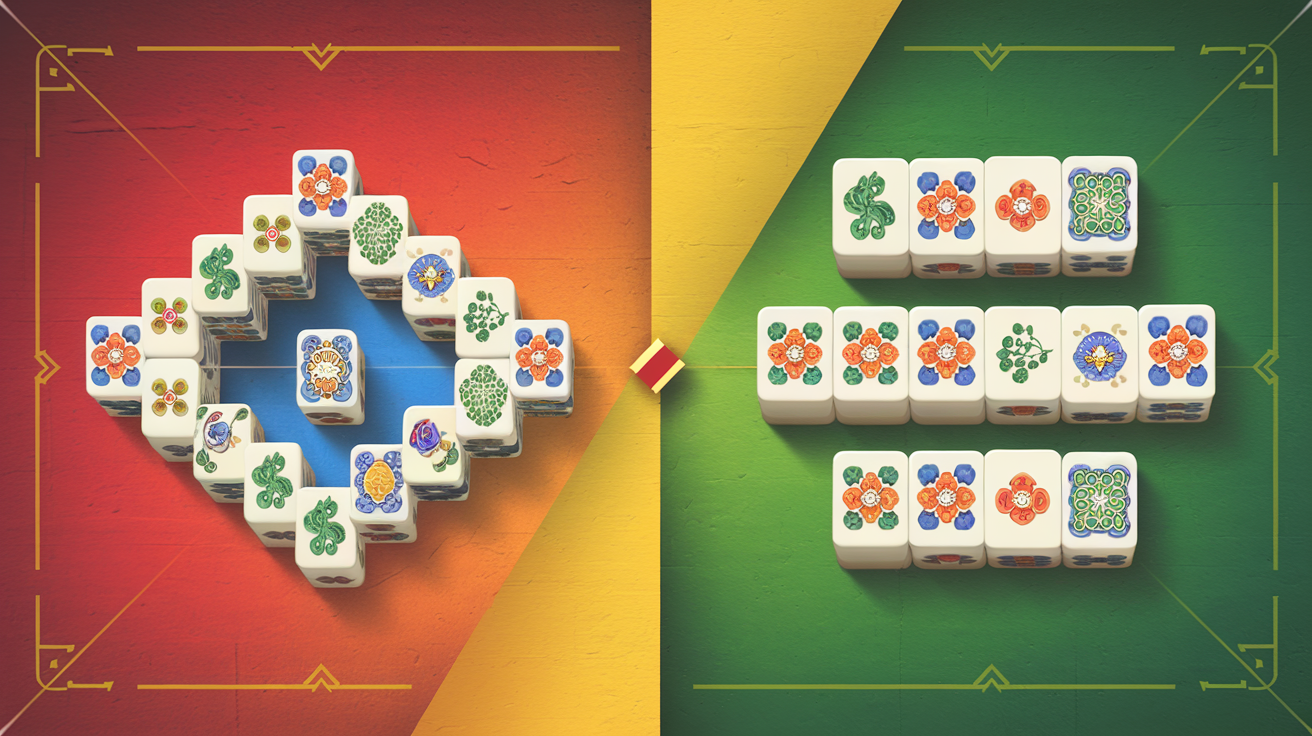
Mahjong Solitaire vs. Traditional Mahjong: Understanding Two Completely Different Games
When you sit down to play mahjong solitaire on themahjong.io, you're engaging with a game that shares almost nothing with the traditional Chinese mahjong played by four players around a table for centuries. Yet the name persists, creating genuine confusion. This article clarifies the two games, their actual origins, and why this naming overlap exists.
What Is Traditional Mahjong?
Traditional mahjong is a four-player strategy and luck game originating in 19th-century China. Players draw and discard tiles from a shuffled wall, attempting to form melds (combinations of tiles) according to specific hand patterns. The gameplay involves memory, strategic discarding, reading opponents, probability assessment, and careful hand management. A typical game involves multiple rounds, scoring systems that vary by region, and genuine player-versus-player tactics.
Key characteristics of traditional mahjong:
- 4 players competing simultaneously
- Drawing and discarding tiles strategically
- Complex hand patterns and winning combinations
- Player interaction and bluffing
- Skill-based with significant strategic depth
- Luck plays a role, but decision-making is paramount
What Is Mahjong Solitaire?
Mailjong solitaire is a single-player puzzle game focused on matching pairs of tiles. The board displays tiles in a specific layout (often pyramid-shaped or in stacked formations), and players remove matching pairs by clicking on tiles that share the same design. The challenge lies in finding exposed pairs and clearing the board before running out of valid moves.
Key characteristics of mahjong solitaire:
- Solo play against the puzzle itself
- Pattern matching as the core mechanic
- Spatial awareness and visual recognition
- No player interaction whatsoever
- Puzzle-solving focused
- Skill dominates; luck plays virtually no role
The Birth of Mahjong Solitaire: Brodie Lockard's 1981 Innovation
The story of how mahjong solitaire came to exist is fascinating. In 1981, American computer programmer Brodie Lockard created a computer version called Mah-Jongg (note the hyphenation, which distinguished it from traditional mahjong). Lockard had learned traditional mahjong but wanted to create a single-player puzzle game using mahjong tiles as his visual foundation.
Lockard's innovation was brilliant: he borrowed the aesthetic appeal of mahjong tiles—their beautiful designs and cultural richness—but created an entirely new game mechanic. Rather than simulating the four-player tile-drawing experience, he designed a puzzle where players match exposed pairs. This required no knowledge of traditional mahjong rules and could be enjoyed by anyone who understood the simple concept of matching.
The game was commercially successful and spawned countless variations across different computing platforms.
Shanghai and the Windows Era
The confusion deepened significantly when Microsoft included a mahjong solitaire game in Windows 3.0 (1990), initially named Shanghai (after the Chinese city, though the name had no specific significance to the game). This bundling was transformative. Millions of people encountered the game without prior context, and many naturally assumed they were playing "mahjong" because that's what mahjong tiles looked like.
The Windows version cemented mahjong solitaire as a mainstream casual game. By the time the internet made online versions accessible, the naming conflation was already deeply established. Today, "mahjong" casually refers to solitaire for most casual players, while traditionalists and culture-conscious players distinguish between "mahjong" (the original game) and "mahjong solitaire" (the computer puzzle).
What Do They Actually Share?
It's important to acknowledge what connects these games:
Visual Design: Both use the same tile suits and designs originating from traditional mahjong—bamboo, characters, dots, winds, dragons, and season tiles. These symbols carry cultural significance.
Tile Symbolism: The tiles themselves represent the same iconography in both versions.
Cultural Association: Both are associated with East Asian culture and have become globally recognized.
Tile Count: Traditional games use 136 tiles; solitaire versions use matching pairs, maintaining some mathematical symmetry.
Beyond these surface-level connections, the games diverge fundamentally.
Where They Fundamentally Diverge
Game Structure:
- Traditional: 4 players, turn-based, multiple rounds
- Solitaire: 1 player, continuous action, single session
Rules Complexity:
- Traditional: Extensive rulebooks, regional variations, intricate hand patterns
- Solitaire: A single rule—match exposed identical tiles
Strategy Type:
- Traditional: Player psychology, hand management, probability with incomplete information
- Solitaire: Spatial reasoning, puzzle-solving, working with complete information
Social Element:
- Traditional: Inherently social and competitive
- Solitaire: Entirely solo
Decision-Making:
- Traditional: Decisions made with uncertainty about opponent hands and the draw pile
- Solitaire: All information visible; decisions based purely on puzzle logic
Why the Naming Confusion Persists
The name "mahjong solitaire" persists because:
- Historical inertia: Brodie Lockard chose the name, and it stuck
- Manufacturer decisions: Microsoft's bundling of Shanghai cemented casual usage
- Visual connection: The tiles are genuinely mahjong tiles
- Marketing advantage: "Mahjong" is a recognized, culturally intriguing name
- Casual acceptance: Millions learned the solitaire version first, so mahjong means solitaire to them
A Respectful Perspective
There's no shame in not knowing the distinction. The game industry and technology companies created this confusion through naming decisions. A person who loves mahjong solitaire isn't "playing mahjong wrong"—they're playing a different game that borrowed a name and aesthetic.
Conversely, understanding the distinction enriches appreciation for both games. Traditional mahjong represents centuries of strategic game design; mahjong solitaire represents a modern puzzle innovation. Both are worthwhile in their own right.
Conclusion
Mailjong solitaire and traditional mahjong are separate games with different rules, strategies, player counts, and decision-making frameworks. They share tiles and cultural imagery but little else mechanically. This distinction matters for anyone seeking to understand either game deeply. Whether you're enjoying mahjong solitaire for casual relaxation or learning traditional mahjong for strategic challenge, knowing the difference helps you appreciate what each game uniquely offers.
