

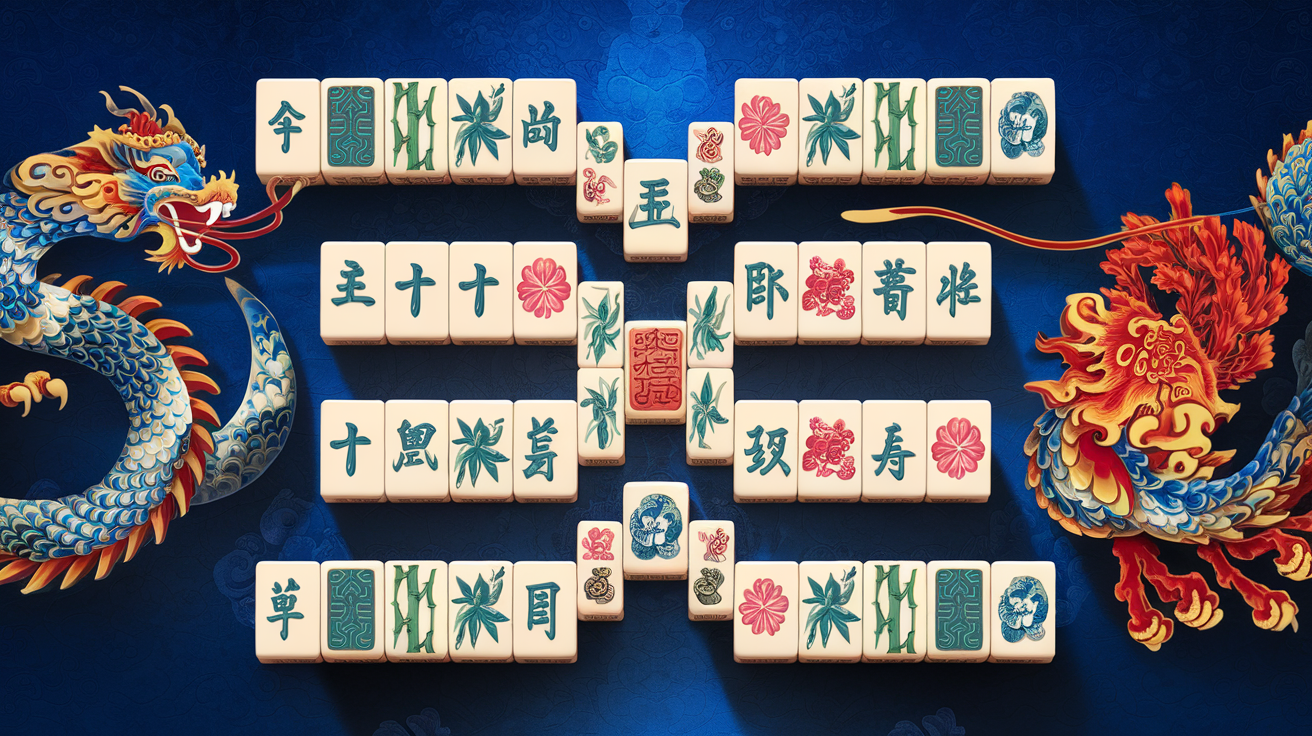
Mahjong Solitaire vs. Traditional Mahjong: Understanding Two Very Different Games
If you've played mahjong solitaire online or on your computer, you might assume it's a digital version of the classical Chinese mahjong game played around tables for centuries. In reality, these are two entirely different games that happen to use related tile sets. Understanding their distinct origins, rules, and strategies helps clarify why the confusion exists—and why both deserve appreciation as standalone games.
The Origins: Where Each Game Came From
Traditional Mahjong emerged in 19th-century China and developed into a complex four-player card game played for centuries across Asia. It's a game of strategy, memory, reading opponents, and calculated risk-taking. The tiles represent suits and honors, and winning requires skill, observation, and sometimes negotiation with other players.
Mahjong Solitaire, by contrast, is a modern invention. In 1981, computer programmer Brodie Lockard created a single-player tile-matching game using mahjong tile imagery. Lockard was inspired by the appearance of mahjong tiles but created an entirely new game mechanic: matching pairs of identical tiles on a board to clear the layout. This had no precedent in traditional mahjong culture.
Lockard's game was called "Mah-Jongg" and became popular among early computer users. Later, when Microsoft bundled a version of this tile-matching game with Windows 3.1 (and subsequent versions), they renamed it "Shanghai," though the gameplay remained unchanged. This bundled game introduced millions of people to tile-matching solitaire, often their first exposure to anything using mahjong tiles.
Why the Naming Confusion Persists
The confusion between traditional mahjong and mahjong solitaire is entirely understandable and rooted in several factors:
1. Shared Tile Imagery Both games use the same beautiful, symbolic tiles—bamboos, dots, characters, dragons, and wind symbols. This visual overlap creates an intuitive connection, even though the gameplay is completely different.
2. Bundled Software Legacy Millions learned this solitaire variant through Windows, where it appeared alongside other classic games. The association between "mahjong tiles" and "computer solitaire" became normalized.
3. Naming Ambiguity The term "mahjong" in popular usage became attached to both the traditional game and the solitaire version. Many websites and apps use "mahjong" generically for any tile-matching game, further blurring distinctions.
4. Geographic and Cultural Distance Traditional mahjong remained more prevalent in Asia and specific diaspora communities, while the solitaire version became a global computer phenomenon. Most Western players encountered only the digital version.
The Fundamental Differences
Traditional Mahjong: Strategy and Social Play
Traditional mahjong is a four-player game where:
- Players compete directly against three opponents simultaneously
- Strategy involves reading opponents, remembering discarded tiles, and calculating probabilities
- Rule variations exist by region (Hong Kong style, Shanghai style, American style, etc.), though core mechanics remain similar
- Winning requires building sets (punghai, chow patterns) and declaring victory before opponents
- Luck and skill both matter, but skill in observation and planning is paramount
- Social elements include conversation, negotiation, and the rhythm of play around a table
- Games last 30 minutes to several hours, depending on house rules and player skill
Mahjong Solitaire: Puzzle Logic
Mahjong solitaire is a single-player game where:
- You play alone against the board, not against opponents
- Strategy involves spatial reasoning and planning, deciding which pair removals preserve access to hidden tiles
- Rules are simple and universal—match adjacent or blocked pairs until the board clears (or you get stuck)
- Winning is binary: you either clear the board or you don't
- Luck plays almost no role—every board state is fixed and solvable with optimal play (though not all starting configurations are)
- The experience is meditative and personal, with no social component in the traditional sense
- Games last 5-20 minutes, making them ideal for quick mental breaks
What They Actually Share
Despite their differences, traditional mahjong and solitaire do share genuine connections:
Tile Sets and Symbolism Both use the same tiles, honoring the aesthetic and symbolic richness of mahjong imagery. Even in solitaire, these tiles carry cultural weight.
Pattern Recognition Both games reward players who quickly recognize patterns—in traditional mahjong, recognizing hand possibilities; in solitaire, spotting available pairs and planning sequences.
Accessibility Both games are relatively easy to learn but rewarding to master. You can play either casually or with deep strategic engagement.
Cognitive Benefits Research suggests both games provide mental benefits—improving memory, problem-solving, and concentration, though through different mechanisms.
Why Both Games Matter
Neither game is "better" or more authentic than the other. They serve different purposes:
Traditional mahjong preserves a centuries-old cultural practice, offering social connection, strategic depth, and competitive play. It remains vital in Asian communities and has gained renewed interest globally.
Mahjong solitaire offers an accessible, meditative puzzle experience that has brought joy to millions of casual players. It stands on its own merits as a well-designed game, regardless of its name.
Moving Forward
Understanding this distinction helps players appreciate what each game offers without diminishing either. If you enjoy mahjong solitaire at themahjong.io, you're playing a game with its own legitimate history and design lineage. If you want to explore traditional mahjong, you're discovering something entirely different—but equally rewarding.
The confusion between these games isn't a mistake or shame; it's simply the result of how games spread, evolve, and adapt across cultures and technology. Both have earned their place in how people around the world play, relax, and think.
