

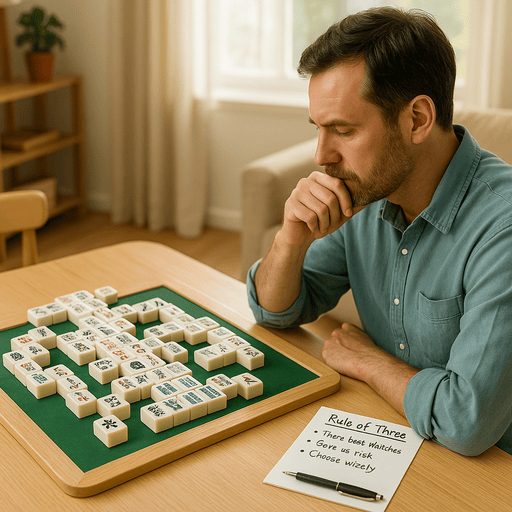
Mahjong Strategy Lab: Turning Luck into Logic
Some players say Mahjong is all about luck — that the tiles decide your fate before the game even begins. But watch an expert play, and you’ll see something else entirely: calculation, timing, and intuition working in perfect sync. The truth? Luck might open the door, but strategy keeps it open.
People love having the freedom to enjoy their favorite hobbies whenever and wherever they want — and Mahjong fans are no exception. Everyone wants to jump in for a quick game at any moment, to play non-stop, every day of the week — or as we like to call it, Mahjong 247.
This guide will help you turn that anytime passion into deliberate skill — using logic, structure, and smart decision-making to take full control of every match.
From Instinct to Insight
The biggest leap from intermediate to advanced play is understanding that every move has ripple effects.
Ask yourself:
Does this match open more tiles or close future options?
What is the long-term cost of removing this pair now?
How do I maintain the highest number of available moves possible?
You can explore this concept safely by testing different approaches in relaxing mahjong puzzle — where there’s no time pressure, and every move becomes a lesson in logic.
The Key Metrics of Smart Play
Strategic players measure their decisions, not just their wins. Let’s break down three simple but powerful metrics you can use to evaluate your play.
1. Open Pair Density (OPD)
This measures how many of your open tiles currently have a match available.
Formula: OPD = Open pairs / Total open tiles.
A good OPD early in the game is around 0.5 or higher — meaning half of your open tiles can be paired.
To maintain it, focus on moves that increase possibilities, not just clear space.
2. Layer Exposure Rate (LER)
LER tracks how many hidden tiles you uncover per move.
If a match reveals multiple tiles underneath, that’s a strong move.
Averaging 1.0 or higher in the opening stage is ideal.
You can practice raising your LER by playing Turtle Mahjong — its layered shape is perfect for visibility training.
3. Deadlock Risk Index (DRI)
Count how many stacks are capped by one blocking tile.
Reducing this number steadily throughout the game means you’re preventing late-stage frustration.
When you want to stress-test this skill, switch to Timer Mahjong — pressure will reveal how fast your brain evaluates risk.
Strategy in Motion: The Rule of Three
Here’s a simple method used by high-level players to make quick, structured decisions:
Identify three best matches available on the board.
For each, ask: “What do I gain immediately, and what do I risk later?”
Choose the match that opens the most unique tiles or reduces the most choke points.
It’s a mental shortcut for complex analysis — fast, effective, and scalable.
Try this on your next free mahjong game session and see how often it saves you from a dead end.
Micro-Drill: The Strategic Snapshot
Duration: 5 minutes.
Goal: Train awareness of options and outcomes.
Open a layout — Castle Mahjong works well for this.
At the start, count how many open tiles you have.
Choose one match and note: did the number of open tiles go up or down after your move?
Repeat for 10 turns and record the trend.
By the end, you’ll know if your intuition aligns with strong logical play.
The Balance of Logic and Flow
Mahjong strategy isn’t just numbers and formulas. True mastery lies in blending logic with instinct.
Some matches demand careful calculation; others reward fluid, intuitive rhythm.
When you learn to shift between the two — analysis and flow — you reach what experts call “cognitive balance.” That’s the state where Mahjong feels effortless, even when it’s most complex.
You can cultivate it with consistent 15-minute sessions on mahjong 3D online — the extra depth keeps your brain alert and adaptable.
Why This Matters
Turning luck into logic transforms Mahjong into more than a pastime — it becomes a mental discipline. You’ll start recognizing the same thinking patterns in everyday life: prioritization, patience, and strategic planning.
When you’re ready to track your progress, check your consistency on the Mahjong leaderboard. You’ll notice that the most logical players aren’t always the fastest — but they’re almost always the most consistent.
Final Thoughts
Every Mahjong game is a new puzzle of probability and pattern. You can’t control which tiles appear, but you can control how intelligently you respond.
👉 Start your next mahjong game with one goal: don’t play for luck — play for logic. Each decision, each match, each pause is a step toward mastery.
Because the smartest move in Mahjong isn’t always the flashiest — it’s the one that keeps your options open.
