

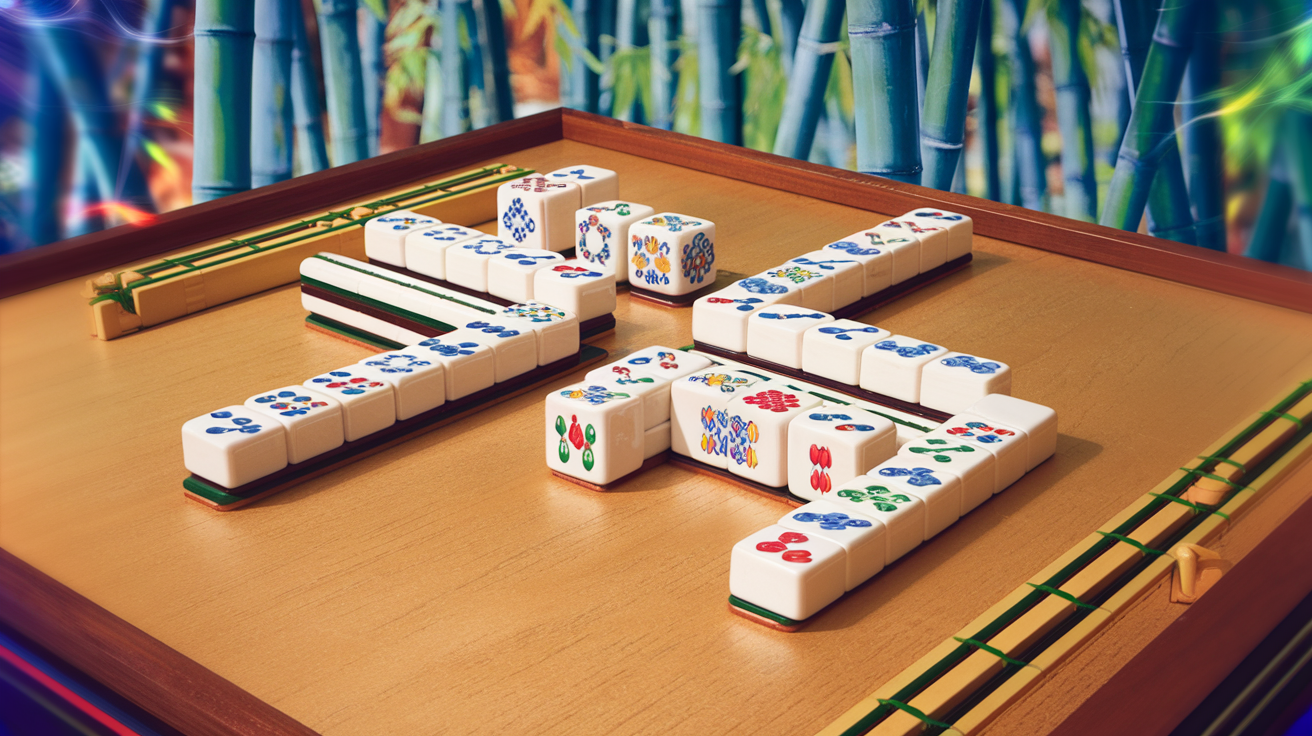
Mahjong Solitaire vs. Traditional Mahjong: Understanding Two Completely Different Games
If you've played mahjong solitaire on themahjong.io or encountered "Shanghai" on an older Windows computer, you might assume it's the same game your grandmother plays with three friends around a table. The truth is more interesting: they're fundamentally different games that happen to share tiles, aesthetics, and a name—a quirk of digital history that has confused players for over 40 years.
The Real Origin Story: 1981 and Brodie Lockard
The story of mahjong solitaire begins not in ancient China, but in 1981 when programmer Brodie Lockard created a computer game called Mah-Jongg for the Apple II. This wasn't an attempt to digitize traditional mahjong; it was something entirely new.
Lockard's innovation was simple but elegant: take the beautiful tiles of traditional mahjong and create a single-player, turn-based puzzle game where you match pairs of identical tiles. The tiles had to be exposed on at least one side, and they couldn't be blocked by other tiles. It was inspired by the solitaire card game tradition—puzzle-solving games meant for one player—not by how traditional mahjong is actually played.
This distinction matters because traditional Chinese mahjong is a multiplayer strategy game involving four players, complex hand-building mechanics, luck, and social interaction. What Lockard created was a puzzle game, closer in spirit to card solitaire than to the mahjong played in Chinese communities worldwide.
How Windows Made It Global: The Shanghai Era
While Lockard's Mah-Jongg found an audience among Apple II enthusiasts, the game exploded into mainstream consciousness through an unexpected channel: Microsoft Windows 3.1 in 1992.
Microsoft licensed a version of the game, named it "Shanghai" (a geographical nod to the game's Chinese heritage without claiming it was a true adaptation), and bundled it with Windows. For millions of users worldwide, their first encounter with any game called "mahjong" was this solitaire puzzle on their computer. The bundling was brilliant marketing—it gave the game global reach—but it also created lasting confusion about what mahjong actually is.
The game became so iconic that many subsequent digital tile-matching games adopted the Shanghai formula, ensuring that "mahjong" became synonymous with "tile-matching solitaire" in the digital realm, even though traditionalists knew it was a misnomer.
What They Share: More Aesthetic Than Mechanical
Let's be honest about what traditional mahjong and mahjong solitaire do have in common:
The Tiles: Both use sets of 144 tiles decorated with Chinese characters, bamboo, circles, and wind/dragon symbols. These beautiful, tactile pieces are integral to both games' identities.
Cultural Heritage: Mahjong solitaire borrows its visual language from a game with real historical depth. That aesthetic connection is genuine and worth appreciating, even if the gameplay diverged completely.
Pattern Recognition: Both games require players to recognize and remember tiles, though this plays a vastly different role in each.
Where They Diverge: Strategy, Multiplayer Dynamics, and Rules
Now for the fundamental differences:
Traditional Mahjong
- Four players competing simultaneously
- Hand-building mechanic: you draw and discard tiles to create winning combinations (melds)
- Luck and skill balance: randomness determines available tiles; strategy determines how you use them
- Social game: conversation, negotiation, and reading opponents are part of play
- Complex scoring systems that vary by regional rules (Hong Kong style, American style, etc.)
- Win condition: be the first to complete a valid hand
- Tile discards are visible and meaningful: other players watch what you discard to infer your strategy
Mahjong Solitaire
- Single player against a puzzle layout
- No hand-building: you simply match exposed pairs
- Pure puzzle logic: no luck involved (the layout is fixed)
- Solitary game: you're solving a puzzle, not competing or negotiating
- Simple scoring based on speed, remaining tiles, or bonus mechanics
- Win condition: clear all tiles before running out of moves
- No discard strategy: you choose which pairs to match
In practical terms: traditional mahjong is like bridge or poker (multiplayer, strategy-heavy, social). Mahjong solitaire is like Sudoku or Tetris (puzzle-based, single-player, logic-driven).
Why the Naming Confusion Persists
The conflation isn't accidental or ignorant—it's historical and economic:
- Microsoft's Windows bundling created the strongest association most casual players have with the word "mahjong"
- Marketing appeal: calling a tile-matching game "mahjong" evokes elegance and exoticism more than "tile solitaire" ever could
- Intellectual honesty doesn't sell games: acknowledging the games are entirely different might have confused consumers
- No authority to stop it: there's no governing body deciding what counts as "mahjong" in the digital space
Today, you'll find a mix:
- Traditionalists (especially in Asian communities) use "mahjong" only for the four-player game
- Casual digital players assume "mahjong" means tile-matching solitaire
- Game developers use "mahjong solitaire" to be technically precise, though the shorter "mahjong" still dominates
Playing With Eyes Open
None of this diminishes the fun of mahjong solitaire. It's a legitimately engaging puzzle game with its own appeal: satisfying, achievable, and deeply relaxing. Brodie Lockard created something worth playing.
But understanding the history matters. If you've only played solitaire and want to learn traditional mahjong, you're starting essentially from scratch—the tiles will be familiar, but everything else is new. Conversely, if you're a traditional mahjong player encountering the digital version, you're not learning your game in a new format; you're encountering a different game entirely.
The confusion was built into the game's success. Embrace it as a quirk of digital history rather than a mistake, and enjoy both games for what they actually are.
