

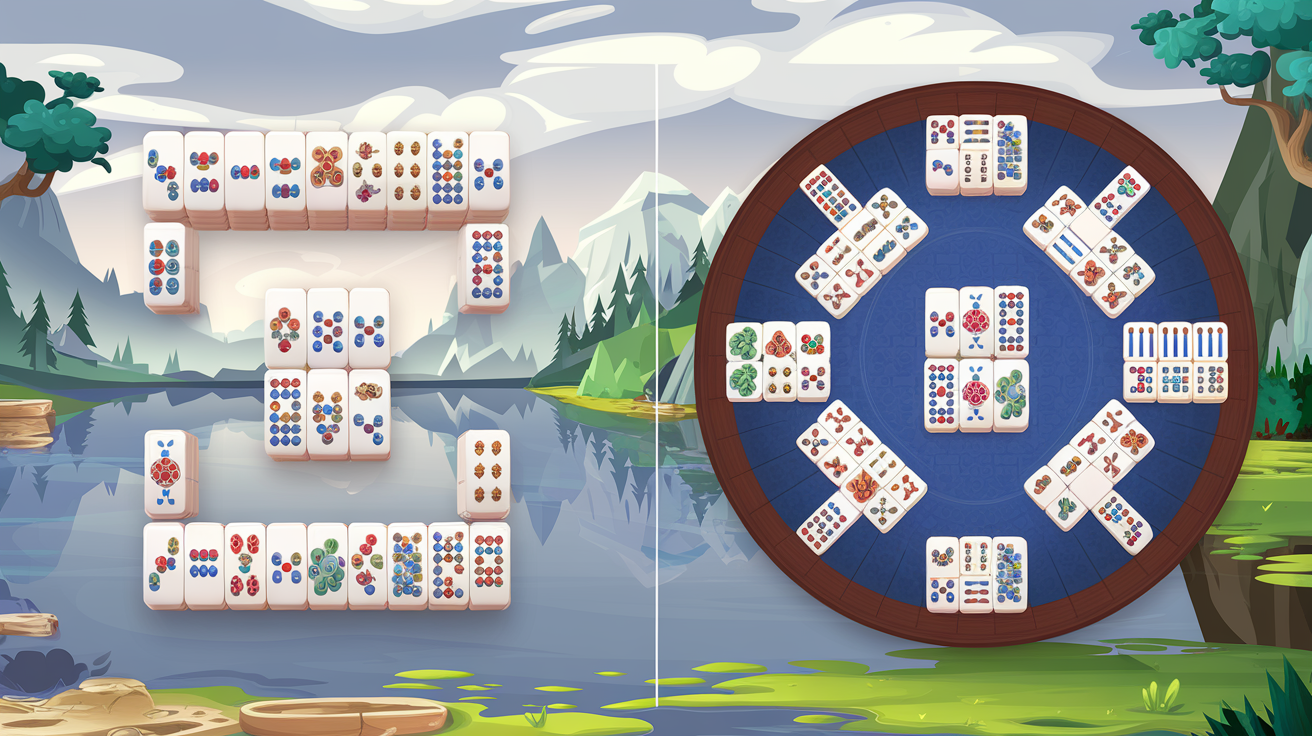
Mahjong Solitaire vs Traditional Mahjong: Understanding Two Completely Different Games
If you've played mahjong solitaire online or on your computer, you might assume it's a digital version of the traditional Chinese game of mahjong. It's a reasonable assumption—they share the same tiles, after all. However, these are genuinely two distinct games with entirely different rules, strategies, and origins. Understanding this distinction enriches your appreciation of both.
A Brief History of Two Different Games
Traditional Mahjong emerged in 19th-century China as a four-player strategy game combining elements of card games and domino games. It involves skill, memory, probability calculation, and competitive play among multiple participants. The game spread throughout Asia and eventually worldwide, with variations developing in different regions.
Mahjong solitaire, by contrast, is a modern invention. In 1981, computer programmer Brodie Lockard created a digital tile-matching game called Mah-Jongg for the Apple II computer. Lockard's creation was a solo puzzle game where players match pairs of identical tiles to clear the board. It had nothing to do with traditional mahjong's four-player strategy format—it simply borrowed the aesthetically pleasing tiles from traditional mahjong as its game pieces.
Lockard's game found its audience, and when Microsoft bundled a similar tile-matching game with Windows 3.0 under the name "Shanghai" in 1991, it became ubiquitous. Later, Microsoft would rebrand it as "Mahjong," inadvertently cementing decades of confusion about what the game actually is.
What They Share: The Tiles
Both traditional mahjong and mahjong solitaire use the same tile set: bamboos, characters, dots, winds, dragons, and flowers. This visual similarity is the primary source of the naming confusion. If you know traditional mahjong tile meanings, that knowledge transfers directly to recognizing tiles in solitaire—a genuine connection that makes the naming overlap somewhat understandable, even if historically inaccurate.
The tiles themselves carry aesthetic and cultural significance that Lockard wisely preserved in his design. This is perhaps why mahjong solitaire feels intuitively "mahjong-like" to players, even though the actual gameplay is unrelated.
The Core Differences: Rules and Gameplay
Traditional Mahjong
- Players: Four (occasionally three in some variants)
- Objective: Form winning combinations called "melds" (sets of three or four tiles) before your opponents
- Play Style: Competitive, real-time decision-making based on what opponents are discarding
- Strategy: Reading opponents, calculating probabilities, remembering discarded tiles, managing your hand
- Complexity: High—requires understanding hand combinations, scoring systems, and interpersonal strategy
- Luck Factor: Significant but balanced by skill
Mahjong Solitaire
- Players: One (solitaire)
- Objective: Clear the board by matching pairs of identical tiles
- Play Style: Puzzle-solving, self-paced, no time pressure or opponents
- Strategy: Spatial awareness, pattern recognition, forward planning about which tiles to remove
- Complexity: Low to moderate—the core mechanic is simple, but optimal play requires planning
- Luck Factor: Minimal (the board state is fixed; there's usually a logical solution)
Why the Naming Confusion Persists
Several factors explain why millions of people use "mahjong" to refer to tile-matching solitaire:
Microsoft's naming choice: When the company rebranded "Shanghai" as "Mahjong" in Windows, it gave the misnaming official legitimacy.
Cultural unfamiliarity: Most Western players never experienced traditional mahjong, so they had no reference point to question the name.
Marketing simplicity: "Mahjong" is recognizable; inventing a new name for an already-established game would have been commercially foolish.
Generational reinforcement: Decades of "Mahjong" solitaire games on computers and mobile devices have normalized the incorrect association.
The Strategic Divide
Understanding the strategic differences illuminates why these games appeal to different audiences:
Traditional Mahjong demands:
- Memory (tracking discards)
- Social intelligence (reading opponents)
- Mathematical probability assessment
- Risk management (knowing when to play conservatively)
- Real-time adaptation
Mahjong Solitaire requires:
- Spatial reasoning
- Pattern recognition
- Lookahead planning ("if I remove this pair, will I trap others?")
- Patience and systematic exploration
- No social or competitive pressure
These are genuinely different cognitive skills. Someone who excels at traditional mahjong might struggle with solitaire's spatial puzzles, and vice versa.
Why This Matters
Clarifying this distinction respects both games. Traditional mahjong players sometimes dismiss solitaire as not being "real" mahjong—a fair technical point, but one that overlooks solitaire's own merits as a contemplative, skillful puzzle game.
Conversely, solitaire players curious about traditional mahjong often feel disappointed or confused when they discover the games are unrelated. Setting accurate expectations helps people find games they'll genuinely enjoy.
Conclusion
Mahjong solitaire and traditional Chinese mahjong are two distinct games unified by shared tile aesthetics but separated by fundamentally different rules and strategies. The naming confusion is a historical artifact born from commercial decisions and cultural unfamiliarity, not evidence of any deep connection.
Both games merit respect and enjoyment on their own terms. Whether you're drawn to the contemplative puzzle-solving of mahjong solitaire or the competitive strategy of traditional mahjong, you're playing something with genuine depth. Understanding the difference between them simply helps you appreciate what each game actually offers.
So the next time someone asks if you play "mahjong," you'll know exactly which game you're referring to—and you can explain, with friendly clarity, just how different the two really are.
