

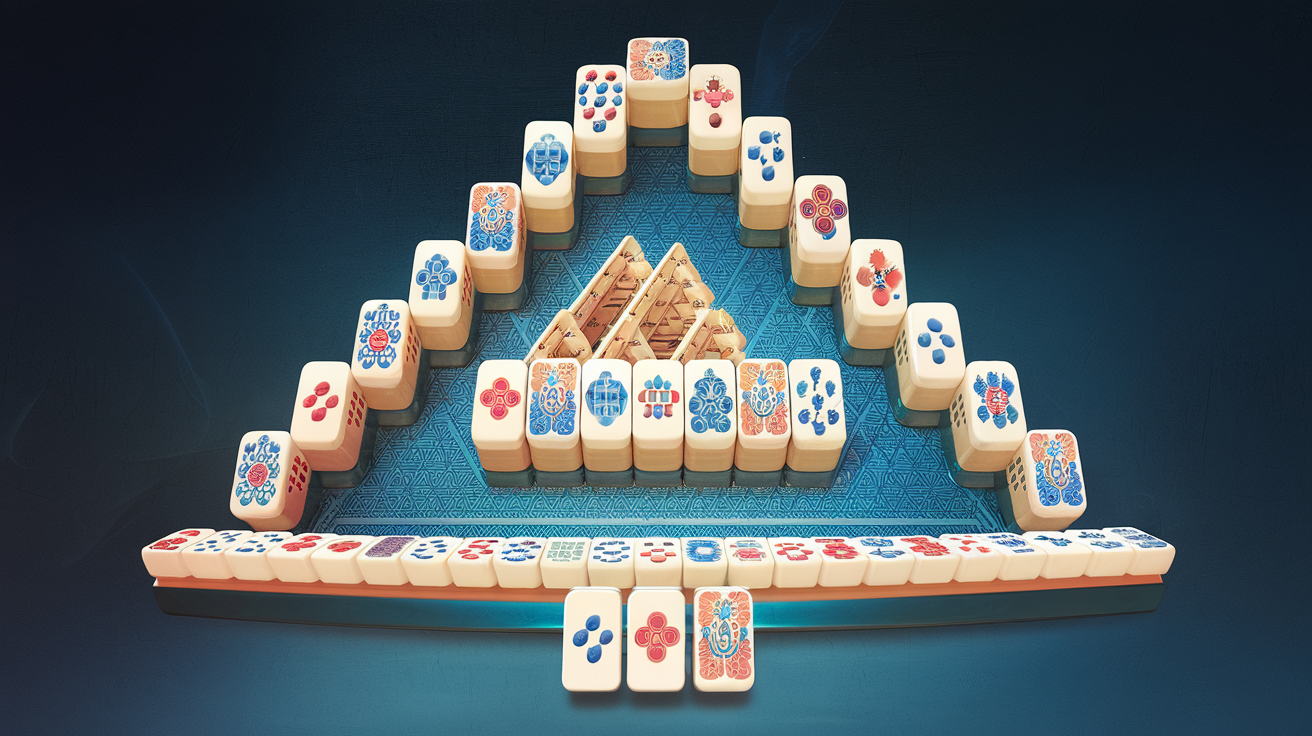
Mahjong Solitaire vs. Traditional Mahjong: Understanding Two Very Different Games
If you've ever played the tile-matching game at themahjong.io, you might be surprised to learn that it shares very little with the game your grandmother's mahjong club plays. Despite sharing the same name and tiles, mahjong solitaire and traditional mahjong are essentially two distinct games. Understanding this distinction enriches appreciation for both—and clarifies a naming confusion that's persisted for over 40 years.
The Origins of Mahjong Solitaire
The story begins in 1981 with Brodie Lockard, a computer programmer in California. Lockard created a digital tile-matching game and called it "Mah-Jongg." His creation used traditional mahjong tiles visually, but the gameplay was entirely different: players matched pairs of identical tiles on a single-player board with no strategy depth beyond pattern recognition and memory.
Lockard's innovation wasn't the tile aesthetics—it was adapting them into a casual, meditative puzzle format that required no opponents and no complex strategy. The game was elegant in its simplicity: find matching tiles, remove them, and clear the board. This was genuinely novel because no one had played mahjong this way before.
The game remained niche until the 1990s, when it became bundled with Microsoft Windows under the name "Shanghai" (likely to avoid trademark concerns). Suddenly, millions of computer users encountered this tile-matching game. Many assumed it represented traditional mahjong—it had the tiles, the aesthetic, the name—but encountered something far simpler than the actual game.
What Traditional Mahjong Actually Is
Traditional Chinese mahjong is a 4-player strategy and luck game that has been played since at least the 19th century. Think of it as closer to Rummy or Poker than to a tile-matching puzzle:
Four players sit around a table drawing and discarding tiles, trying to form specific patterns (called "melds") before opponents. It involves:
- Strategic decision-making: Which tiles to keep, which to discard, reading opponents' intentions
- Risk assessment: Knowing when to declare victory and when to wait for a better hand
- Probability and memory: Tracking discarded tiles to infer what opponents hold
- Negotiation and house rules: Regional variations mean each group plays slightly differently
- Social dynamics: Real-time interaction, bluffing, and table talk
Matches last 1-4 hours. Money often changes hands. The learning curve is steep; true mastery takes years. It's a game of conversation and psychology as much as tiles.
What Mahjong Solitaire Actually Is
Mahjong solitaire (the game you play at themahjong.io) is:
- Single-player only: No opponents, no negotiation, no psychology
- Pattern recognition: Match identical pairs—there's one correct solution
- Meditative and casual: No time pressure, no risk, no stakes
- Short play sessions: Most games end in 5-15 minutes
- No luck element: The same board layout always offers the same solution
- No strategic depth: Moves are either valid or invalid; there's no "good" vs. "bad" choice strategically
Mahjong solitaire is closer to Bejeweled, Tetris, or Solitaire card games than to actual mahjong. It uses mahjong tiles as graphic design, but the gameplay mechanics bear virtually no resemblance.
Why the Confusion Persists
The naming conflation happened for understandable reasons:
- Visual association: Using mahjong tiles creates instant visual recognition
- Marketing: "Mahjong" had cultural cachet; "tile-matching game" didn't
- Windows distribution: Millions encountered Shanghai without context about its origins
- Casual audience: Players unfamiliar with traditional mahjong assumed the digital version represented the real thing
- Inertia: Once established, the name stuck despite being inaccurate
This is similar to how "Solitaire" refers both to card games played solo and to a specific 19th-century card game tradition—the term expanded beyond its original meaning.
What They Actually Share
It's fair to acknowledge genuine connections:
- Tiles: Both use the same beautiful tile designs, traditionally featuring bamboo, characters, circles, dragons, winds, and season symbols
- Aesthetic traditions: The visual language—colors, symbols, materials—creates a shared atmosphere
- Accessibility: Both games can be learned in minutes (though mastering traditional mahjong takes much longer)
- Cultural heritage: Both represent connections to Chinese cultural traditions, albeit in very different ways
- Contemplative appeal: Both can be played in relaxed, social settings
The Strategic Divide
Here's where they truly diverge:
Traditional Mahjong demands:
- Reading probability and memory
- Predicting opponent behavior
- Managing risk and hand composition
- Adapting to randomness
- Psychological resilience
Mahjong Solitaire requires:
- Pattern recognition
- Spatial reasoning
- Occasionally, luck (when multiple valid moves exist and wrong choices block solutions)
- Planning several moves ahead
- Patience and focus
They're solving different problems with the same aesthetic vocabulary.
Why This Matters
Clarity matters for appreciation. Someone excelling at mahjong solitaire hasn't necessarily gained insight into traditional mahjong—and that's completely fine. The solitaire version offers genuine value: it's accessible, meditative, and genuinely challenging in its own way.
Conversely, traditional mahjong players might find solitaire version too simple, but they should recognize it as a legitimate descendant that created an entirely new game category.
Brodie Lockard's 1981 innovation wasn't to perfectly recreate traditional mahjong digitally—it was to create something new using mahjong tiles as inspiration. That innovation deserves recognition on its own terms, without the burden of trying to represent something it never aimed to be.
Final Thoughts
The beauty of mahjong solitaire is precisely that it distilled something complex into something accessible. The beauty of traditional mahjong is the depth of human interaction and strategy. Both are worthy of respect—they're just different things.
Next time someone mentions mahjong, it's worth asking: which one do they mean? The answer reveals two rich gaming traditions that simply happened to share a name.
