

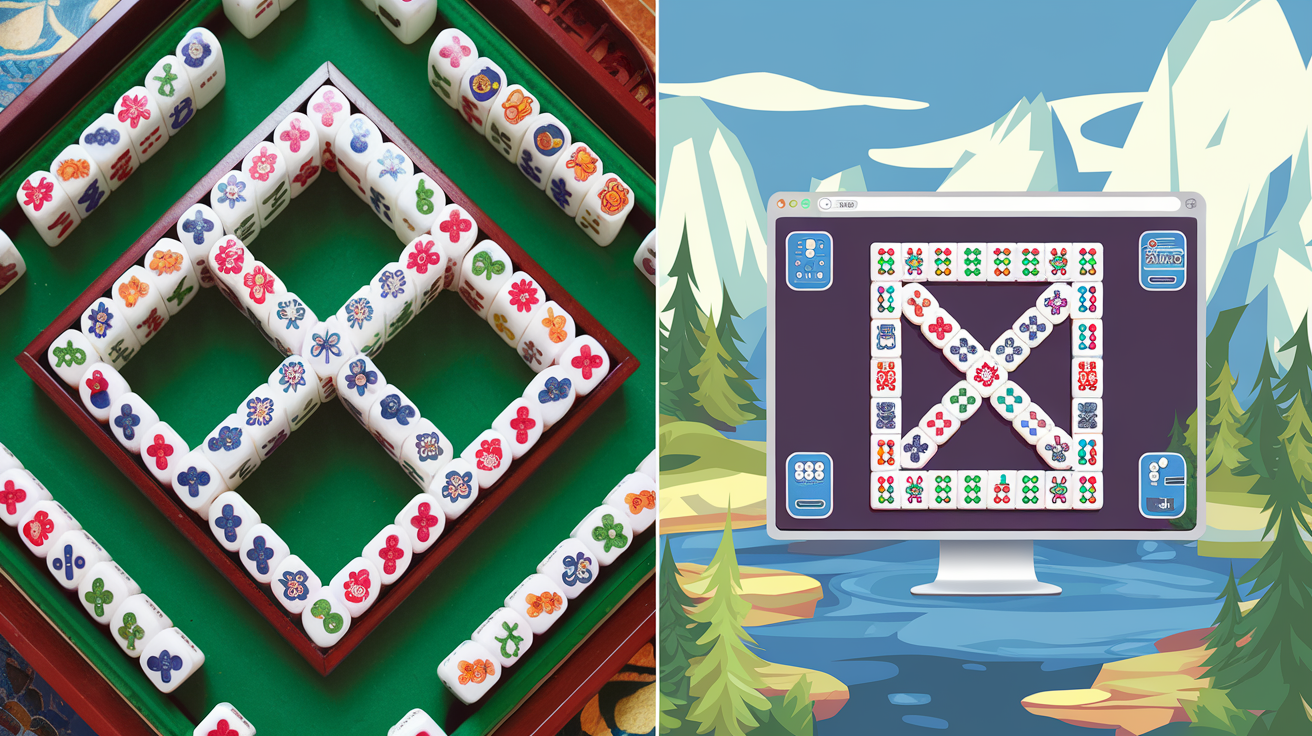
Mahjong Solitaire vs. Traditional Mahjong: Understanding Two Very Different Games
If you've played mahjong solitaire—the relaxing tile-matching game where you remove pairs of identical tiles from a stacked pyramid—you might assume you're playing a modern adaptation of traditional Chinese mahjong. You'd be partially right about the heritage, but the connection is more complicated and interesting than it first appears.
The truth is: mahjong solitaire and traditional mahjong are fundamentally different games that happen to share aesthetic elements. Understanding their distinct origins helps explain why two such different experiences share the same name.
The Ancient Game: Traditional Chinese Mahjong
Traditional mahjong emerged in 19th-century China and is a 4-player strategy and luck game played with 144 tiles divided into suits (bamboo, characters, dots, and honors). Players draw and discard tiles in real-time, attempting to form specific winning combinations called "melds." The game involves:
- Real-time decision-making with other players
- Tile counting and probability assessment
- Bluffing and psychological play against opponents
- Complex regional rule variations across China, Japan, and other countries
- Simultaneous action with three other players
Traditional mahjong is a social, competitive game that can take 30 minutes to several hours per round. Mastery requires understanding tile relationships, reading opponents, and strategic tile sequencing.
The Modern Creation: Mahjong Solitaire (1981)
In 1981, American game designer Brodie Lockard created something entirely new. Working on an early personal computer, Lockard designed a single-player puzzle game using mahjong tiles as the visual foundation. His game, called "Mah-Jongg," had nothing to do with the strategic gameplay of traditional mahjong.
Instead, Lockard's innovation was beautifully simple:
- Arrange mahjong tiles in a 3D pyramid or other aesthetic layout
- Match and remove identical pairs by clicking them
- Clear all tiles to win
- Play solo against the clock (or without time pressure)
- Focus on pattern recognition and spatial reasoning
This was a puzzle game—closer in spirit to matching games like Memory or Concentration than to the Chinese strategic game. Lockard's design was elegant, meditative, and immediately appealing on early computers.
Why "Shanghai" Matters: The Windows Effect
The real pivotal moment came when Microsoft licensed a version of the tile-matching game and bundled it with Windows 3.1 (1991) under the name "Shanghai." This decision had enormous consequences:
- Millions of people encountered the game as a free bundled application
- The name "Shanghai" became associated with the solitaire format
- The confusion with traditional mahjong deepened because players saw mahjong tiles but experienced solitaire gameplay
- Both names persisted: "Mahjong Solitaire," "Shanghai," and simply "Mahjong" all came to refer to Lockard's 1981 concept
The irony is that neither Lockard's "Mah-Jongg" nor Microsoft's "Shanghai" are actually about the traditional game—but the naming stuck because the tiles looked familiar to anyone who'd heard of mahjong.
What They Actually Share
Before diving into differences, it's worth noting the genuine connections:
- Visual aesthetic: Both use the same beautiful tile designs (bamboo, characters, dots, dragons, winds, etc.)
- Cultural heritage: Mahjong solitaire appropriates (respectfully) the visual language of an ancient Chinese game
- Tile sets: The 144-tile structure appears in both, though used completely differently
- Regional variations: Both exist in multiple regional versions with slight rule differences
These connections mean mahjong solitaire isn't random—it's a conscious artistic choice to use mahjong tiles as the foundation for a new game type.
The Strategic Divides: Where They Diverge
Traditional Mahjong
- Multiplayer competition (4 players)
- Real-time play with simultaneous decisions
- Hidden information: Other players' tiles are unknown
- Strategic depth: Understanding tile probabilities, reading opponents, adapting strategy
- Long games: 30 minutes to several hours
- Social element: Essential to the experience
Mahjong Solitaire
- Solo play against the puzzle
- Self-paced: You control timing completely
- Perfect information: All tiles are visible
- Puzzle logic: Success depends on spatial reasoning and planning
- Quick games: Usually 5-15 minutes
- Meditative quality: Relaxing rather than competitive
Why Does the Confusion Persist?
The naming conflation survives for good reasons:
- Marketing momentum: The Windows bundling created decades of exposure
- Tile recognition: The mahjong tile set is iconic and beautiful—why not use it?
- Cultural respect: Using mahjong tiles acknowledges their origins, even in a new context
- User familiarity: People searching for "mahjong" find the solitaire game and accept it
- Casual player dominance: Most people know solitaire mahjong, not traditional mahjong
It's not a mistake or deception—it's a natural linguistic evolution where a game format adopted visual elements from another culture and inherited its name.
Appreciating Both Games
The beauty of this history is that both games have genuine merit:
Traditional mahjong offers sophisticated strategic gameplay, cultural depth, and social connection. If you want to experience the authentic game that has entertained millions for over a century, learn the regional rules and play with others.
Mahjong solitaire offers meditative puzzle-solving, accessibility for solo players, and beautiful aesthetic design. Brodie Lockard created something genuinely new—a game type that has flourished for over 40 years.
You don't have to choose. Understanding their differences lets you appreciate what makes each special. Whether you're enjoying a quick solitaire puzzle at themahjong.io or learning to play traditional mahjong with friends, you're participating in a living legacy that spans from ancient China through 1981 computer science to your screen today.
The shared name isn't confusion—it's a bridge between cultures and across time.
