

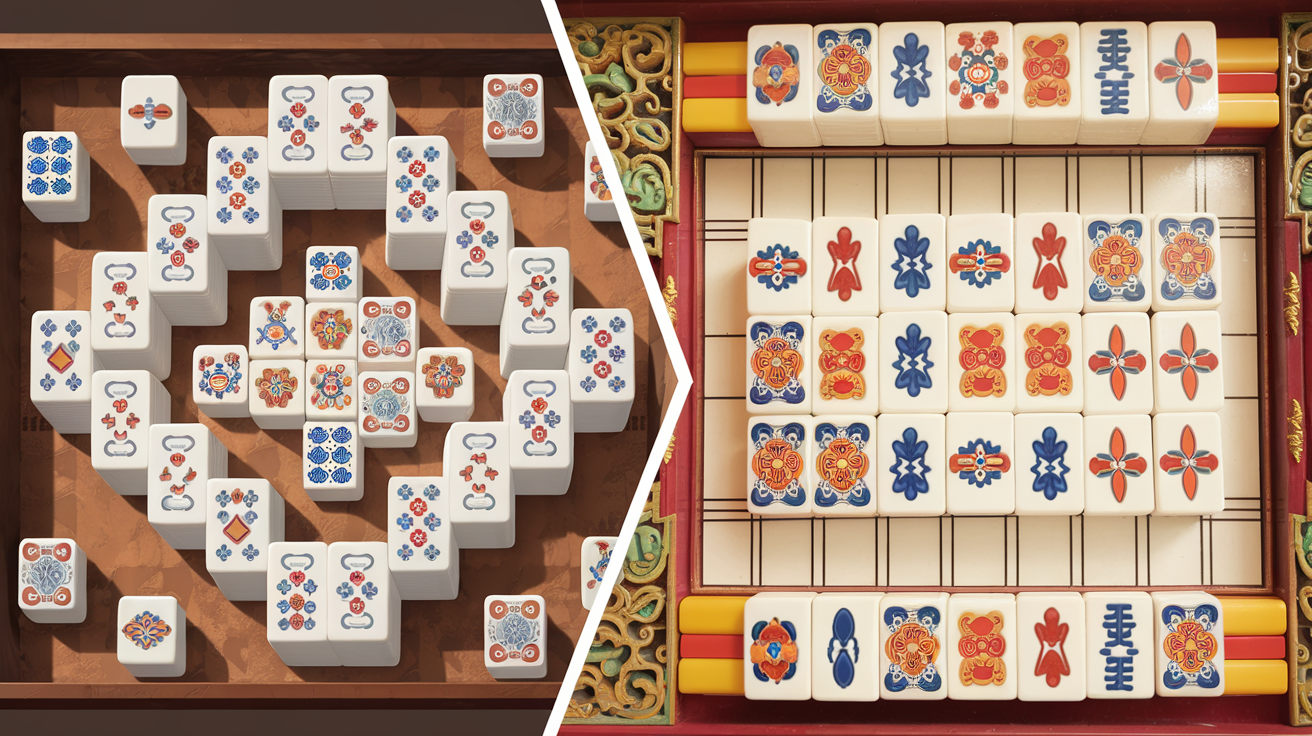
Mahjong Solitaire vs. Traditional Mahjong: Understanding Two Very Different Games
If you've played mahjong solitaire online or enjoyed the classic Windows tile-matching game, you might assume you're playing the same game that's been enjoyed in East Asia for centuries. The truth is more interesting: while both games use similar tiles and share the mahjong name, they are distinct games with different origins, rules, and strategies.
The Real Origins: Two Separate Games
Traditional mahjong emerged in 19th-century China as a tile-based strategy game played by four players, similar in competitive structure to card games like poker or rummy. The game involves drawing and discarding tiles, reading opponents' intentions, and managing hand composition—all hallmarks of a genuine table game with real player interaction and skill depth.
Mahjong solitaire, by contrast, is a much younger invention. The tile-matching game as we know it today was created in 1981 by Brodie Lockard, an American programmer, who developed the first computerized version called "Mah-Jongg" for the Apple II. Lockard's game was a solitaire puzzle: a single player faced a predetermined board layout of stacked tiles and won by removing all tiles by matching pairs. This was not an attempt to recreate traditional mahjong but rather an original puzzle game that borrowed mahjong's distinctive tiles and aesthetic.
How Shanghai Made It Ubiquitous
The real explosion in popularity came in 1986 when Brodie Lockard's game was licensed and released as "Shanghai" by Activision. Shanghai became one of the most successful computer games of the era, ported to multiple platforms and eventually bundled with Windows 3.11 as a default solitaire game—just as Solitaire (the card game) was included in the operating system.
This bundling was crucial. Millions of people encountered the game simply as part of their Windows installation, and many assumed it was a computerized version of the traditional game. The name similarity, the Chinese tile imagery, and the exotic aesthetic all reinforced this misconception. Over decades, the association became cemented in popular culture.
What They Share
Before diving into differences, it's worth acknowledging genuine commonalities:
The Tiles: Both games use the same or very similar tile sets, including suited tiles (bamboo, characters, dots) and honor tiles (winds and dragons). The imagery and symbols carry the same cultural heritage.
The Name: Both games carry the mahjong name, which reflects that solitaire developers were consciously evoking the traditional game's aesthetic and cultural prestige, even if gameplay diverged completely.
Skill Component: While completely different in nature, both require genuine skill. Traditional mahjong demands strategic thinking about probability and opponent psychology. Mahjong solitaire demands spatial reasoning, pattern recognition, and planning ahead.
Where They Fundamentally Diverge
The differences are substantial:
Game Structure
Traditional Mahjong: A game for 4 players (sometimes 3), played over multiple rounds. Players simultaneously draw, form melds, and compete. Each game typically lasts 20-30 minutes.
Mahjong Solitaire: A single-player puzzle game where all tiles are visible from the start. There's no drawing phase, no competition, and no opponent interaction. You either solve the puzzle or you don't.
Strategic Elements
Traditional Mahjong involves:
- Reading opponents' discards and intentions
- Managing hand composition and waiting patterns
- Risk assessment about winning chances
- Timing and psychological play
Mahjong Solitaire involves:
- Spatial awareness and recognizing available pairs
- Planning ahead to avoid blocking yourself
- Understanding how to work backward from the goal state
- Tile arrangement and sequencing
Randomness vs. Predetermined Layout
Traditional Mahjong uses random tile distribution (from a shuffled wall), making every hand unpredictable. Your skill lies in adapting to what you draw.
Mahjong Solitaire has a fixed, predetermined board layout. Every time you play the same level, the tiles are in identical positions. Skill comes from finding the optimal removal sequence, not from adapting to randomness.
Outcome Determination
Traditional Mahjong: Success depends partly on luck (tile draws) and partly on skill. You're competing against other players, and someone will win and someone will lose each round.
Mahjong Solitaire: Most puzzles have a solution—they either have one, multiple solutions, or none. The outcome is deterministic based on the starting layout and the player's decisions.
Why the Confusion Persists
The naming conflation endures for understandable reasons:
Cultural Prestige: Calling the game "mahjong" connected it to an ancient, respected tradition, making it more marketable than calling it "Tile Match Puzzle."
Genuine Tile Sharing: Both games use similar or identical tile sets, creating a real visual and thematic connection.
Windows Legacy: Generations grew up with Shanghai bundled in their operating system, learning the name "mahjong" in that context without knowing the traditional game.
Lack of Distinction in Popular Culture: Many websites and apps still use "mahjong" loosely to describe solitaire variants, perpetuating the confusion.
Why It Matters
Understanding the distinction isn't about gatekeeping or correcting people—it's about appreciating two different but equally valid games. Traditional mahjong is a genuine social and strategic game with centuries of cultural depth. Mahjong solitaire is an elegant puzzle game that happens to use borrowed aesthetics.
Both have value. Solitaire games are wonderful for solo relaxation and mental challenge. Traditional mahjong offers rich social gameplay and strategic depth that no computer version can fully replicate.
At themahjong.io, we celebrate mahjong solitaire for what it is: an engaging, skill-based puzzle game with a rich digital history. Understanding its true origins—from Brodie Lockard's 1981 invention through Shanghai to Windows ubiquity—helps us appreciate it on its own merits rather than as a simplified version of something else.
Whether you're a solitaire enthusiast or curious about traditional mahjong, knowing the difference enriches your appreciation of both.
