

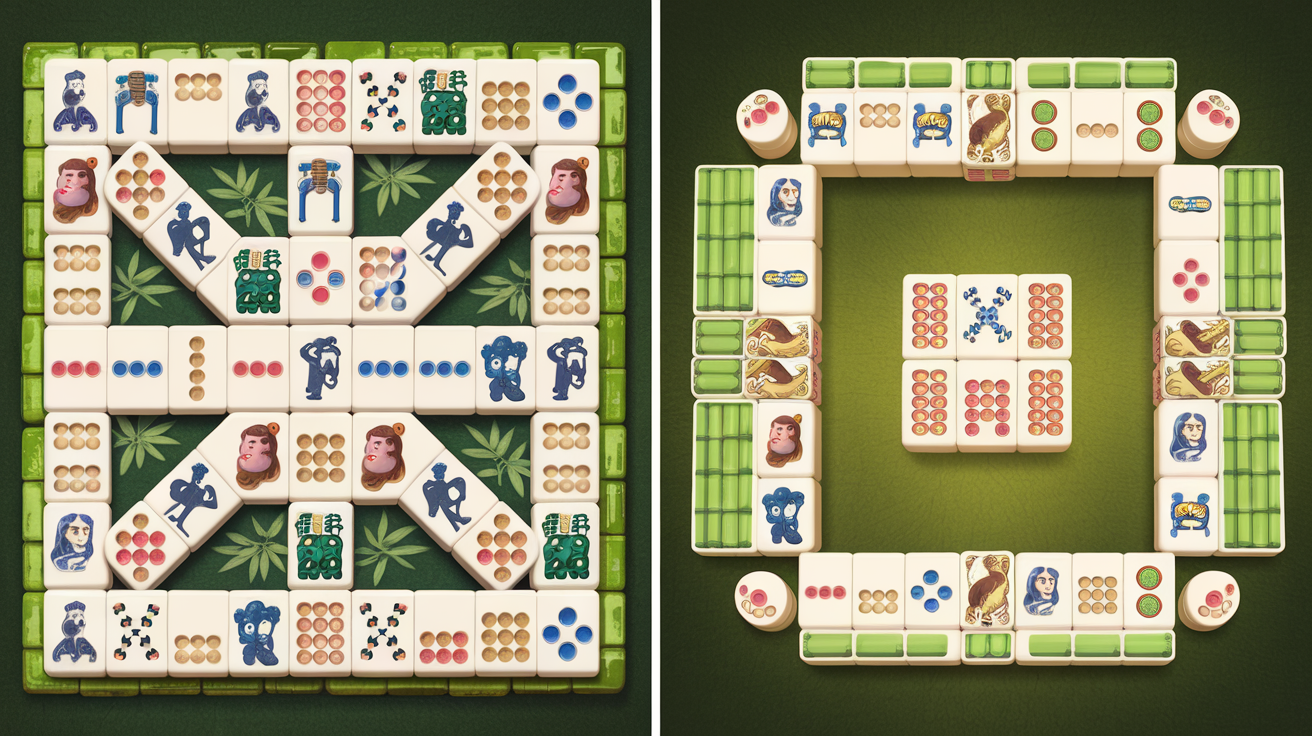
Mahjong Solitaire vs. Traditional Mahjong: Understanding Two Very Different Games
If you've played mahjong solitaire on themahjong.io or encountered the classic "Shanghai" game that came bundled with Windows, you've experienced something quite different from traditional Chinese mahjong—even though they share the same name and tile imagery. This distinction is important not because one game is "more authentic" than the other, but because understanding the difference helps you appreciate what each game actually offers.
The Real Origins: 1981 and Brodie Lockard
The story begins in 1981 with a computer programmer named Brodie Lockard. Working on early personal computers, Lockard created a solitaire game using mahjong tiles as his visual foundation. He called it "Mah-Jongg"—deliberately adding the hyphen to signal that his creation was inspired by mahjong imagery rather than attempting to recreate traditional mahjong rules.
Lockard's insight was elegant: mahjong tiles are visually distinctive and thematically cohesive, making them perfect for a tile-matching solitaire experience. The game presented players with a pyramid or other 2D arrangement of tiles, and the objective was simple—match pairs of identical tiles and remove them from the board until all tiles disappeared.
This was never meant to replicate the four-player strategy game played in homes and tournaments across China and beyond. It was a new concept: a computerized solitaire game dressed in mahjong aesthetic clothing.
From Niche Software to Windows Bundling
Lockard's game gained modest popularity in computer circles through the 1980s, but it achieved mainstream exposure through Microsoft's Windows operating system. Renamed "Shanghai," the game was bundled with many versions of Windows, introducing tens of millions of casual computer users to tile-matching gameplay.
This bundling was transformative. Suddenly, a solitaire game was reaching people who'd never heard of traditional mahjong and had no framework for distinguishing between the two. "Shanghai" became the reference point—the game that most Western computer users knew as "mahjong."
The naming issue became entrenched: players called it mahjong because it said so on the screen, and because the tiles looked authentically mahjong-like. The distinction between the computer solitaire game and the traditional strategy game faded from public consciousness.
What Traditional Mahjong Actually Is
To understand what these games don't share, we need to acknowledge what traditional mahjong genuinely requires:
Traditional mahjong is a four-player strategy game where:
- Players draw and discard tiles in real-time, managing incomplete combinations (melds) in their hand
- Memory, pattern recognition, and probability assessment are crucial—you must track what others have discarded and infer what they're seeking
- Luck (from the initial tile draw) interacts with skill (reading opponents, deciding what to discard)
- The game has scoring systems, complex rule variations by region, and tournaments with standardized rulesets
- Social interaction and psychological reading of opponents is central to gameplay
It's roughly analogous to rummy or bridge in the Western card game world—a combination of skill, strategy, and incomplete information.
What Mahjong Solitaire Actually Is
Mahjong solitaire, conversely, is:
- A single-player puzzle game with complete information (you can see all tiles on the board)
- Purely about pattern matching and spatial reasoning—matching identical tiles and removing them until the board clears
- Deterministic within constraints—a given board layout has optimal solutions you can theoretically calculate
- Devoid of opponent interaction or bluffing—there's no hidden information, no reading of other players
- About planning ahead to ensure you don't trap tiles in ways that make board clearance impossible
It shares more DNA with games like Klondike solitaire (the classic card game) than with traditional mahjong.
What They Actually Share
Despite their fundamental differences, the games do share genuine common ground:
The tiles: Both use the same symbolic tiles—bamboo, characters, dots, winds, dragons, and honors. The visual language is identical.
Aesthetic and cultural resonance: Both evoke the same cultural heritage and carry similar visual appeal.
Skill-based play: While the skills differ (strategy and reading in traditional mahjong, spatial planning and memory in solitaire), both reward attentive, thoughtful play.
Accessibility: Both games are easy to learn at a basic level but rewarding to master, making them engaging across different skill levels.
Why the Confusion Persists
The naming conflation has several roots:
- Historical precedent: "Shanghai" and "Mah-Jongg" have been the dominant names since the 1980s for computer solitaire
- Simplicity: Calling it "mahjong" is shorter than "mahjong solitaire" or "tile-matching solitaire"
- Authentic visual packaging: The tiles look genuinely traditional, creating cognitive shortcuts
- Limited cross-cultural game literacy: Many Western players have no personal reference point for traditional mahjong to compare against
None of these are problems—they're simply how cultural and gaming terminology evolves.
Appreciating Each Game on Its Own Terms
The most productive way to think about this distinction is to stop treating it as a hierarchy. Traditional mahjong and mahjong solitaire aren't "versions" of each other. They're different games that borrowed tile aesthetics and created entirely separate experiences.
If you love mahjong solitaire—the contemplative, puzzle-solving version available at themahjong.io—you're engaging with a legitimate and popular game form with real historical roots (back to 1981) and millions of devoted players. You're not playing a "simplified" or "incorrect" version of something else.
Conversely, if you play traditional mahjong in tournaments or with family, you're engaging with a centuries-old strategy game that remains vibrant and complex.
They simply occupy different spaces in the gaming landscape, each with its own rewards and its own appeal.
Final Thoughts
Understanding that mahjong solitaire and traditional mahjong are different games is useful context, not pedantic gatekeeping. It helps you appreciate what each game actually offers—and if you ever encounter traditional mahjong in person or online, you'll recognize it as an entirely different experience from the tile-matching puzzles you're familiar with.
Both deserve respect as distinct games with their own communities, strategies, and reasons for existing. The naming confusion is simply part of gaming history, a reminder of how a clever 1981 software design choice rippled through decades of computing culture.
