

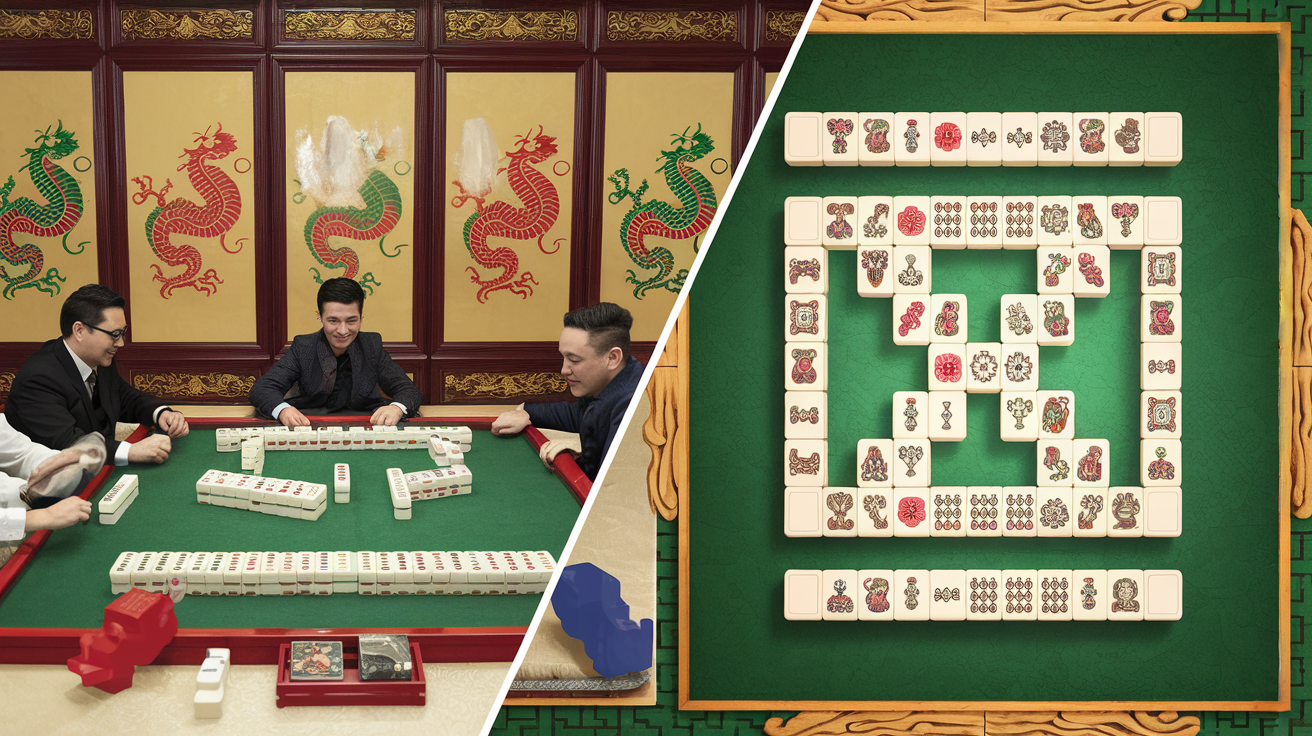
Mahjong Solitaire vs. Traditional Mahjong: Understanding Two Completely Different Games
If you've played mahjong on your computer or phone, matching pairs of identical tiles until the board is clear, you've experienced something quite different from what players have enjoyed for centuries in China, Japan, and beyond. This distinction often surprises people—and that's completely understandable. The confusion isn't new; it stems from a deliberate creative choice made in 1981 that shaped digital gaming history.
The Real Mahjong: A 4-Player Strategy Game
Traditional mahjong emerged in 19th-century China and remains fundamentally a multiplayer tile-based strategy game played by four players simultaneously. Like poker or bridge, it involves:
- Live competition against three opponents
- Strategic hand-building where players draw and discard tiles to form winning combinations (melds)
- Hidden information about what other players hold
- Real-time decision-making with immediate consequences
- Scoring systems that vary by region (Chinese, Japanese, American, and other rule sets exist)
- Skill development in probability assessment, memory, and psychological gameplay
Traditional mahjong requires understanding tile values, reading opponents' moves, calculating odds, and managing risk. A single game can take 30 minutes to several hours. It's taken seriously by competitive players worldwide, with tournaments, rankings, and substantial prize pools.
The 1981 Innovation: Mahjong Becomes a Solitaire Puzzle
In 1981, designer Brodie Lockard created groundbreaking software called "Mah-Jongg" for the Apple II computer. Lockard wasn't trying to replicate traditional mahjong in digital form—that would have been technically complex and required online multiplayer decades before that was feasible. Instead, he created something entirely new: a single-player puzzle game that borrowed mahjong's beautiful tiles but invented a completely different gameplay mechanic.
The concept was elegant: arrange identical tiles in a pyramid or other pattern, and the player's goal is to match and remove all pairs until the board is empty. This is a matching puzzle, similar in structure to card games like Memory or Concentration. It required no opponents, no hidden information, and no strategic bluffing—just pattern recognition, visual memory, and forward-thinking about which matches to make to unlock others.
Lockard's choice to use mahjong tiles was aesthetically inspired; the ornate designs made for beautiful computer graphics compared to abstract game pieces. The name drew from gaming tradition without claiming to recreate traditional mahjong faithfully.
Shanghai and the Path to Ubiquity
The game found its widest audience through Microsoft Windows. In the early 1990s, Windows bundled a mahjong solitaire variant called "Shanghai"—named after the tile arrangement pattern—with various versions of the operating system. This bundling was decisive: millions of people encountered mahjong solitaire before ever hearing of traditional mahjong.
Windows Shanghai wasn't Lockard's original, but it followed his template faithfully. The game became so familiar that for many people worldwide, "mahjong" simply meant the tile-matching puzzle. This association strengthened as the game appeared on countless websites, mobile apps, and casual gaming platforms.
Why the Naming Persists (and Why It's Understandable)
The confusion endures for logical reasons:
- Shared visual identity: Both games use the same striking tile set with bamboo, character, circle, wind, and dragon designs
- Branding momentum: Decades of Windows bundling and casual game marketing established "mahjong" as synonymous with the solitaire version for most digital players
- Practical naming: Developers needed a recognizable name for their puzzle games; "mahjong solitaire" is descriptive, but "mahjong" alone is catchier
- Geographic exposure asymmetry: In Western countries, people encountered the digital solitaire version long before learning traditional mahjong existed
Neither developers nor players were being deceptive—it's simply how language and market forces shaped gaming culture.
What These Games Actually Share
Despite fundamental differences, the connection isn't purely nominal:
- Tile aesthetics and symbolism: Both use the same 136-tile set with traditional designs
- Cultural heritage: The solitaire game borrows visual language from an ancient tradition, which carries real cultural significance
- Pattern recognition at their core: Both games require players to recognize and work with combinations of tiles (though in entirely different ways)
Thinking of the relationship this way—as the solitaire version being a respectful homage that borrows cultural elements for a different game—is more accurate than claiming they share gameplay.
Key Strategic Differences
Traditional Mahjong demands:
- Real-time adaptation to opponents' plays
- Probability calculations about remaining tiles
- Social reading and bluffing
- Risk management (going for a high-scoring hand vs. settling for safer wins)
Mahjong Solitaire demands:
- Spatial visualization and planning ahead
- Foresight to avoid creating unreachable pairs
- Patience and pattern-matching ability
- No interaction with other players
In traditional mahjong, luck and psychology intertwine constantly. In solitaire, the board's layout is fixed; theoretically, every puzzle has a demonstrably correct solution path (though many are solvable only through careful planning).
Respecting Both Games
Recognizing these differences enriches appreciation for both. Traditional mahjong players have legitimate reasons to gently correct the conflation—they're preserving a sophisticated strategy game with centuries of cultural weight. Casual players enjoy mahjong solitaire for valid reasons too: it's meditative, accessible, requires no learning curve for complex scoring rules, and offers the satisfaction of puzzle-solving.
The story of how a clever 1981 software innovation borrowed mahjong's aesthetic to create an entirely new game genre is itself fascinating—a reminder of how technology, creativity, and cultural exchange shape modern entertainment.
Next time you play mahjong solitaire, you're not playing a digital adaptation of a centuries-old game. You're playing a game born from that tradition, inspired by it, named after it—but fundamentally its own creation. And that's genuinely interesting in its own right.
