

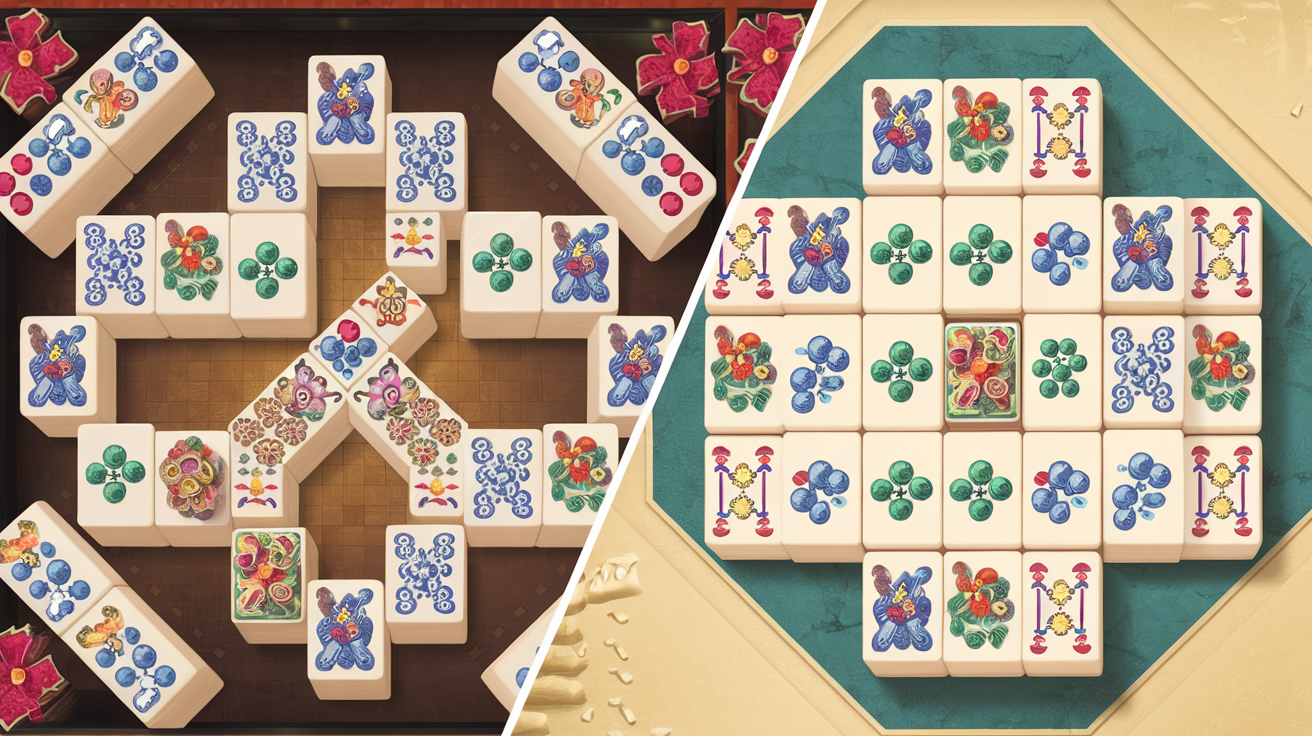
Mahjong Solitaire vs. Traditional Mahjong: Understanding Two Completely Different Games
If you've played mahjong solitaire on themahjong.io or remember "Shanghai" from your Windows computer, you might be surprised to learn that this tile-matching puzzle game shares almost nothing with traditional Chinese Mahjong—except for the tiles themselves. The naming confusion is understandable, but the games are genuinely distinct in nearly every meaningful way. Let's explore their actual origins and what makes them so different.
The Real History: Where Tile-Matching Solitaire Came From
Traditional Chinese Mahjong has been played for centuries—historians trace its roots to 19th-century China, possibly evolving from earlier card games. It's a complex, strategy-driven game for four players involving skill, memory, and calculated risk.
Tile-matching solitaire, by contrast, is a modern invention. In 1981, programmer Brodie Lockard created the first digital tile-matching game called "Mah-Jongg." Lockard developed it for the Apple II computer, and it was purely his own design—a single-player puzzle game where players matched pairs of identical tiles by clicking them.
Lockard chose to use traditional Mahjong tiles (the symbols and aesthetics) as the visual foundation, but he invented an entirely new game mechanic. There's no evidence he intended to recreate traditional Mahjong; rather, he borrowed the visual identity because Mahjong tiles are visually distinctive and culturally interesting.
The game was a success, and when Microsoft included a tile-matching game called "Shanghai" in early Windows operating systems (starting around 1992), the confusion became cemented. Millions of people encountered this solitaire puzzle through Windows and assumed it was related to the traditional game. The naming perpetuated the conflation.
What They Actually Share
Let's be clear about the genuine connections:
- The tiles: Both games use the same 144 traditional Mahjong tiles (or similar variants). These include suits (bamboo, circles, characters), honors (winds and dragons), and flowers/seasons.
- Cultural aesthetics: Traditional Mahjong carries centuries of Chinese cultural significance, and solitaire borrowed that visual language.
- The name: This is perhaps the only substantive overlap, though it's historically misleading.
That's genuinely it. Everything else is different.
Where They Dramatically Diverge
Number of Players
Traditional Mahjong: Requires exactly four players (or three in some regional variants).
Mahjong Solitaire: Single-player only. You're playing against the board, not opponents.
Objective and Rules
Traditional Mahjong: Players draw and discard tiles over multiple rounds, attempting to form specific hand combinations (melds) before other players. The game involves announcing your moves aloud, reading opponents' strategies, and competitive claiming of discarded tiles. Victory requires being the first to complete a legal hand.
Mahjong Solitaire: You're given a pyramid or layout of stacked tiles. The objective is simply to match pairs of identical tiles and remove them from the board until all tiles are cleared. There's no hand-building, no competition, and no announcing moves.
Strategy and Skill
Traditional Mahjong: Requires genuine strategic thinking—remembering what tiles have been discarded, reading opponents' hands, deciding which tiles to keep or discard, managing risk, and adapting to what others play. The outcome depends on player decisions made under incomplete information.
Mahjong Solitaire: Requires puzzle-solving logic and spatial reasoning. Strategy involves identifying which pairs to match first to avoid blocking yourself from accessing other tiles. However, with a given board state, there's typically one optimal (or limited optimal) solution path. The outcome depends entirely on the puzzle's design and your ability to recognize patterns.
Luck vs. Logic
Traditional Mahjong: Contains both luck (tile draws) and skill (decision-making). Different players can make different strategic choices from the same situation.
Mahjong Solitaire: Almost entirely logic-based. The board is fixed. Luck plays virtually no role; either the puzzle is solvable or it isn't.
Why the Confusion Persists
Several factors explain why people conflate the two:
- Windows bundling: Most people's first encounter with "Mahjong" on computers was the solitaire version, making them think of it as the primary game.
- Shared visual language: The tiles look identical to those in traditional Mahjong, making the connection feel intuitive.
- Cultural mystique: Traditional Mahjong carries cultural prestige and complexity, which gets borrowed by association.
- Naming choices: Calling a solitaire game "Mah-Jongg" was Lockard's creative decision, not a historical claim.
The Verdict: Genuinely Different Games
If you enjoy mahjong solitaire, you're playing an excellent puzzle game with a cool visual aesthetic—but it's fundamentally a modern tile-matching logic puzzle, not a gateway to understanding traditional Mahjong.
Conversely, if you wanted to learn traditional Mahjong and tried it based on solitaire experience, you'd find almost nothing transferable. The games share tiles and little else.
Both are worthy of respect in their own right. Mahjong Solitaire is an elegant, accessible puzzle game with genuine strategic depth in tile selection and board management. Traditional Mahjong is a centuries-old social game requiring real skill, memory, and interpersonal strategy.
Understanding the distinction helps you appreciate each game for what it actually is, rather than assuming one is a digital version of the other. They simply aren't.
Play Mahjong Solitaire Knowing Its Real Identity
Enjoy tile-matching solitaire on themahjong.io confident that you're playing a legitimate puzzle game with its own history and merit. Just know that if someone invites you to "play Mahjong" in person with four players and tile racks, it'll be something entirely different—and that's perfectly fine. Both games are worth playing, each in their proper context.
