

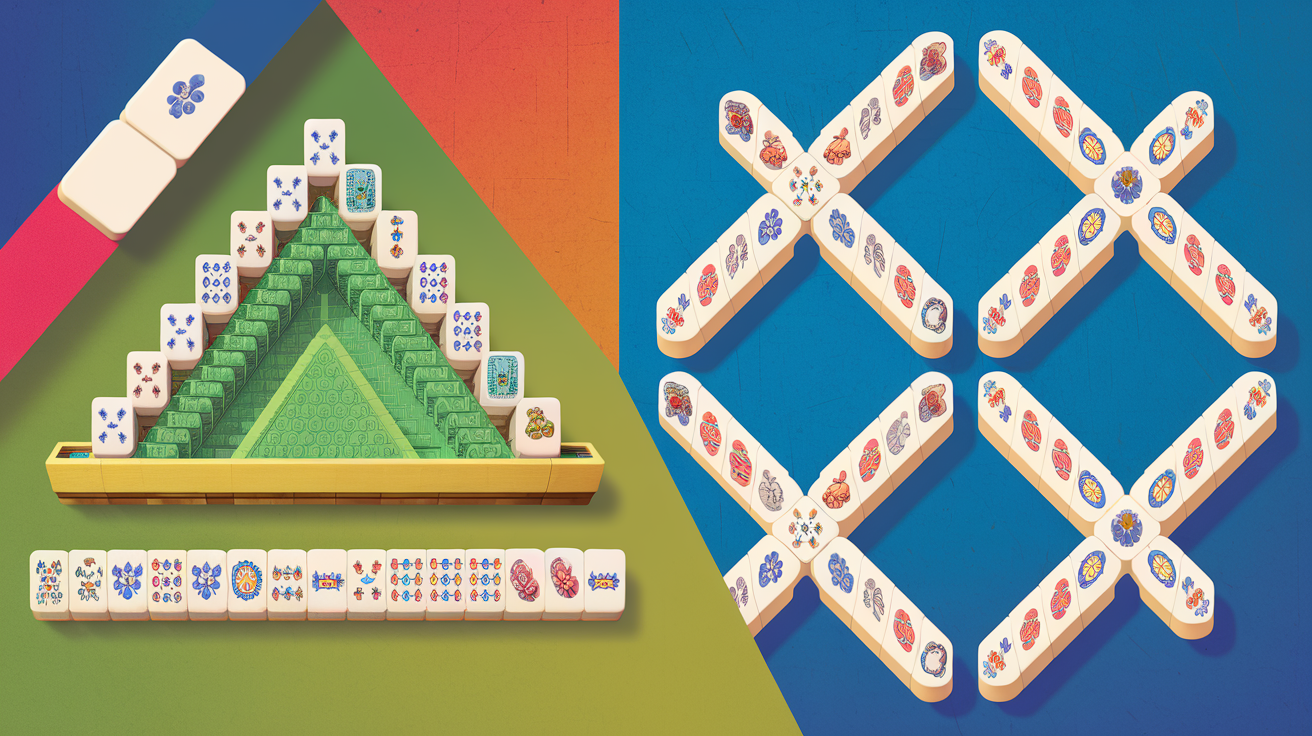
Mahjong Solitaire vs. Traditional Mahjong: Understanding Two Very Different Games
If you've played the tile-matching game on themahjong.io, you've experienced mahjong solitaire—a game that shares a name and tiles with traditional mahjong but is, in nearly every meaningful way, a completely different game. This confusion is understandable and has deep historical roots. Understanding the distinction enriches appreciation for both games and helps clarify what you're actually playing.
The Origin Story: How Mahjong Solitaire Came to Be
In 1981, a computer programmer named Brodie Lockard created a solitaire game on his Apple II computer. Lockard, inspired by the visual elegance of mahjong tiles, designed a tile-matching puzzle where players remove pairs of identical tiles from a layered pyramid arrangement. This game bore only a superficial resemblance to traditional mahjong—it shared the tiles and aesthetic, but nothing of the actual gameplay mechanics.
Lockard's creation was clever and addictive. The puzzle had enough variation to feel fresh across multiple plays, yet simple enough rules that anyone could pick it up in seconds. Crucially, it was a single-player game—no opponents, no real-time play, no complex scoring systems.
The game remained relatively niche until 1989, when Microsoft included a version called "Shanghai" (a name borrowed from earlier tile solitaire versions) in Windows 3.0. This bundling was transformative. Suddenly, millions of computer users worldwide had access to this puzzle game. Shanghai became one of the most played computer games of the early 1990s, introducing the mechanic to a generation unfamiliar with actual mahjong.
Why the Name Stuck (and Confused Everything)
The naming situation deserves examination. Why call this tile-matching puzzle "mahjong" at all? The answer combines historical confusion and pragmatic marketing. The term "mah-jongg" was already familiar to Western audiences as exotic and intriguing. The tiles, derived from Chinese culture, created an aesthetic connection. Earlier Western solitaire card games had often borrowed exotic names to suggest mystery and sophistication.
Over time, "mahjong solitaire" and "Shanghai" became interchangeable terms for this game, even as it drifted further from any meaningful association with traditional mahjong. The naming persisted because it worked commercially and because, once established, terminology tends to calcify in the marketplace.
What They Actually Share
Let's acknowledge the genuine connections:
Tiles: Both games use mahjong tiles derived from traditional Chinese sets. Solitaire uses the basic tile types (characters, bamboo, circles) plus dragons and winds, though not always in traditional arrangements.
Aesthetic: Both carry visual and cultural resonance from Chinese tradition, even if solitaire games use this in a decorative rather than functional way.
Pattern Recognition: Both require players to recognize patterns and sequences, though applied very differently.
That's largely where the similarities end.
The Fundamental Differences
Game Structure
Traditional Mahjong is a four-player game where participants actively draw and discard tiles, build melds (combinations like sets of three identical tiles or sequences), and race to complete a winning hand. Play happens in real-time with other players, involving psychology, observation, and strategic decision-making about what to play and what to hold.
Mahjong Solitaire is a single-player puzzle where all tiles are visible from the start, arranged in a fixed layout. There's no drawing, no melds, and no winning hand condition beyond matching pairs. The goal is simply to remove all tiles before reaching an unwinnable state.
Strategy and Complexity
Traditional Mahjong involves:
- Hidden information (other players' tiles)
- Real-time decision-making
- Risk assessment and probability
- Reading opponents
- Dozens of regional rule variations affecting scoring and winning conditions
- Potential gambling stakes, adding psychological pressure
Mahjong Solitaire involves:
- Complete information (all tiles visible)
- Contemplative, pausable gameplay
- Pattern recognition and spatial reasoning
- Logical deduction about tile removal order
- Consistent rules across all versions
- No competitive element
Skill and Luck Balance
Traditional Mahjong balances luck (tile draws and chance) with substantial skill (strategy, memory, psychology). Strong players consistently outperform weaker ones over many hands.
Mahjong Solitaire is primarily a logic puzzle. The outcome depends almost entirely on whether a particular layout is solvable and whether the player makes optimal decisions. Luck plays minimal role—success is about skill and pattern recognition.
Social Aspect
Traditional Mahjong is inherently social. Players sit around a table, interact, negotiate, and compete directly. Regional variations reflect centuries of cultural development and social gaming traditions.
Mahjong Solitaire is solitary by design. While people play it, they're engaging in personal puzzle-solving rather than social interaction.
Why This Distinction Matters
Understanding these differences helps contextualize what you're doing when playing tile-matching solitaire. You're not learning mahjong, even though marketing has often implied otherwise. You're playing a modern puzzle game that borrows visual elements from traditional mahjong culture.
This isn't a criticism. Mahjong solitaire is an excellent puzzle game with genuine appeal. But it's intellectually honest to recognize that someone who plays Shanghai or games at themahjong.io hasn't learned traditional mahjong any more than someone who plays chess.com has learned to read music because chess pieces have Baroque names.
The Digital Legacy
The digital age created this confusion. Before computers, "mahjong" in the West referred almost exclusively to the four-player game. Solitaire games were called solitaire games, even if they used mahjong tiles. Digitization changed this because:
- Distribution: Windows made solitaire ubiquitous
- Branding: The mahjong name was marketable
- Convenience: Single-player digital games are easier to implement than multiplayer ones requiring multiple human players
For decades, most Westerners' only exposure to "mahjong" was actually the solitaire variant. This reversed the typical order—the derivative game became the public face of the original.
The Bottom Line
They're different games that happen to share tiles and a name. Traditional mahjong is a sophisticated social game with deep strategic elements. Mahjong solitaire is an elegant logic puzzle. Both have merit. Understanding the distinction respects both the historical game and the modern digital creation.
When you play at themahjong.io, you're enjoying a game with a legitimate lineage back to 1981 and a place in computer gaming history. That's genuinely interesting—even if it's not actually mahjong.
