

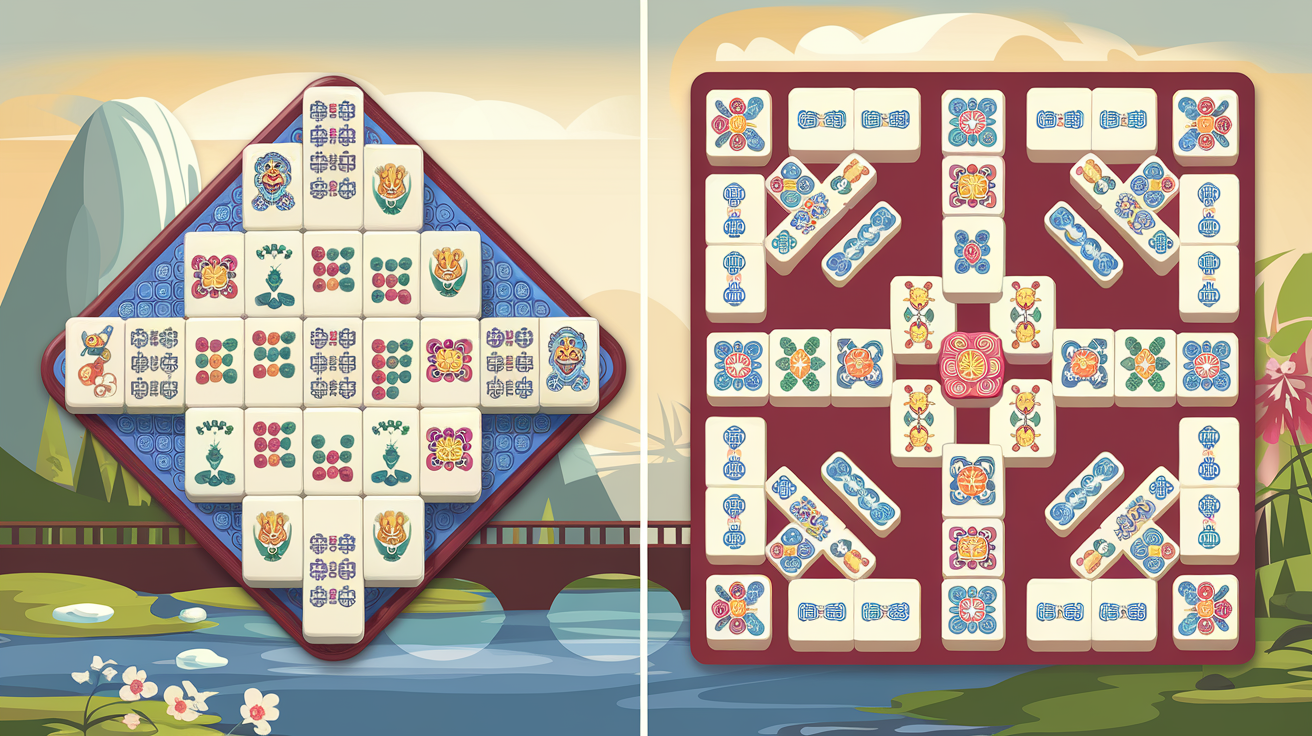
Mahjong Solitaire vs. Traditional Mahjong: Understanding Two Very Different Games
If you've ever played mahjong on your computer or phone, matching colorful tiles until the board clears, you've experienced something quite different from what players in China, Japan, and Korea have enjoyed for over a century. Yet both games share the name "mahjong"—and that shared name has created one of gaming's most persistent misconceptions.
The good news? Understanding the actual history clarifies everything.
The Origins: Where Mahjong Solitaire Really Came From
Traditional mahjong emerged in 19th-century China as a four-player strategy game played with 144 tiles, incorporating elements of card games, dominoes, and chess-like tactical thinking. It spread throughout Asia and eventually worldwide, becoming a beloved pastime involving skill, probability, psychology, and social interaction.
But the "mahjong" you play online has a different origin story entirely.
In 1981, Brodie Lockard, a programmer, created a computer solitaire game called Mah-Jongg for the Apple II. Lockard's game used mahjong tiles as its visual vocabulary—those distinctive characters and symbols were recognizable and aesthetically appealing—but the gameplay was fundamentally different. Instead of competing against three opponents, players faced a solo puzzle: match pairs of identical tiles on a stacked board, clearing layers until nothing remained.
Lockard's choice to use mahjong tiles was partly practical (they had distinct designs that worked well on early computer screens) and partly respectful of their cultural origin. However, this naming choice, however well-intentioned, created a lasting source of confusion.
The Windows Effect: Shanghai and Global Recognition
The real turning point came in the 1980s and 1990s when Microsoft bundled a tile-matching solitaire game called Shanghai with Windows. Millions of people encountered this game, often without realizing it was a computer-original puzzle game unrelated to traditional mahjong gameplay.
Shanghai became ubiquitous on office computers, school computers, and home systems worldwide. Meanwhile, the original Mah-Jongg and its many digital variants continued spreading across different platforms. Many of these games still used "Mahjong" in their titles—understandably, since Lockard's game had established that nomenclature—but the gaming public at large didn't always know that these were solitaire puzzle games, not simulations of the traditional four-player game.
Over time, "mahjong" (lowercase, referring to the digital solitaire games) became distinct from "Mahjong" (the traditional game) in many gaming contexts, though the distinction wasn't always obvious to new players.
What the Games Share
Before diving into differences, it's worth acknowledging what connects them:
The Tiles: Both use traditional mahjong tiles featuring characters, numbers, and symbols from Chinese culture. This visual continuity is genuine and respectful.
Cultural Appreciation: Both games introduce players to mahjong's aesthetic and symbolic traditions, even if they don't preserve the strategic depth.
The Name and Community: There's real cultural continuity in using the mahjong name and imagery, even if the gameplay diverged. Players of solitaire mahjong often become curious about traditional mahjong, creating a pipeline of cultural interest.
Where They Truly Diverge
Game Structure
Traditional Mahjong: Played with four players, each drawing and discarding tiles in turn. The game involves reading opponents, managing risk, understanding probability, and making split-second decisions based on incomplete information. Rounds may last 15 minutes to an hour, depending on house rules.
Mahjong Solitaire: A solo puzzle game. You control the entire board and can see all tiles (though some are hidden). There's no opponent, no time pressure from other players, and no need to infer what tiles others hold. Rounds typically last 5-15 minutes.
Strategic Depth
Traditional Mahjong: Requires psychological insight, memory of discarded tiles, risk assessment, and adaptation to opponents' playing styles. Winning depends partly on luck (tile draws) but heavily on decision-making quality.
Mahjong Solitaire: Primarily a puzzle game. Strategy involves identifying which pairs to match in what order to access hidden tiles below. Outcomes are largely determined by initial tile placement; the player's skill is in pattern recognition and planning ahead.
Learning Curve
Traditional Mahjong: Takes significant time to learn. Rules vary by region, and mastering strategy takes practice with experienced players.
Mahjong Solitaire: Instantly understandable. The rule—"match pairs to clear the board"—requires no explanation.
Outcome
Traditional Mahjong: Every hand has a winner and losers (in most rule sets). Your success depends on decisions and luck together.
Mahjong Solitaire: Some boards are unsolvable from the start, while others are guaranteed to have a solution. Winning means finding the correct sequence of moves.
Why the Confusion Persists
The confusion endures for solid reasons:
- The name: "Mahjong" naturally suggests connection to the traditional game.
- The visual design: The tiles are authentic, creating cultural continuity that feels meaningful.
- Global distribution: Most people's first "mahjong" experience was the solitaire version via Windows or mobile apps.
- No alternative name: Unlike chess variants that are named distinctly (3D chess, chess variants), tile-matching solitaire games never adopted a wholly separate name in mainstream culture.
Appreciating Both Games
Understanding the difference doesn't diminish either game. Mahjong solitaire is a legitimate, enjoyable puzzle game with its own satisfying logic. It's not supposed to replicate traditional mahjong—it's a distinct creative work that borrowed a culturally rich visual language to create something new.
Traditional mahjong, meanwhile, offers competitive depth and social connection that computer puzzles can't match. Both are worth playing, and understanding their separate origins and purposes deepens appreciation for each.
When you're matching tiles at themahjong.io, you're engaging with a game lineage that runs back to Brodie Lockard's 1981 innovation—not to 19th-century China, though the tiles honor that tradition. And that's perfectly fine. Games evolve, adapt, and sometimes diverge. Knowing the actual history lets you enjoy each game for what it genuinely is.
Moving Forward
If you're new to mahjong solitaire, play it with full confidence—it's a complete, satisfying game in itself. If you're curious about traditional four-player mahjong, seek out local games, apps that simulate it properly, or communities where it's played competitively. Both enrich different parts of gaming culture, and both deserve respect for what they actually offer.
