

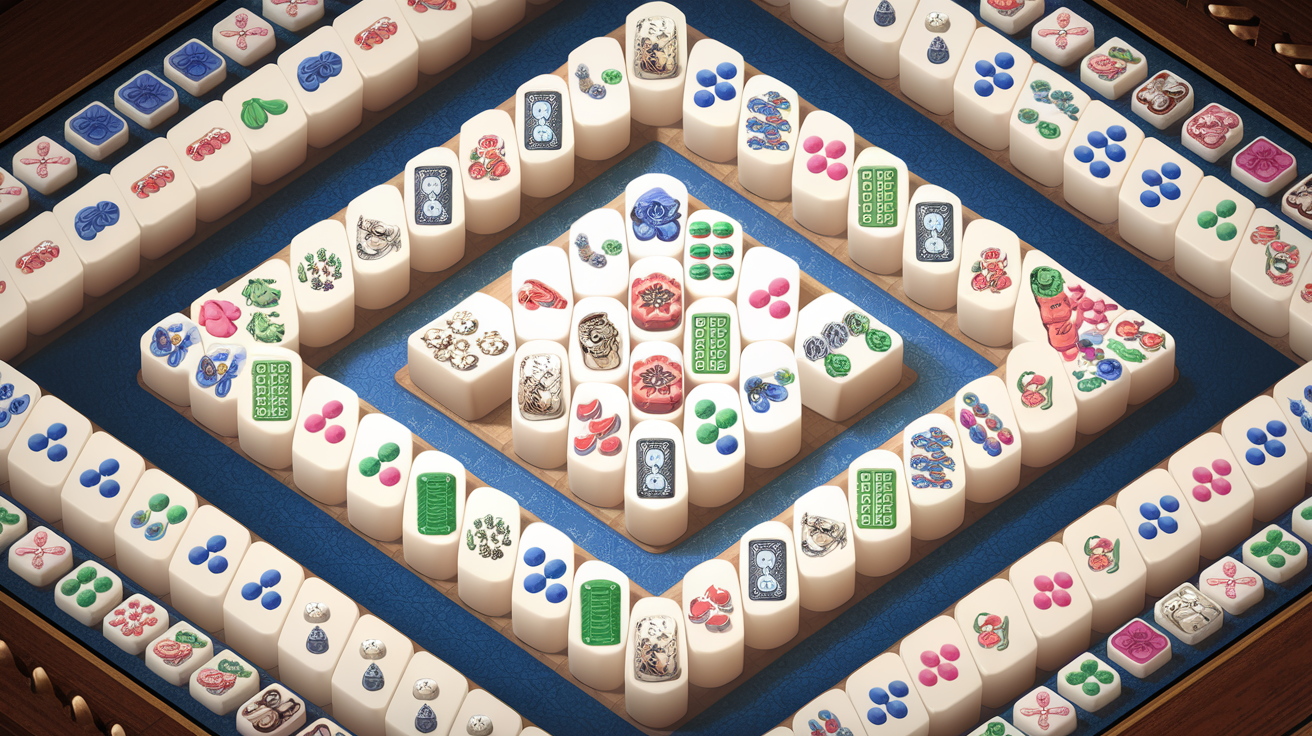
Mahjong Solitaire vs. Traditional Mahjong: Understanding Two Completely Different Games
If you've played mahjong solitaire online or on your computer, you might assume you're playing a simplified version of traditional Chinese mahjong. The truth is more interesting: mahjong solitaire is a completely separate game that only borrows the visual language of traditional mahjong. Understanding this distinction helps appreciate both games for what they truly are.
What Are We Actually Playing?
When you're matching pairs of tiles on themahjong.io, you're playing a single-player puzzle game. When four players sit around a table playing traditional mahjong, they're engaged in a complex, multiplayer strategy game involving hand management, psychology, and real-time decision-making. These are as different as chess and solitaire—both strategic, but fundamentally separate experiences.
The Real Origin Story: 1981 and Brodie Lockard
The tile-matching solitaire format has a precise origin point that many players don't know about. In 1981, Brodie Lockard created a computer game called "Mah-Jongg" for the Apple II. This was the first digital iteration of what we now call mahjong solitaire.
Lockard's innovation was elegant: take the visual tiles from traditional mahjong and arrange them in a solvable puzzle where players match identical pairs by clicking them. The tiles would only match if they were free—meaning they had no tile resting on top of them and at least one free side. This created the constraint-based puzzle mechanics that define the genre.
The game was immediately popular, and for good reason. It was meditative, skill-based, and infinitely replayable. You didn't need to know traditional mahjong rules to enjoy it. You didn't need opponents. You could play at your own pace.
The Windows "Shanghai" Era: When Naming Got Confused
The confusion about what "mahjong" means largely traces to one major event: Microsoft bundled a mahjong solitaire game with Windows 3.0 (1990), calling it "Shanghai." This was actually a smart naming choice—it avoided claiming the game was traditional mahjong while keeping the same tiles and aesthetic.
However, many subsequent digital releases went back to calling the game simply "Mahjong," and the naming convention stuck. For millions of people, their first (or only) experience with anything called "mahjong" was the solitaire version. This created a lasting association between the word "mahjong" and the single-player tile-matching game.
When people heard "mahjong," they thought of Shanghai or its many clones. When they eventually encountered traditional mahjong, they were often surprised to discover it was a completely different animal.
What the Two Games Actually Share
Despite their fundamental differences, mahjong solitaire and traditional mahjong do share some genuine heritage:
Tiles and Symbolism: Both use the same tile designs—bamboos, circles, characters, winds, dragons, and flowers. These tiles have centuries of history in traditional mahjong.
Aesthetic and Culture: The visual presentation carries the cultural weight of East Asian design. Playing mahjong solitaire still engages you with this beautiful tradition, even if you're not playing the original game.
Tile Recognition: Learning tile names and their meanings in solitaire gives you a genuine introduction to traditional mahjong tile terminology.
Turn-Based Thinking: Both games reward careful consideration and pattern recognition, though the types of patterns differ entirely.
Where They Truly Diverge
The differences are far more significant than the similarities:
Game Structure
- Traditional Mahjong: Played by 4 players simultaneously. Players draw and discard tiles in real-time. The game ends when someone completes a winning hand or when the deck is exhausted.
- Mahjong Solitaire: Single player. You control all moves and take your time. There's no luck involved in what tiles you draw—the puzzle layout is fixed from the start.
Strategy and Skill
- Traditional Mahjong: Requires reading opponents, managing probability (what tiles might be in others' hands), remembering discards, and making split-second decisions. It's a game of incomplete information.
- Mahjong Solitaire: All information is visible. Strategy involves recognizing which pairs to match first, planning ahead, and solving the puzzle efficiently. It's pure logic.
The Role of Luck
- Traditional Mahjong: The draw is random. Skill matters, but so does the luck of which tiles you receive.
- Mahjong Solitaire: No luck. Every puzzle has a solution (or doesn't), and that's determined entirely by the layout. Your success depends only on skill and logic.
Winning Conditions
- Traditional Mahjong: Complete a specific hand pattern (melds and a pair) to win and score points.
- Mahjong Solitaire: Clear all tiles from the board by matching pairs. The goal is binary: complete or don't.
Why This Matters
Understanding the distinction isn't pedantic—it helps you appreciate what you're actually doing when you play mahjong solitaire. You're not playing a simplified version of traditional mahjong. You're playing a distinct puzzle game that happens to use beautiful tiles with a rich history.
If you love mahjong solitaire, you might find traditional mahjong rewarding in different ways—it offers the thrill of competition, the psychology of reading opponents, and the engagement of real-time decision-making. Or you might prefer the meditative, logic-based experience of solitaire.
Both are valid. Both are engaging. And both deserve to be understood for what they truly are.
The Bottom Line
Thanks to the 1981 creation of Brodie Lockard's "Mah-Jongg" and the widespread distribution of Windows "Shanghai," the tile-matching solitaire game became more famous than traditional mahjong in the West. This historical accident created lasting confusion about what "mahjong" means.
Today, when you play mahjong solitaire at themahjong.io, you're enjoying a well-established digital puzzle game with its own 40+ year history. You're not playing traditional mahjong, and you don't need to know its rules to enjoy what you're playing. The tiles are borrowed, but the game is entirely its own thing—and that's perfectly fine.
