

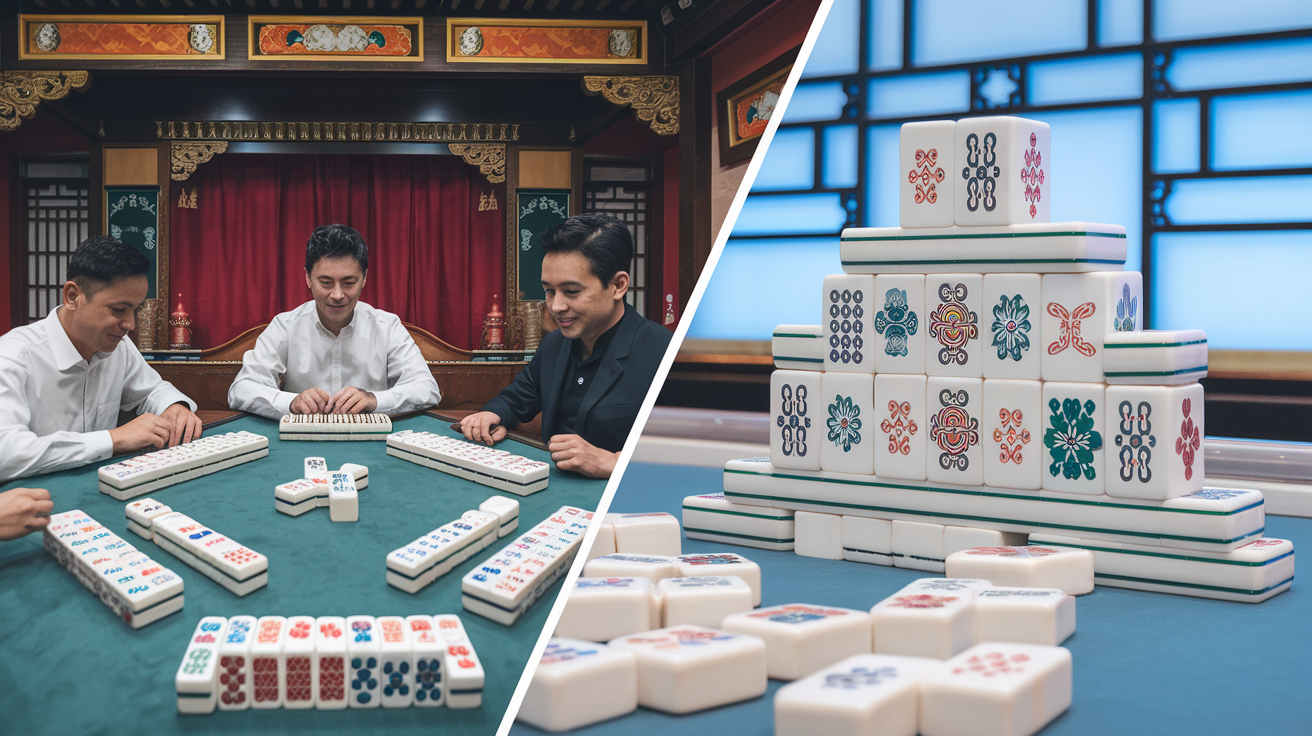
Mahjong Solitaire vs. Traditional Mahjong: Understanding Two Completely Different Games
If you've played mahjong on your computer or phone, you've likely enjoyed matching pairs of tiles to clear the board. But if you've ever sat down to play traditional mahjong with friends, you might have noticed something surprising: these feel like completely different games. That's because they are.
The confusion is understandable and historically rooted. Both games use similar-looking tiles decorated with Chinese symbols and numbers. But traditional mahjong is a competitive four-player strategy game involving draws, discards, and complex hand management. Mahjong solitaire is a single-player puzzle game about finding matching pairs. The relationship between them is more like the connection between chess and checkers—they share a board and pieces, but the gameplay is fundamentally distinct.
Understanding this difference enriches how we appreciate both games. Let's explore their genuine origins and what makes each compelling.
The True Origins of Traditional Mahjong
Traditional mahjong emerged in 19th-century China as a tile-based card game combining elements of poker and rummy. Players typically compete in groups of four, drawing and discarding tiles in an attempt to form winning combinations called "melds"—sets of three or four matching tiles.
The game spread throughout Asia and eventually worldwide, with different regions developing their own rule variations. Cantonese mahjong, American mahjong, and Japanese mahjong each have distinct scoring systems and hand requirements, but they all share the core mechanic: competitive play involving skill, luck, memory, and strategic decision-making.
What makes traditional mahjong genuinely challenging is uncertainty. You don't know what tile you'll draw next. You must track what other players have discarded, anticipate their hands, and make split-second decisions about what to discard yourself. It requires reading opponents, managing risk, and adapting strategy based on incomplete information.
How Mahjong Solitaire Was Born: The Brodie Lockard Innovation (1981)
In 1981, American software designer Brodie Lockard created something entirely new. While working on early computer games, Lockard designed a solitaire-style game using mahjong tiles. Rather than recreating the four-player competitive game (which would be difficult to code and less suitable for single-player computer play), he invented a new puzzle concept: arrange 144 tiles in a specific pattern, then clear them by matching identical pairs.
Lockard's game retained the visual aesthetics of mahjong tiles—the beautiful Chinese characters, the bamboo and dot suits, the wind and dragon designations—but discarded the competitive mechanics entirely. What remained was pure puzzle logic: spatial reasoning, pattern recognition, and memory.
This was a stroke of creative genius. The mahjong tile set provided visual richness and cultural resonance, while the solitaire mechanic created an accessible, meditative gameplay experience perfectly suited to computer interfaces.
The Naming Confusion: Shanghai and Windows Bundling
The naming conflation that persists today largely stems from one critical moment in computing history.
After Lockard's innovation, tile-matching solitaire games became increasingly popular on personal computers. A notable version called "Shanghai" (developed by Activision in the mid-1980s) gained widespread recognition. The game was simple, elegant, and addictive.
Then, in the early 1990s, Microsoft bundled a mahjong solitaire game directly into Windows. For millions of computer users worldwide, this bundled game became their first—and often only—experience with mahjong. The game was simply called "Mahjong," reinforcing the misconception that this tile-matching solitaire represented what mahjong actually was.
For casual players, the equation became simple: mahjong = computer game you play alone, matching tiles until the board clears. This naming choice, while pragmatic, created lasting confusion that persists across generations of players.
What They Actually Share
Despite their fundamental differences, traditional mahjong and mahjong solitaire do share meaningful common ground:
Tile Sets: Both use the standard mahjong tile set featuring suits (bamboo, dots, characters), honors (winds and dragons), and special tiles. The visual language is identical.
Memorization: Both games reward memory. In traditional mahjong, remembering discards helps you track opponents' hands. In mahjong solitaire, remembering tile locations is essential for efficient play.
Cultural Connection: Both games carry genuine connection to Chinese culture and aesthetics. The tile designs aren't arbitrary—they represent centuries of artistic and gaming tradition.
Accessibility: Both games have relatively simple rule entry points. Beginners can start playing either game without extensive study, though mastery takes time.
Where They Fundamentally Diverge
The differences are equally striking:
Player Count: Traditional mahjong is inherently social—designed for four players. Mahjong solitaire is single-player by design.
Strategy Type: Traditional mahjong involves incomplete information, bluffing, and player prediction. Mahjong solitaire involves perfect information and spatial logic. You can see every tile; the challenge is solving the puzzle.
Outcome Determination: In traditional mahjong, luck and skill intertwine. A skilled player can improve odds but cannot guarantee wins. In mahjong solitaire, most game states have definite solutions. You either solve the puzzle or you don't.
Competitive vs. Meditative: Traditional mahjong is competitive—you win against opponents. Mahjong solitaire is typically non-competitive. You play against the puzzle itself, not another person.
Time Investment: Traditional mahjong games can last 30 minutes to several hours. A mahjong solitaire round typically takes 5-15 minutes.
Why This Distinction Matters
Understanding this difference doesn't diminish either game. Rather, it clarifies what makes each valuable.
Traditional mahjong offers the rich, social experience of competitive play with variable outcomes. It rewards strategic thinking, psychological insight, and adaptability. Players develop genuine skills that transfer to other domains.
Mahjong solitaire offers meditative puzzle-solving, accessible gameplay, and the satisfaction of clearing a board through logic and memory. It's perfect for relaxation, brain training, or casual entertainment.
Neither game is "better." They serve different purposes and appeal to different motivations. A player who loves mahjong solitaire might not enjoy traditional mahjong's competitive pressure, and vice versa. Both are legitimate ways to engage with this iconic tile set.
Conclusion
The naming confusion between traditional mahjong and mahjong solitaire is understandable—it emerged from practical decisions made during the personal computer era and has persisted through decades of widespread gaming. But recognizing the distinction enriches our appreciation of both.
When you play mahjong solitaire at themahjong.io, you're enjoying the direct descendant of Brodie Lockard's 1981 innovation—a game that borrowed the aesthetic language of mahjong tiles but invented an entirely new form of gameplay. When traditional players invite you to play real mahjong, you're experiencing something with roots stretching back to 19th-century China—a competitive social game fundamentally different in spirit.
Both deserve their place in gaming history. And understanding the difference between them makes playing either one more enjoyable.
