

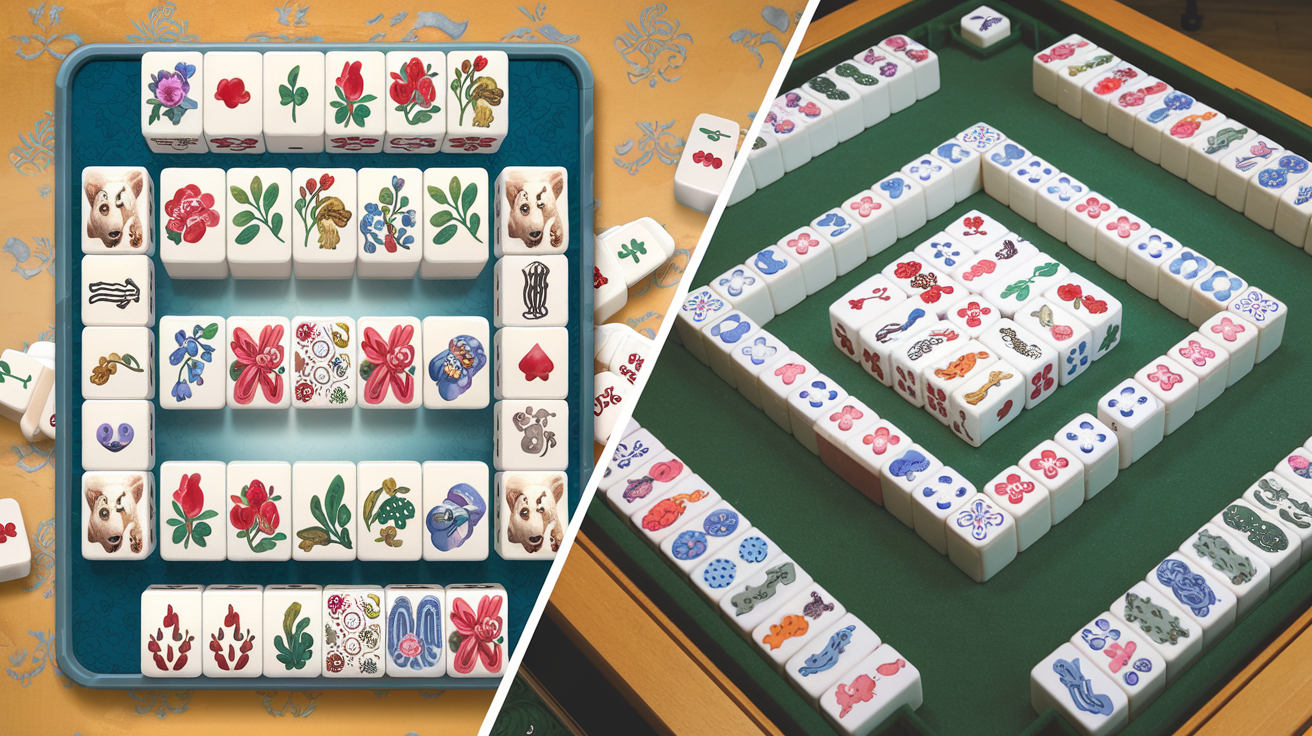
Mahjong Solitaire vs. Traditional Mahjong: Understanding Two Completely Different Games
If you've ever played mahjong solitaire online or on your computer, you might assume you're playing a simplified version of traditional mahjong. In reality, these are two entirely separate games that only share a visual connection through their tile designs. This distinction matters not for gatekeeping reasons, but because understanding the difference enriches your appreciation of both.
A Brief History: Where These Games Diverged
Traditional Mahjong: A Four-Player Strategy Game
Traditional mahjong emerged in China during the 19th century, though some scholars trace its roots to earlier games. It evolved into a complex, four-player competitive game played with 144 tiles representing bamboo, circles, characters, winds, dragons, and honors. Players draw and discard tiles strategically, aiming to form winning combinations called "melds" while reading opponents' intentions and managing risk. Regional variations exist across China, Japan, and other Asian countries, each with distinct rules and complexity levels.
Traditional mahjong is fundamentally about strategic decision-making under uncertainty, hand management, probability assessment, and reading your opponents' strategies—similar in some ways to poker or bridge.
Mahjong Solitaire: A Single-Player Matching Puzzle
Fast forward to 1981. Brodie Lockard, a computer programmer, created "Mah-Jongg" for the Apple II computer. This wasn't an adaptation of traditional mahjong. Instead, Lockard designed something entirely new: a tile-matching puzzle game where a single player systematically matches pairs of identical tiles from a stacked layout, with the goal of clearing the entire board.
Lockard's innovation was elegantly simple. Rather than the probabilistic, multi-player complexity of traditional mahjong, this software created a deterministic puzzle: given a specific board layout, there's either a solution or there isn't. It became instantly popular because it offered the meditative, problem-solving satisfaction of a solitaire card game.
How "Shanghai" Made Mahjong Solitaire a Household Name
In 1986, Microsoft licensed a version of this tile-matching game and bundled it with Windows 3.1 under the name "Shanghai." This distribution decision was transformative. Hundreds of millions of computer users encountered the game as a bundled application, often the first introduction to anything with "mahjong" branding.
The naming choice—which referenced the game's Shanghai-based origins among Lockard's inspirations—ironically cemented the confusion. Most players who encountered "Shanghai" had no awareness of traditional mahjong and naturally assumed the Windows game was mahjong, just in digital form. The name stuck, and subsequent digital versions proliferated under various titles: "Mah-Jongg," "Mahjong Solitaire," "Mahjong Tiles," and more. Each used the same core mechanic Lockard invented.
This wasn't deception—it was simply how digital distribution shaped popular understanding. The game earned its place in cultural memory not through false claims but through ubiquitous presence.
What They Actually Share
Despite their fundamental differences, the games do share meaningful connections:
Tile designs: Mahjong solitaire uses the traditional mahjong tile suits (bamboo, circles, characters, winds, dragons, honors). These aren't arbitrary—they're culturally significant symbols with centuries of meaning.
Cultural heritage: Both games carry the aesthetics and symbolic weight of Chinese tradition. Playing mahjong solitaire doesn't diminish the cultural respect owed to traditional mahjong; they're simply different expressions of that heritage.
Tile combinations: Some mahjong solitaire variants reference traditional combinations, though they function differently in puzzle form than in strategic play.
Accessibility appeal: Both games have transcended their origins to become internationally beloved, demonstrating the universal appeal of games involving pattern recognition and decision-making.
Where They Diverge: The Strategic Divide
Traditional Mahjong
- Multi-player: Four players competing simultaneously
- Hidden information: Other players' hands and intentions remain partially unknown
- Risk assessment: Discarding a tile might help an opponent win; strategy involves calculated risk
- Probability and luck: Tile draws introduce chance; skilled players manage probability
- Reading opponents: Psychology and pattern recognition of other players' tactics matters
- Variable games: Even with identical rules, every game unfolds differently
Mahjong Solitaire
- Single-player: You compete against the puzzle, not opponents
- Perfect information: The entire board is visible; there are no hidden elements
- Logical deduction: You must identify matching pairs and plan removal sequences
- Pure strategy: No luck involved; success depends entirely on recognizing valid solution paths
- No opponent reading: There are no opponents, only the puzzle's inherent logic
- Deterministic puzzles: Each board layout has a definite answer; the challenge is finding it
Why the Confusion Persists (and Why It's Okay)
The naming conflation persists because:
- Historical timing: Millions encountered tile-matching solitaire before learning traditional mahjong existed
- Shared visuals: The tiles are authentic mahjong tiles; the connection feels legitimate
- Marketing simplicity: "Mahjong" is shorter and more memorable than "Tile-Matching Solitaire Puzzle Game"
- Cross-cultural translation: Games often get renamed when crossing cultural boundaries
This isn't a crisis deserving condescension toward players who didn't know the distinction. Language and naming conventions evolve organically. Many people who play chess have never heard of its Persian origins ("shah mat"), and that's unremarkable.
What This Means for Players
If you love mahjong solitaire, you're enjoying a legitimate, well-designed puzzle game with a fascinating origin story. If you want to explore traditional mahjong, you'll discover a rich strategic experience that requires time to learn but offers deep complexity. The two games satisfy different gaming urges—one meditative and logical, the other social and probabilistic.
Understanding the distinction helps you appreciate each game on its own terms, rather than viewing one as a diminished version of the other. Both deserve respect as games worthy of your time and attention.
Conclusion
The mahjong solitaire you play at themahjong.io traces its lineage to Brodie Lockard's 1981 innovation and Microsoft's 1986 distribution decision, not to traditional mahjong strategy. That's not a flaw—it's a feature. Lockard created something genuinely new by building a single-player puzzle game from mahjong's visual language and cultural aesthetic.
Next time someone mentions mahjong, you'll know whether they're discussing a four-player strategic competition or a single-player tile-matching puzzle. And if you enjoy the latter, you can appreciate it fully without feeling you're missing something about the former. Both games have earned their place in gaming culture—they just earned it in different ways.
