

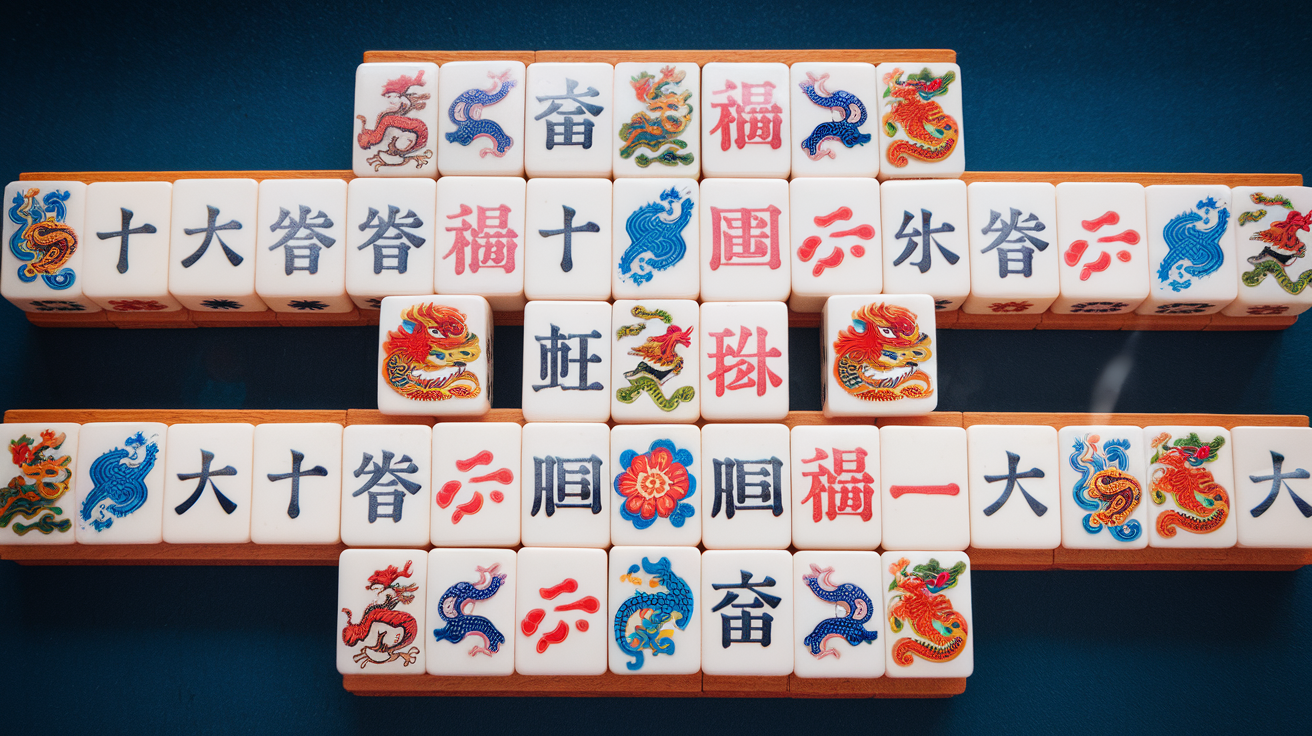
Mahjong Solitaire vs. Traditional Mahjong: Understanding Two Different Games
If you've ever played mahjong solitaire online or on your computer, you might assume it's a digital version of the classic four-player Chinese game. The shared tile imagery certainly suggests a connection. In reality, these are two entirely separate games with different origins, rules, and strategic demands. Understanding this distinction enriches appreciation for both.
The Actual Origins: 1981 and Brodie Lockard
The story of mahjong solitaire begins not in ancient China, but in 1981 Silicon Valley. Brodie Lockard, a computer programmer and amateur game designer, created the first tile-matching solitaire game on an Apple II computer. Lockard borrowed the visual aesthetic of traditional mahjong tiles—the dragons, winds, flowers, and character sets that make the tiles instantly recognizable—but created an entirely new game mechanic.
Lockard's innovation was elegantly simple: arrange mahjong tiles in a pattern, then remove them by matching pairs. The game became a meditation puzzle, a game of spatial reasoning and memory rather than negotiation and strategy. There was no dealer, no point calculation, no strategic betting, and no adversarial gameplay. It was, in essence, mahjong solitaire as we know it today.
Why did Lockard choose mahjong tiles? Partly aesthetic preference, partly practical—mahjong tile sets were visually distinct and thematically rich. The choice proved fortuitous but also created lasting confusion about what the game actually was.
Shanghai and the Windows Era
The real explosion of mahjong solitaire's popularity came in 1986 when Activision released Shanghai, a polished commercial version of Lockard's game. Shanghai became a landmark title in early computer gaming, known for its atmospheric music, smooth graphics, and deeply satisfying gameplay. It appeared on Amiga, Atari ST, and Commodore 64, building a dedicated following.
But the pivotal moment came when Microsoft included a mahjong solitaire game in Windows 3.0 (1990) and continued bundling it through subsequent versions. Suddenly, tens of millions of people had access to this tile-matching game on their computers—often without realizing it was neither Chinese in origin nor related to the traditional game beyond aesthetic borrowing.
For many computer users in the 1990s and 2000s, this Windows version was mahjong. The naming conflation became cemented in popular culture. Ask a casual player what they think of when they hear "mahjong," and they're statistically more likely to picture digital solitaire than the four-player game played in homes and tournament halls worldwide.
What They Share (And It's Less Than You'd Think)
The connection between mahjong solitaire and traditional mahjong is primarily visual and nominal:
Shared Elements:
- Tile designs: Both use the same character sets, dragons, winds, and flower tiles. These beautiful, symbolic designs are instantly recognizable.
- Cultural aesthetic: Both games draw from Chinese cultural traditions, even if mahjong solitaire's connection is superficial.
- Tile count and sets: Traditional mahjong uses 144 tiles (typically), and most solitaire versions use the same base tile set, though arranged differently.
That's largely where the similarity ends.
Where They Diverge Dramatically
The differences are fundamental and affect everything about how the games are played:
Player Count and Structure
- Traditional mahjong: Requires four players (though regional variants exist with two or three). It's inherently social and competitive.
- Mahjong solitaire: Single-player only. It's you against the puzzle, not against opponents.
The Core Mechanic
- Traditional mahjong: Players draw and discard tiles, forming melds (sequences of three or four related tiles) and sets. The game involves hand management, reading opponents, and strategic tile control. Victory comes from being first to complete a winning hand.
- Mahjong solitaire: Match pairs of identical or complementary tiles. The entire board is visible from the start. There's no hand, no drawing phase, and no meld-building. Victory means clearing the board.
Strategic Depth
- Traditional mahjong: Demands skill in probability, psychology, memory, and risk assessment. You must anticipate what others hold, remember discarded tiles, and adapt your strategy based on their actions.
- Mahjong solitaire: Rewards pattern recognition, spatial reasoning, and careful sequencing. Strategy involves planning which pair removals open access to trapped tiles. It's puzzle-solving more than game theory.
Scoring and Duration
- Traditional mahjong: Games involve point calculation, betting, and multiple rounds. A session typically lasts hours.
- Mahjong solitaire: No scoring system—either you clear the board or you don't. Games last minutes to around 15 minutes maximum.
Luck vs. Skill
- Traditional mahjong: Involves luck (the draw) combined with skill (play decisions). The outcome isn't predetermined.
- Mahjong solitaire: Every board configuration has a solution (in most versions). With perfect play, you can theoretically win every time. It's deterministic puzzle-solving.
Why the Confusion Persists
The naming confusion isn't anyone's fault—it's simply how language works. When Lockard and Activision needed a name for a tile-matching game that visually referenced Chinese aesthetics, "Mahjong" was natural shorthand. There was no malicious misrepresentation, just a convenient label that stuck.
The persistence of this confusion also reflects technology's role in cultural knowledge. For millions of people, their first (and sometimes only) exposure to tiles called "mahjong" came through Windows solitaire. The game's ubiquity made it the default definition, even as players of traditional mahjong continued their entirely separate practice.
Respectfully Coexisting
Today, both games thrive in different contexts. Traditional mahjong remains deeply embedded in Chinese culture, with competitive tournaments, regional rule variations, and passionate player communities. Mahjong solitaire has evolved into hundreds of digital variations, each with different tile arrangements, themes, and difficulty levels.
There's no hierarchy here—neither game is "more authentic" in a meaningful sense. Traditional mahjong is older and culturally rooted. Mahjong solitaire is an elegant modern creation that borrowed an aesthetic and created something entirely new.
If you play mahjong solitaire at themahjong.io, you're engaging with a game that traces its lineage to Brodie Lockard's 1981 innovation, refined and distributed by the Windows era. It's a legitimate game with its own appeal: meditative, puzzle-focused, and endlessly replayable.
But if someone invites you to play traditional mahjong with four players, chips, and complex hand-building rules, don't expect the same experience. You're stepping into a different world entirely—one with centuries of history and a completely distinct set of skills and strategies.
Both have their place. Both deserve respect. And now, knowing the actual history, you can enjoy each for what it genuinely is.
