

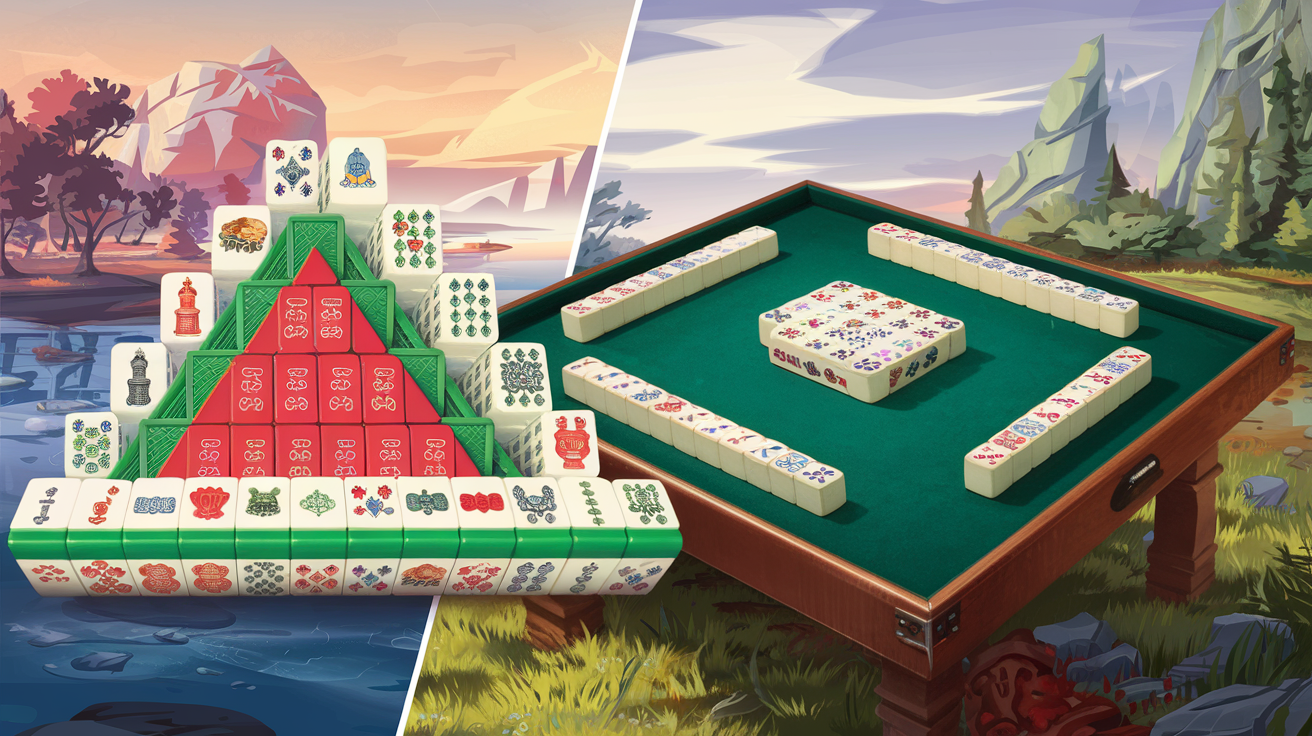
Mahjong Solitaire vs. Traditional Mahjong: Understanding Two Completely Different Games
If you've played mahjong solitaire at themahjong.io, you're participating in a game that shares almost nothing mechanically with traditional Chinese mahjong—despite the identical name. This confusion is so widespread that many players assume they're playing variants of the same game. Understanding the actual history explains not only why they're different, but how this naming confusion came about in the first place.
What Traditional Mahjong Actually Is
Traditional mahjong is a 4-player strategy game with roots in 19th-century China. Think of it as the Asian equivalent of rummy or bridge. Players:
- Draw and discard tiles in turn
- Form sets and sequences (called "melds")
- Compete to be first to complete a winning hand
- Employ bluffing, memory, and probability calculation
- Play multiple rounds with complex scoring systems
- Interact directly with other players through draws, claims, and strategic discards
The game involves psychology, risk assessment, and real-time decision-making against opponents. A traditional mahjong session can last hours and requires active participation from all players simultaneously.
The Birth of Mahjong Solitaire (1981)
In 1981, software designer Brodie Lockard created a computer game for the Apple II called "Mah-Jongg." This game was inspired by—but entirely separate from—traditional mahjong. Lockard's innovation was elegantly simple: arrange mahjong tiles in a decorative pyramid on screen, and create a single-player matching game where you remove pairs of identical tiles.
The rules were straightforward:
- Only tiles on the edges or top of the pyramid could be selected
- Players could only match two identical tiles
- The goal was to remove all tiles from the board
- Success depended on pattern recognition and planning ahead
This was a puzzle game, not a strategy game. There were no opponents, no discards, no melds, no scoring variations. Lockard had taken the visual aesthetic of mahjong tiles and created something entirely new.
"Shanghai" and Mass Adoption
The real catalyst for widespread adoption came in 1986 when Brodie Lockard's game was licensed and released under the name "Shanghai" by Activision. This version became wildly popular on home computers and arcades.
But the most decisive moment came in the 1990s: Microsoft bundled a version of this tile-matching game with Windows as "Mahjong." Suddenly, millions of computer users worldwide encountered this game under the traditional name, despite it having no relation to traditional mahjong gameplay.
This single decision—to call the solitaire puzzle "Mahjong" rather than "Shanghai" or giving it an entirely different name—created a naming conflation that has persisted for over 30 years.
Why the Confusion Persists
Several factors explain why players still conflate the two games:
Visual Identity: Both use identical tile designs (bamboo, circles, characters, winds, dragons, etc.). The tiles themselves are beautiful and distinctive, creating a strong visual association.
Naming Authority: Microsoft's bundling with Windows gave the solitaire game enormous legitimacy and reach. Millions learned to call this puzzle game "Mahjong" without ever encountering traditional mahjong.
Marketing Inertia: Once "Mahjong" became the established name for the computer puzzle, it stuck. Renaming established software is commercially impractical.
Casual Gaming Culture: Traditional mahjong requires 4 players and hours of commitment. The solitaire version is perfect for casual, solitary play—a different audience with different expectations.
What These Games Actually Share
Despite their differences, the games do share meaningful elements:
- Tile Designs: Both use the same traditional tile symbols and imagery
- Cultural Heritage: Both draw from Chinese gaming traditions (though mahjong solitaire is a Western computer game invention)
- Accessibility: Both are played recreationally rather than professionally by most participants
- Social Capacity: Modern digital versions of both can be played online, though traditional mahjong is inherently social in ways the solitaire version is not
Where They Diverge Dramatically
The mechanical and strategic differences are fundamental:
| Aspect | Traditional Mahjong | Mahjong Solitaire |
|---|---|---|
| Players | 4 simultaneous | 1 player |
| Game Type | Strategy/psychology | Puzzle |
| Decision-Making | Interactive, real-time | Contemplative, pausable |
| Opponents | 3 active players | The board itself |
| Memory Role | Tracking discards and hands | Pattern recognition |
| Luck Factor | Draw luck + strategic play | Puzzle layout randomization |
| Session Length | 1-4 hours | 5-30 minutes |
| Skill Expression | Reading opponents, probability | Lookahead, planning |
| Winning Condition | First to complete hand | Clear all tiles |
Why This Matters
Understanding the distinction matters because:
- Expectation Management: Players shouldn't expect traditional mahjong gameplay from solitaire versions
- Skill Development: The skills valuable in one game (bluffing, negotiation, real-time decision-making) don't transfer to the other (planning, spatial reasoning, puzzle-solving)
- Cultural Accuracy: Traditional mahjong is a significant cultural artifact with rules developed over 150+ years. The solitaire game, while enjoying and legitimately using its aesthetic, is a separate Western invention
- Community Understanding: Players interested in traditional mahjong and those who enjoy solitaire puzzles are often looking for entirely different experiences
The Verdict
They're different games that happen to share a name and tile set. The mahjong solitaire you play at themahjong.io is descended from Brodie Lockard's 1981 innovation—a clever puzzle game with a misleading name. Traditional mahjong is a centuries-old strategy game that shares visual elements but nothing else.
Neither is "less authentic" than the other; they're simply different. Understanding that distinction makes you a more informed player, regardless of which game you prefer.
