

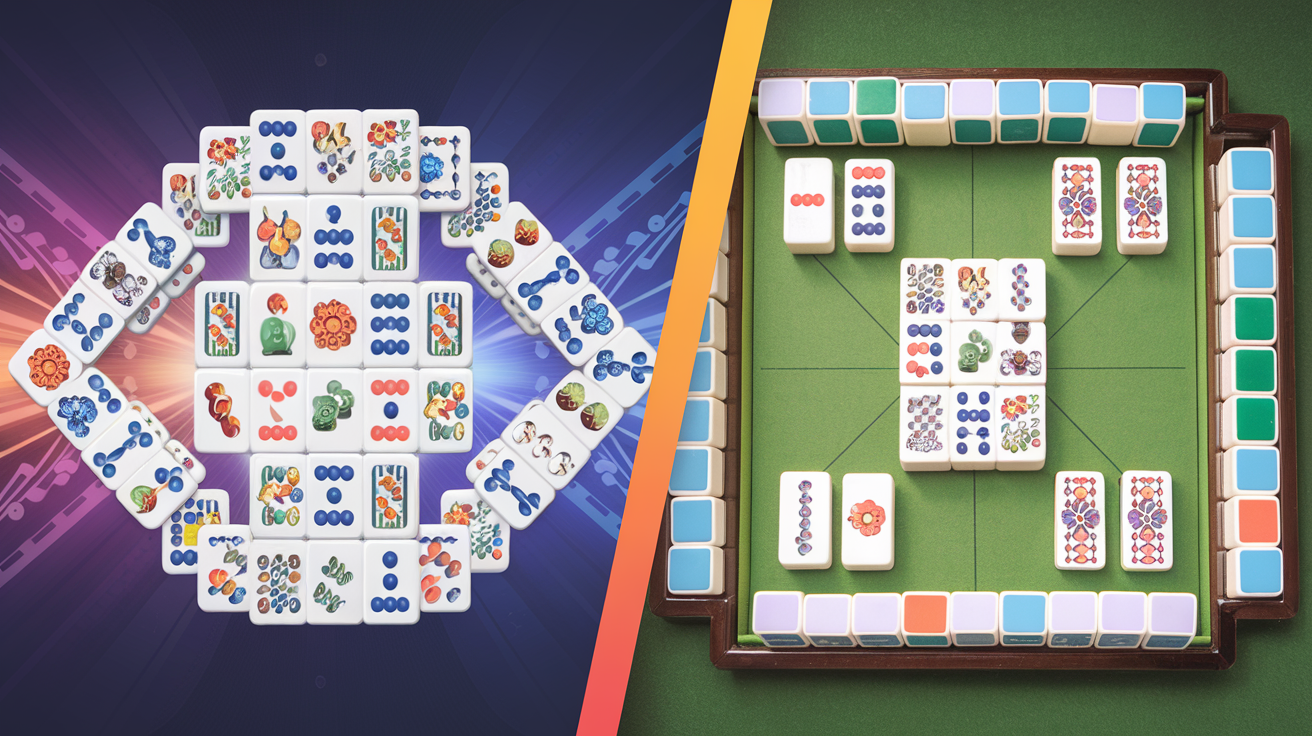
Mahjong Solitaire vs. Traditional Mahjong: Understanding Two Completely Different Games
If you've played mahjong solitaire on themahjong.io, you might assume you're playing a simplified version of traditional Chinese mahjong. That's a reasonable assumption—after all, both games use similar tiles and share a cultural connection to China. However, this assumption would miss a crucial truth: mahjong solitaire and traditional mahjong are entirely different games, born from different creative visions and played under completely different rules.
Understanding this distinction enriches your appreciation for both games. Let's explore their actual histories, their shared elements, and the key differences that make them unique.
The Origin of Mahjong Solitaire: Brodie Lockard's 1981 Innovation
The story of mahjong solitaire begins not in ancient China, but in 1981 California, when software designer Brodie Lockard created a computer game simply called Mah-Jongg. Lockard, working with limited processing power and display capabilities, designed a single-player tile-matching puzzle that used mahjong tiles as its visual elements.
Here's the critical point: Lockard created this game independently, inspired by the aesthetic and cultural appeal of mahjong tiles, not by attempting to recreate traditional mahjong gameplay. The game's mechanics—matching identical tiles on a layout, clearing the board by finding accessible pairs—had nothing to do with traditional mahjong's complex four-player competitive structure.
Lockard's innovation was elegant in its simplicity: the gameplay required no knowledge of traditional mahjong rules, no multiplayer coordination, and could be played casually on a personal computer. It became remarkably popular in early computing circles.
Shanghai: The Windows Era and the Naming Confusion
The real inflection point came when Microsoft bundled a version of Lockard's game with Windows 3.0 in 1991, naming it 'Shanghai'. This distribution was transformative. Millions of people worldwide encountered this tile-matching game for the first time, often without understanding mahjong's actual cultural origins.
When Microsoft eventually released other mahjong solitaire variants (like the "Mahjong" game in Windows 7), the naming became even more conflated. Most casual players—and honestly, most people who've encountered these games—know them as "mahjong," even though the traditional game had been played competitively for over a century before Lockard's creation.
This naming confusion is understandable, not a sign of ignorance. When a game reaches hundreds of millions of people through Windows, that branding sticks. Many players reasonably assumed they were engaging with a digital version of a traditional game, rather than an entirely new creation that borrowed visual elements.
What Do the Games Actually Share?
Despite their fundamental differences, mahjong solitaire and traditional mahjong do share meaningful connections:
Visual Elements: Both use the same tile designs—bamboo, characters, circles, winds, dragons, flowers, and seasons. These tiles carry cultural significance rooted in centuries of Chinese tradition.
Tile Counting: Both games require players to track which tiles they've seen and predict which remain unseen. This cognitive element is genuinely shared.
Pattern Recognition: Both games reward players who can identify and remember visual patterns, though they apply these patterns in entirely different ways.
Cultural Heritage: Mahjong solitaire's use of these tiles connects casual players to a rich cultural tradition, even if they're not playing traditional mahjong. This isn't insignificant—it introduces people to cultural symbols and creates a bridge to the game's history.
The Core Differences: Why They're Fundamentally Different Games
Now, the crucial distinctions:
Player Count: Traditional mahjong is a four-player competitive game (or three-player in some variants). Mahjong solitaire is single-player by design. You're not competing against opponents; you're solving a puzzle.
Strategy Type: Traditional mahjong involves reading opponents, predicting their hands, managing risk, and making split-second decisions about discards. It's deeply interactive and strategic in a social sense. Mahjong solitaire is a spatial puzzle—you're solving a predetermined layout through pattern matching and tile accessibility. The outcome is determined the moment the board is generated; your skill is in finding the solution path.
Winning Conditions: In traditional mahjong, you win by forming the specific hand patterns required by the game's rules, and you can win on another player's discard or your own draw. In mahjong solitaire, you win by successfully matching and removing all tiles from the board. There's no hand to form, no discard pile, no opportunity for others to block your victory.
Scoring Systems: Traditional mahjong has complex scoring systems that reward certain hands and patterns more than others. Points vary based on what hand you form and how you form it. Mahjong solitaire typically offers binary success (you cleared the board or you didn't) or measures success by time or remaining moves.
Luck vs. Skill Balance: Both games contain luck and skill, but in different proportions. Traditional mahjong's outcome depends significantly on which tiles are drawn and discarded by others. Mahjong solitaire's entire puzzle is predetermined—luck comes only from which layout you're given. Skill is purely in solving the layout systematically.
Why This Distinction Matters
Recognizing these differences enriches both gaming experiences:
For Solitaire Players: Understanding that you're playing a spatial puzzle rather than a traditional game helps you appreciate the game for what it is—a relaxing, meditative problem-solving experience.
For Curious Players: If you enjoy mahjong solitaire's strategic elements, you might genuinely enjoy traditional mahjong, which offers competitive depth, social engagement, and a completely different type of challenge. Or you might not—they appeal to different gaming sensibilities.
For Cultural Understanding: Recognizing that mahjong solitaire is a modern digital invention that borrows from traditional mahjong's visual language allows us to appreciate both the ancient game and the creative adaptation separately.
Conclusion
The persistence of naming confusion between mahjong solitaire and traditional mahjong isn't anyone's fault. It's the natural result of how technology, branding, and cultural adaptation work. Microsoft's bundling of Shanghai with Windows 3.0 created a global phenomenon that overshadowed centuries of mahjong tradition.
But now, when you play mahjong solitaire on themahjong.io, you can appreciate it for what it truly is: a clever, engaging tile-matching puzzle that happens to use culturally rich visual elements. It's not a "beginner's version" of traditional mahjong or a dumbed-down adaptation. It's a distinct game with its own history, its own creative merit, and its own devoted player base.
And that distinction—understood clearly—makes both games more enjoyable.
