

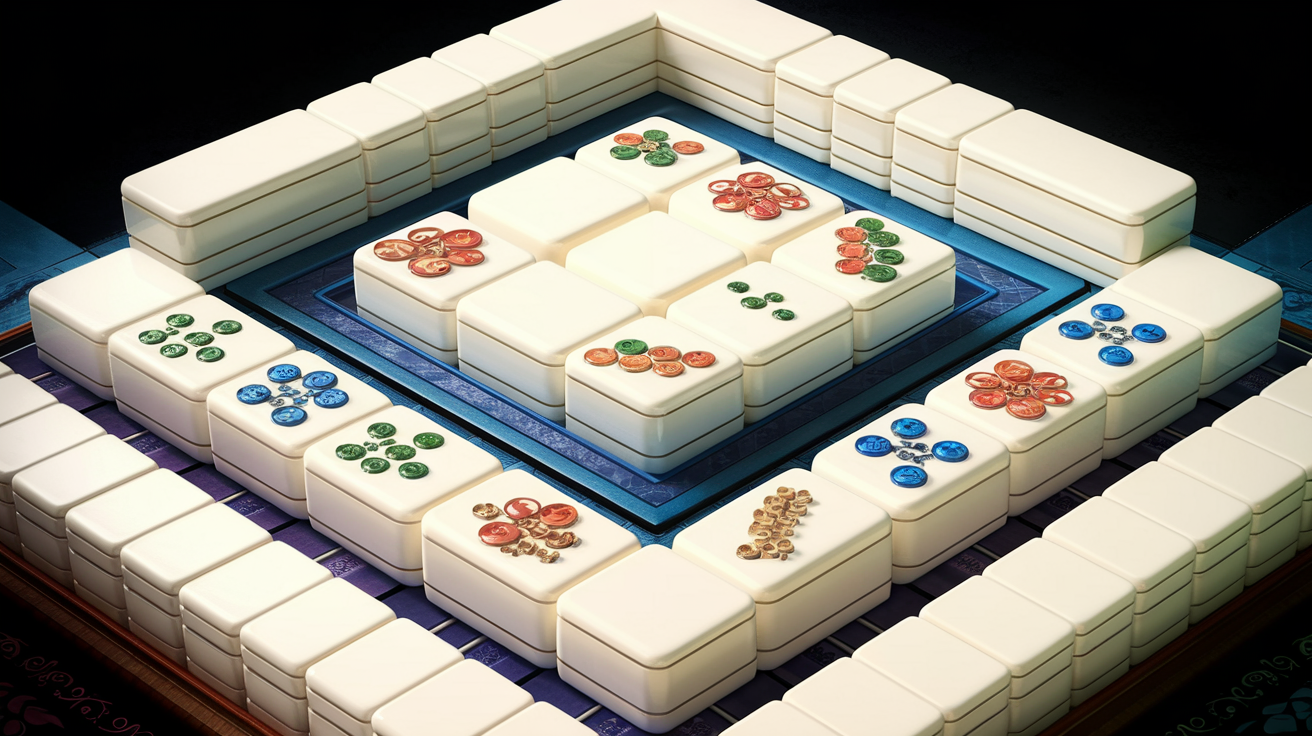
Mahjong Solitaire vs. Traditional Mahjong: Understanding Two Completely Different Games
If you've played mahjong solitaire at themahjong.io, you might assume you're playing a variation of traditional Chinese mahjong. The shared name, the beautiful tiles, the East Asian aesthetic—it all seems to point toward a common ancestry. But here's the truth: mahjong solitaire and traditional mahjong are entirely different games. They happen to use the same tiles, but that's where the similarity ends.
Understanding this distinction isn't just trivia—it helps explain why mahjong solitaire has become so beloved worldwide, and why someone who's mastered solitaire might struggle at a traditional mahjong table. Let's dive into the real history and what actually separates these two games.
The True Origins of Mahjong Solitaire
The story begins in 1981 with Brodie Lockard, a software designer who created a computer game called Mah-Jongg. Lockard, inspired by the aesthetics of traditional mahjong tiles but unconstrained by the need to replicate the original game's complex multiplayer mechanics, invented something entirely new: a tile-matching puzzle.
Lockard's innovation was elegant. He took the standard 144 mahjong tiles, arranged them in a layered pyramid or fortress pattern on screen, and created a simple rule: match and remove pairs of identical tiles. But there was a catch—you could only remove a pair if at least one side of each tile was exposed (not blocked by other tiles). This constraint transformed a simple matching game into a challenging puzzle that required strategic thinking and planning ahead.
The game was intuitive, satisfying, and could run on the limited hardware of 1980s computers. It became wildly popular in arcades and on early home computers.
Shanghai: How Mahjong Solitaire Reached Billions
In 1989, Brodie Lockard's concept was licensed and released as "Shanghai" by Activision for Atari computers. Shanghai became a massive commercial success. When Microsoft bundled a version of Shanghai with Windows 3.1 in the early 1990s, it reached an entirely new audience—essentially every person who owned a personal computer.
For millions of people worldwide, their first encounter with anything called "mahjong" was actually Shanghai solitaire on their Windows machine. The game became iconic, spawned countless digital versions, and established the tile-matching puzzle as the dominant form of "mahjong" in casual gaming.
Here's where the naming confusion took root: the game was branded as "Mahjong," but it was never actually mahjong. Lockard had borrowed the aesthetic and tiles but created an entirely original game mechanic. Over three decades, the misnaming became so entrenched that many people believe tile-matching solitaire is mahjong, or at least a legitimate variant of it.
What They Share: More Aesthetic Than Gameplay
Let's be clear about what connects these two games:
The Tiles: Both use a set of 144 tiles divided into suits (bamboo, characters, dots) and special tiles (winds, dragons, flowers, seasons).
The Aesthetic: Both evoke East Asian culture and tradition, with beautiful hand-drawn or digitally rendered tile designs.
The Name: They share the word "mahjong," though increasingly inaccurately.
Satisfaction: Both can be deeply satisfying to play, each in their own way.
Beyond these surface-level similarities, the games have almost nothing in common.
Where They Diverge: Gameplay, Strategy, and Depth
Traditional Mahjong
Player Count: 4 players (sometimes 3)
Core Mechanic: Draw and discard tiles, form melds (sets of three or four identical tiles, or sequences), race to complete a winning hand before opponents
Strategy Elements:
- Reading opponents' intentions from their discards
- Estimating hand values and probability of winning
- Balancing offense (pursuing your own win) with defense (preventing opponents from winning)
- Memory and observation of discarded tiles
- Timing decisions on when to declare winning conditions
- Managing risk (going for high-value hands vs. safe hands)
Luck Factor: Significant—you depend on the draw, but skilled players navigate this uncertainty better than novices
Game Duration: 15-30 minutes per round; multiple rounds in a session
Social Element: Primarily a social, competitive multiplayer experience
Mahjong Solitaire
Player Count: 1 (single-player puzzle)
Core Mechanic: Survey a pre-arranged set of tiles, identify matching pairs with at least one exposed edge, remove pairs, continue until no moves remain
Strategy Elements:
- Planning ahead to keep tiles accessible
- Recognizing when a move will trap tiles beneath and prevent future matches
- Choosing between multiple valid moves based on long-term consequences
- Visual pattern recognition
- Memory (occasionally, in later moves)
Luck Factor: Minimal to none—the solution (or lack thereof) is determined by the initial tile arrangement. Winning is about skill and logic, not chance
Game Duration: 5-15 minutes per puzzle
Social Element: Individual achievement, though modern versions allow online scoring and leaderboards
The Naming Confusion: How It Happened and Why It Persists
Several factors explain why the misnaming has endured for 40+ years:
Early Commercial Branding: Lockard's game was explicitly marketed as "Mah-Jongg" to leverage the existing cultural intrigue around the authentic game. The name was more marketable than "Tile Matching Puzzle."
Mass Distribution: By the time millions encountered mahjong solitaire bundled with Windows, the name was already established. Few people questioned whether this was "real" mahjong.
Casual vs. Serious Players: Players of traditional mahjong—largely older, often first-generation immigrants to Western countries—continued playing and knew the distinction. But casual solitaire players had no reason to research the game's history.
Geographic Separation: Traditional mahjong remained predominantly played in Asian communities and among enthusiasts. Mahjong solitaire became the default "mahjong" experience in the West.
No Strong Correction Mechanism: Digital solitaire wasn't actively marketed as solitaire; it was marketed as mahjong. There was no competing "official" version to create a obvious distinction.
Why This Matters
Understanding the difference isn't about gatekeeping or suggesting solitaire is inferior—it's about intellectual honesty and clear communication.
If you love mahjong solitaire, that's wonderful. It's a genuinely excellent puzzle game with real strategic depth. You shouldn't feel defensive about it. Brodie Lockard created something remarkable.
But if you decide to learn traditional mahjong, expect a completely different experience. You'll be entering a social, multiplayer, partially luck-based game that requires reading opponents, managing risk, and navigating uncertainty. It's not better or worse—it's fundamentally distinct.
Conversely, if you play traditional mahjong and someone mentions they "play mahjong," they might be talking about solitaire. Neither of you is wrong; you're just speaking about different games.
The Future of Terminology
Some in the gaming community have pushed for clearer terminology: "mahjong solitaire" or "Shanghai-style matching games" for tile matching, and "traditional mahjong" or just "mahjong" for the 4-player game. Games like themahjong.io increasingly use "mahjong solitaire" explicitly to avoid confusion.
This shift toward clarity is positive. It respects both the origins of traditional mahjong and the legitimate place of solitaire in gaming history.
Conclusion
Thank Brodie Lockard for creating one of gaming's most enduring and satisfying puzzles. Thank Microsoft for distributing it worldwide. And acknowledge that these two games—which share tiles, aesthetics, and a name—are really nothing alike in how they're played.
Whether you're drawn to the contemplative, logic-based satisfaction of solitaire or the social, competitive thrill of traditional mahjong, you're engaging with something wonderful. Just know what you're playing—and why.
