

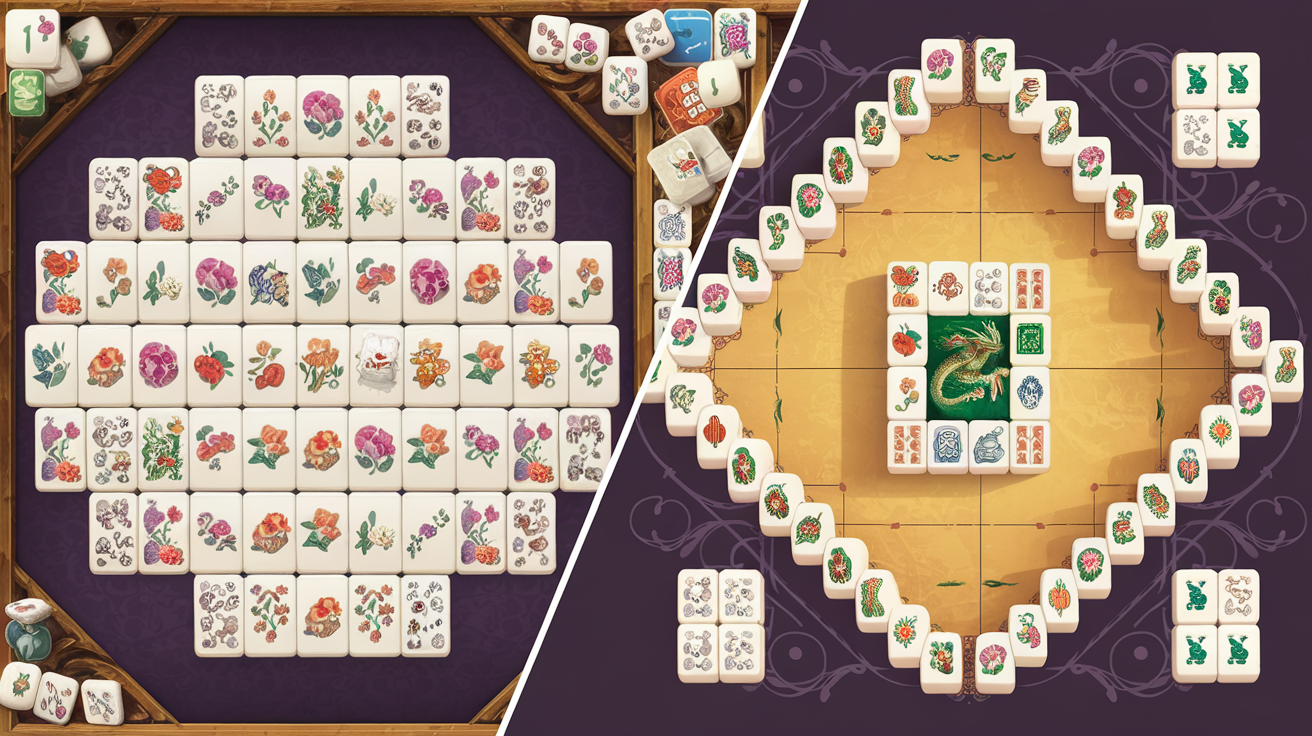
Mahjong Solitaire vs. Traditional Mahjong: Understanding Two Completely Different Games
If you've played mahjong solitaire—the relaxing tile-matching game—and then encountered traditional Chinese mahjong, you might have felt like you'd stumbled into a completely different universe. You'd be right. Despite sharing tiles and the mahjong name, these games have fundamentally different origins, rules, objectives, and skill requirements. This article explains how these two games diverged, why the naming confusion persists, and what genuinely connects them.
The Origins: Two Separate Paths
Traditional Mahjong: Ancient Roots
Traditional mahjong emerged in 19th-century China as a four-player strategy and luck game. It evolved from older card games and was played with bamboo, bone, and ceramic tiles. By the early 20th century, it had become popular across East Asia and eventually worldwide. The game involves complex scoring systems, hand rankings, discard strategy, and player interaction—characteristics that define it as a sophisticated social game requiring memorization, probability assessment, and tactical thinking.
Mahjong Solitaire: Born in 1981
Mahjong solitaire, by contrast, is a relatively recent invention. In 1981, software designer Brodie Lockard created the first computerized tile-matching game called Mah-Jongg for the Apple II computer. Lockard's creation didn't aim to digitize traditional mahjong. Instead, it used mahjong tiles as visual elements in a completely new solitaire puzzle game. The objective was simple: match pairs of identical or complementary tiles until all tiles were removed from the board.
This wasn't a revolutionary concept in gaming—solitaire and patience games had existed for centuries. But applying it to mahjong tiles in a digital format proved charming and addictive. The game's visual appeal, the satisfying click of matching tiles, and the puzzle-solving nature made it an instant hit among computer users.
The Windows "Shanghai" Phenomenon
The real explosion in mahjong solitaire's popularity came in 1988 when Microsoft bundled a version of the game with Windows 3.0 under the name Shanghai. This was a masterstroke of distribution—millions of users suddenly had access to the game right on their computers.
The "Shanghai" version, based on earlier implementations of Lockard's concept, became so ubiquitous that many people assumed this was what mahjong was. The game spread globally, was ported to countless platforms, and spawned countless variations. Yet the naming—continuing to call it "mahjong"—created lasting confusion about what the actual game of mahjong involved.
Today, when most casual players say "mahjong," they mean mahjong solitaire. The original game is now often clarified as "traditional mahjong," "Chinese mahjong," or "multiplayer mahjong" to distinguish it.
What They Share (and Why the Confusion Exists)
Despite their differences, both games do share genuine connections:
The Tiles: Both use the same basic tile set with characters, circles, bamboos, winds, dragons, and flower tiles. This visual continuity is why Lockard chose mahjong tiles for his solitaire game in the first place—they're beautiful and distinctive.
The Name: Both legitimately carry the "mahjong" name, though for different reasons. Traditional mahjong is the original, and solitaire borrowed its aesthetic and nomenclature.
Cultural Significance: Both games represent different aspects of East Asian gaming culture—one rooted in centuries of tradition, the other in modern digital entertainment.
These connections explain why the naming confusion isn't entirely unreasonable, even if it is frustrating to players who know the distinction.
The Fundamental Differences
Game Structure
Traditional Mahjong: Multiplayer game (usually 4 players) played across multiple rounds. Players draw and discard tiles, attempt to form winning hand combinations, and compete directly against opponents.
Mahjong Solitaire: Single-player puzzle game. No opponents, no drawing/discarding mechanics, no scoring system based on hand rankings. Success is binary—you either clear all tiles or you don't.
Strategic Depth
Traditional Mahjong: Requires understanding hand probability, reading opponents' intentions, recognizing discarded tiles as signals, and adapting strategy based on others' plays. Luck plays a role, but skill dramatically affects outcomes.
Mahjong Solitaire: Primarily a puzzle requiring forward planning, pattern recognition, and spatial reasoning. While luck exists (tile arrangement), strategy is about which matches to make in what order to avoid getting stuck.
Decision-Making
Traditional Mahjong: Decisions happen in real-time against opponents, with information uncertainty (unknown tiles in others' hands, unrevealed tiles in the wall). Social dynamics influence play.
Mahjong Solitaire: All information is visible. Decisions are about tile sequencing without time pressure (in most versions) and without opponent interaction.
Skill Expression
Traditional Mahjong: Mastery involves pattern memory, statistical thinking, psychology, and adaptability across thousands of possible hand combinations and scoring systems.
Mahjong Solitaire: Mastery involves board awareness, lookahead planning, and pattern recognition applied to puzzle layouts.
Why This Matters
Understanding the distinction matters for several reasons:
Appreciating Both Games: Each offers unique appeals. Mahjong solitaire provides meditative puzzle-solving; traditional mahjong offers social strategy and competition.
Avoiding Disappointment: Someone expecting traditional mahjong rules from solitaire (or vice versa) will be confused.
Respecting Origins: Traditional mahjong has deep cultural roots. Recognizing this helps preserve its significance while enjoying modern interpretations.
Digital Accessibility: Mahjong solitaire democratized a game concept, making it accessible to billions who might never play traditional mahjong. This is valuable without diminishing the original's importance.
Conclusion
Mahjong solitaire and traditional mahjong are distinct games that happened to share a name and aesthetic. This isn't an error or a dilution of tradition—it's simply how gaming evolved. Brodie Lockard created something genuinely new in 1981, and Microsoft accelerated its popularity four decades ago.
Today, both games thrive in their own spheres. Mahjong solitaire continues to be relaxing entertainment played by millions online and on mobile devices. Traditional mahjong remains a deeply strategic game with millions of dedicated players across Asia and beyond.
The confusion between them is understandable given history, but recognizing their differences allows us to appreciate what makes each uniquely valuable. Whether you enjoy the meditative puzzle-solving of mahjong solitaire or the intricate strategy of traditional mahjong—or both—you're participating in two rich gaming traditions.
