

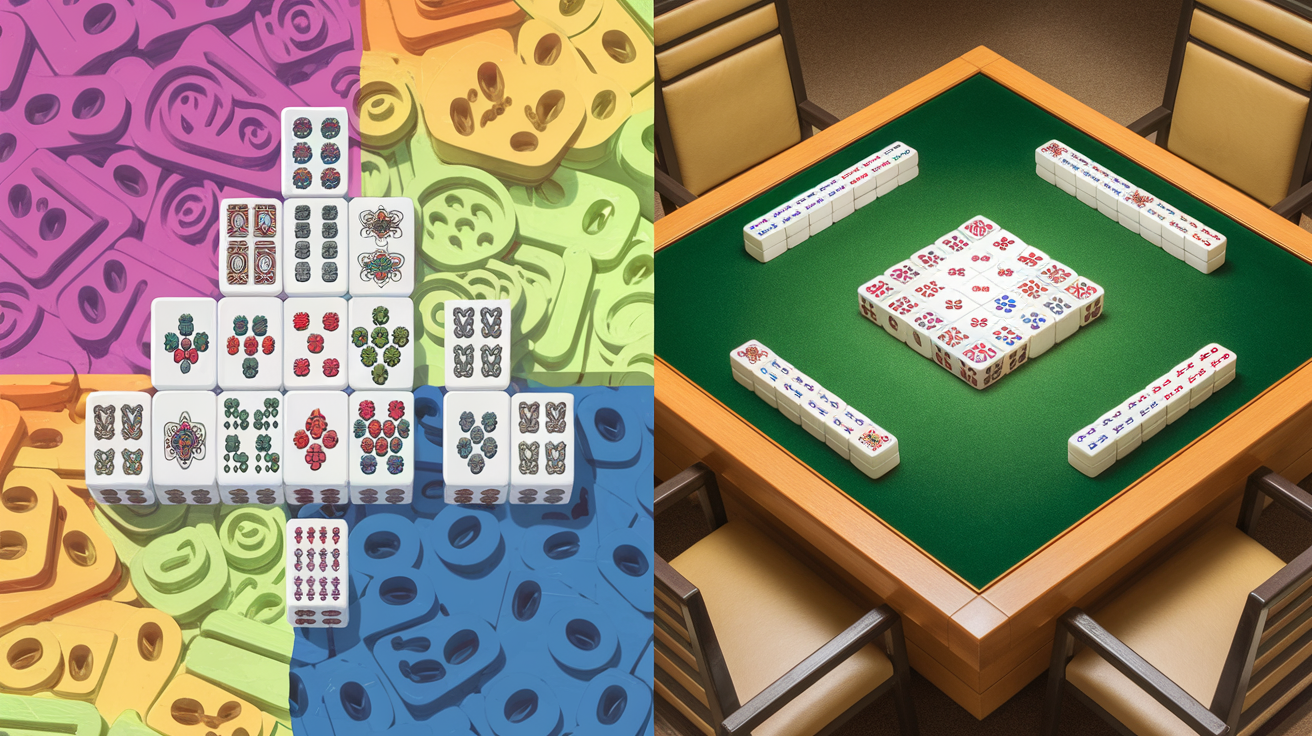
Mahjong Solitaire vs. Traditional Mahjong: Understanding Two Completely Different Games
If you've played mahjong solitaire on themahjong.io or encountered "Shanghai" on your Windows computer, you may have wondered about its relationship to the traditional mahjong game your relatives play around a table. The answer is straightforward: they are fundamentally different games that happen to share tile designs and a cultural heritage. Understanding this distinction enriches both gaming experiences and clarifies decades of naming confusion.
A Brief History of Two Separate Games
Traditional Chinese Mahjong: The Strategy Game
Traditional mahjong emerged in 19th-century China and became a complex 4-player strategy game combining elements of poker, rummy, and dominoes. Played with 136 or 144 tiles (depending on regional rules), it involves drawing, discarding, and reading opponents' intentions. Games can last hours, require significant skill development, and have countless regional variations—from Shanghai rules to Cantonese play styles. The game spread throughout Asia and eventually worldwide, generating professional tournaments and genuine strategic depth.
What makes traditional mahjong strategic:
- Player interaction: Reading discards, blocking opponents, timing declarations
- Risk assessment: Deciding when to draw versus declare victory
- Memory and observation: Tracking which tiles have been played
- Rule complexity: Intricate scoring systems and winning hand combinations
Mahjong Solitaire: The Digital Tile-Matching Game
In 1981, software developer Brodie Lockard created a computer game called "Mah-Jongg" for the Apple II. Lockard's innovation was elegant: instead of recreating the competitive 4-player game on a single computer, he designed a solitaire puzzle using mahjong tiles. The game displayed matched tile pairs that could be removed from the board, rewarding players for clearing all tiles before reaching an unwinnable state.
Lockard borrowed mahjong's visual tile set—a brilliant design choice that tied his game to an existing cultural icon—but created entirely new mechanics suited to solo computer play. This was not an adaptation of traditional mahjong; it was a new game wearing mahjong's aesthetically appealing costume.
The "Shanghai" Era and Mass Confusion
The pivotal moment that entrenched confusion came in the early 1990s. Microsoft included a digitalized version of mahjong solitaire in Windows 3.0 as a sample game to demonstrate multimedia capabilities. They titled it "Shanghai," after the regional style of traditional mahjong. This choice, while culturally resonant, unfortunately cemented the naming problem.
Why this matters: Millions of people encountered Shanghai through Windows and assumed they were playing "mahjong." When they later encountered actual traditional mahjong or learned its rules, confusion naturally followed. The casual, solitaire nature of the digital game—perfect for passing time at a computer—was fundamentally at odds with traditional mahjong's social, strategic complexity.
The game's inclusion in Windows was not a limitation of technology. Rather, it reflected an intentional design choice: tile-matching solitaire is inherently enjoyable as a puzzle, independent of traditional mahjong's rules.
What These Games Share
Despite their differences, genuine connections exist:
Tile Design: Both use the same tile imagery—numbers (dots, bamboos, characters), winds, dragons, and flowers. Seeing these tiles carries cultural and aesthetic weight in both contexts.
Pattern Recognition: Both games reward visual pattern recognition, though applied differently. Traditional players remember tile distributions; solitaire players spot matching pairs.
Cultural Heritage: Both games draw from Chinese tradition and maintain elements of that heritage, even when played digitally or in solitaire format.
Accessibility: Both have gentle learning curves and reward persistence, though traditional mahjong's depths are considerably greater.
Where Strategy Fundamentally Diverges
The strategic separation becomes clear when examining actual gameplay:
Traditional Mahjong:
- Success depends on reading opponents and adapting mid-game
- Luck (tile distribution) matters, but skill in play determines outcomes
- Games involve psychological elements and negotiation
- Strategic depth increases dramatically with experience
- Losing is often educational—you can observe mistakes
Mahjong Solitaire:
- Success depends on forward planning and tile arrangement awareness
- Luck is substantially embedded in the starting board layout
- No opponents means no psychological warfare or adaptation to player behavior
- Strategic depth plateaus once you understand matching mechanics
- Losing often results from initial bad luck rather than player error
The solitaire version is more akin to Solitaire card games or Tetris—puzzle challenges solved by recognizing patterns—rather than a game played against opponents.
Why the Confusion Persists
Several factors keep these games conflated:
- Naming Legacy: "Shanghai" and "Mah-Jongg" created brand associations that newer players inherit
- Tile Familiarity: Identical tile sets make the games appear identical to casual observers
- Digital Prevalence: Solitaire versions are far more common online and on devices than traditional mahjong tutorials
- Cultural Attribution: Both games claim mahjong heritage, even if only one directly descends from it
Conclusion: Respecting Both Games
Understanding this distinction doesn't diminish either game. Mahjong solitaire is genuinely enjoyable—satisfying, accessible, and excellent for brief gaming sessions. Its inheritance of tile design and partial nomenclature is not deceptive; it's a legitimate design choice.
Traditional mahjong, meanwhile, remains a sophisticated strategy game worthy of serious study and social play. Players who invest in learning it discover a depth that solitaire, by design, cannot offer.
Both games have earned their places: mahjong solitaire as accessible digital entertainment, and traditional mahjong as a complex social game with competitive tournaments worldwide. Recognizing them as distinct doesn't diminish enjoyment of either—it simply clarifies what each offers and why millions enjoy playing them.
The next time someone mentions playing "mahjong," a simple question clarifies which experience they mean: "Are you playing solitaire on your phone, or around a table with others?" The answer reveals not confusion, but two separate traditions that share tiles and heritage while remaining wonderfully, deliberately different.
