

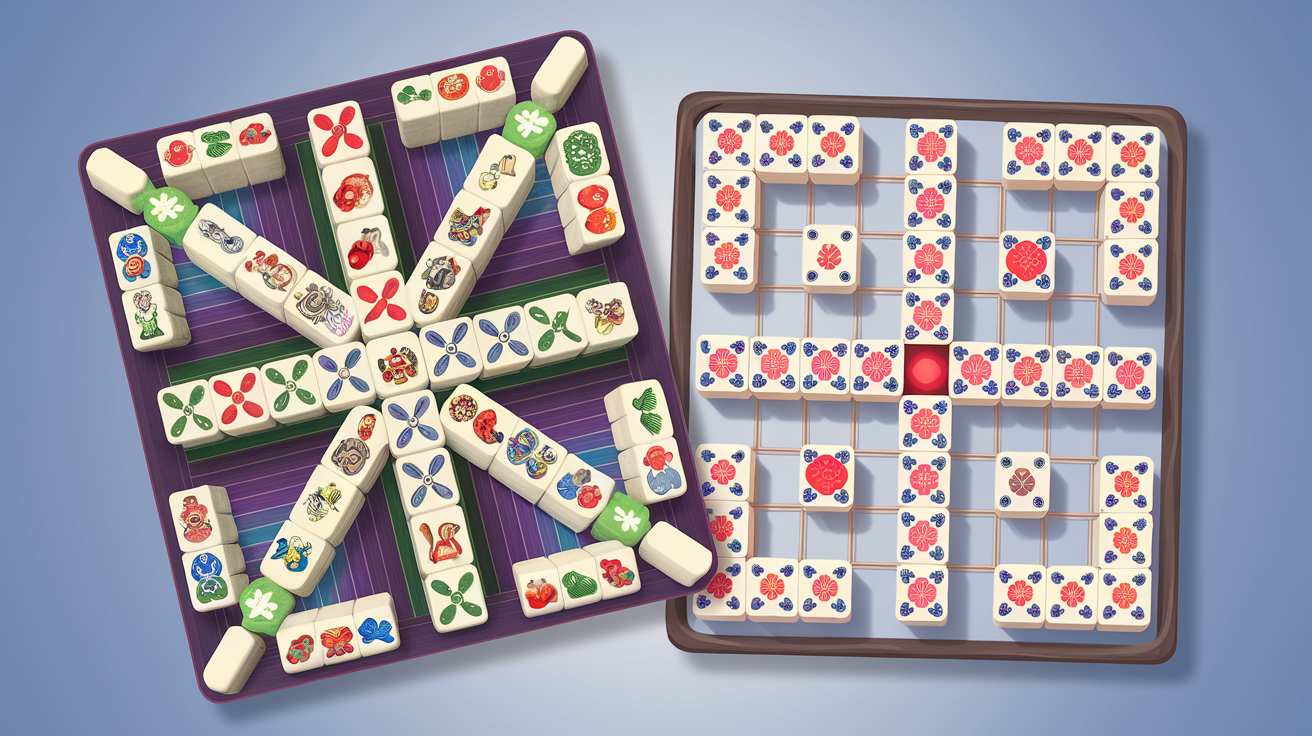
Mahjong Solitaire vs. Traditional Mahjong: Understanding Two Different Games
If you've played mahjong solitaire on themahjong.io—matching pairs of identical tiles until the board clears—you might assume you're playing the same game as traditional mahjong, the classic 4-player card game enjoyed in Asia for centuries. In reality, these are two entirely different games that happen to share tiles and a name. Understanding their distinct origins and mechanics offers fascinating insight into how games evolve and spread across cultures.
What They Share: Tiles and Aesthetics
Both games use the same distinctive tile designs: bamboo suits, circles (dots), characters, honor tiles depicting winds and dragons, and seasonal or flower tiles. This visual connection is real and intentional—mahjong solitaire's creators deliberately borrowed these recognizable, beautiful tiles to create their puzzle game. The aesthetic familiarity is genuine; what differs is everything else.
The Origins: Traditional Mahjong
Traditional mahjong emerged in 19th-century China, likely evolving from earlier card games. It's a 4-player game combining luck and skill, where players draw and discard tiles to build melds (combinations) while blocking opponents' progress. Play involves memory, probability assessment, reading other players' intentions, and strategic discarding. A hand of winning mahjong requires both fortunate draws and intelligent play. The game spread throughout Asia and among Chinese diaspora communities worldwide, where it remains deeply embedded in social and cultural life.
Traditional mahjong has created rich gaming traditions with regional variations, tournaments, and serious competitive communities. The complexity lies in its social and strategic layers: managing your hand, predicting what others need, and deciding what to discard while protecting your own winning possibilities.
The Modern Invention: Mahjong Solitaire (1981)
In 1981, Brodie Lockard, an American software programmer, created a computer game called "Mah-Jongg" for the Apple II computer. Lockard invented the tile-matching solitaire concept entirely—it has no predecessor in traditional mahjong culture. The game presents a board filled with stacked mahjong tiles, and the player's objective is straightforward: match pairs of identical, adjacent tiles to remove them until the entire board is clear.
Lockard's innovation was elegant and computer-appropriate: a single-player puzzle that didn't require opponents, used familiar tile imagery, and offered the satisfying logic of pattern-matching. The game was challenging without requiring knowledge of traditional mahjong rules or strategy.
Shanghai and Mass Popularity
The real turning point came in the 1980s when this tile-matching game was marketed commercially under the name "Shanghai." It found enormous popularity in arcades and early computers. Later, Microsoft bundled a version called "Mahjong" (sometimes "Shanghai") with Windows, making it available to hundreds of millions of PC users worldwide. This bundling was crucial: it meant mahjong solitaire became the first exposure many Western players had to mahjong aesthetics.
The Windows inclusion cemented the naming confusion. For decades, millions of people played "mahjong" on their computers without realizing they were playing something fundamentally different from traditional mahjong. When they encountered the actual 4-player game, the disconnect became apparent—but by then, "mahjong solitaire" had become the default association with the game's name in Western culture.
Core Differences in Gameplay
Traditional Mahjong:
- 4 players, competitive
- Players draw and discard strategically
- Requires reading opponents' intentions
- Combines luck (tile draws) with strategy (discarding decisions)
- Victory depends on both favorable draws and skill
- Takes 30-60 minutes per game
- Rules vary significantly by region
Mahjong Solitaire:
- Single player, puzzle-focused
- All tiles visible on the board from the start
- No opponent interaction
- Purely logic-based (no luck in tile availability)
- Victory depends entirely on pattern recognition and spatial awareness
- Takes 5-15 minutes per game
- Rules are standardized
What the Games Share (Beyond Tiles)
Despite these differences, both games reward:
- Pattern recognition – identifying relationships between elements
- Strategic thinking – planning moves several steps ahead
- Concentration – sustained attention and memory
- Spatial reasoning – understanding how elements relate in space
In traditional mahjong, you recognize which tiles complete your hand and anticipate what others might hold. In mahjong solitaire, you identify which tile pairs can be matched and plan the sequence to clear the board. The cognitive skills overlap, even though the games' structures are completely different.
Why the Confusion Persists
Several factors perpetuate the naming conflation:
- Branding decisions – calling solitaire versions "mahjong" leveraged the established tile imagery
- Windows distribution – Microsoft's bundled version made solitaire the common introduction
- Shared aesthetics – the beautiful, distinctive tiles made clear visual marketing
- Cultural lag – the confusion became embedded before widespread internet access could clarify
- Reasonable shortcuts – calling both games "mahjong" made practical sense even if technically imprecise
A Respectful Perspective
There's nothing wrong with enjoying mahjong solitaire without knowing these distinctions. The game is genuinely entertaining and cognitively stimulating. Similarly, many people who love solitaire have no interest in traditional mahjong's social and strategic complexity. Both are legitimate gaming experiences.
Understanding the difference simply enriches the picture. It explains why someone who excels at solitaire might find traditional mahjong surprisingly complex, and vice versa. It honors the actual history of both games and the creativity of everyone involved—from traditional mahjong's unknown Chinese creators to Brodie Lockard's programming innovation.
Conclusion
Mahjong solitaire and traditional mahjong are wonderfully different games that happen to share tiles and a name. One is a Western computer-era puzzle invention; the other is a centuries-old cultural institution. Both have merit, both exercise the mind, and both deserve to be understood on their own terms. Whether you're playing tile-matching on themahjong.io or sitting at a table with three other players, you're participating in distinct gaming traditions—each with its own logic, history, and appeal.
