

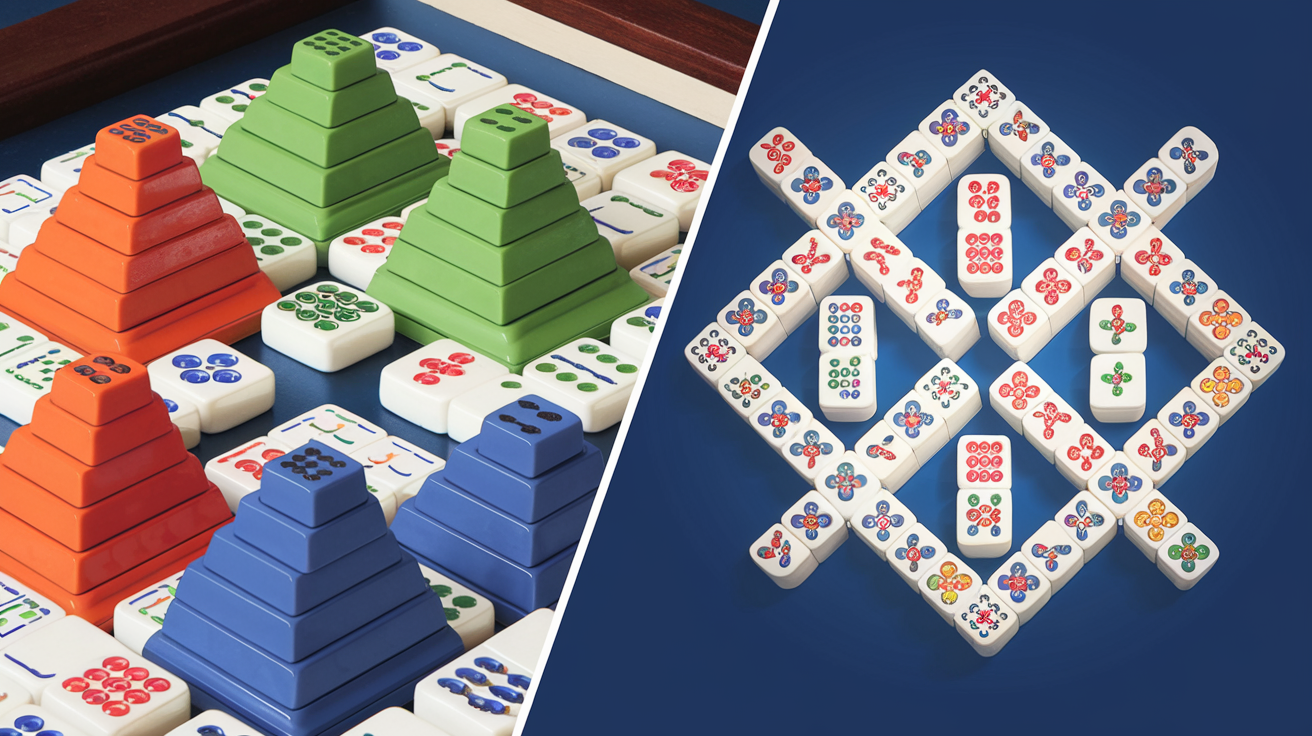
Mahjong Solitaire vs. Traditional Mahjong: Understanding Two Completely Different Games
If you've ever played mahjong solitaire online or on your computer, you might assume it's a digital version of the classic four-player Chinese game your grandmother played. In reality, mahjong solitaire and traditional Chinese mahjong are entirely different games—despite sharing tiles and a name. Understanding this distinction helps clarify both why the confusion exists and why each game has developed such dedicated followings.
The Origins: Two Separate Creations
Traditional Chinese Mahjong: A Game of Strategy and Skill
Traditional mahjong emerged in 19th-century China, likely during the Qing Dynasty, evolving from earlier card games. It's a four-player game combining luck, strategy, memory, and skill. Players draw and discard tiles, building specific winning patterns called "melds." The game requires understanding hand positioning, reading opponents' intentions, managing risk, and executing complex strategies across dozens of rounds.
Traditional mahjong spread throughout Asia and eventually worldwide, developing regional variations with different rules, scoring systems, and tile sets. It remains a serious game of genuine strategic depth.
Mahjong Solitaire: A 1981 Computer Innovation
Mahjong solitaire has an entirely separate origin story. In 1981, computer programmer Brodie Lockard created a digital tile-matching game called Mah-Jongg for the Apple II computer. Lockard used mahjong tiles as his game pieces but invented a completely new game mechanic: players would match pairs of identical tiles from a pyramid-shaped layout, removing them until the board was cleared.
This was not an adaptation of traditional mahjong—it was a new game wearing familiar clothing. Lockard leveraged the aesthetic appeal and cultural recognition of mahjong tiles but created something entirely novel. His innovation was genuinely inspired; matching games have ancient roots, but applying this mechanic to mahjong tiles was creative and commercially successful.
The Windows Bundle Effect
The naming confusion deepened significantly when Microsoft bundled a mahjong solitaire variant with Windows 3.0 in the early 1990s, naming it "Shanghai." This version, developed by Activision, became ubiquitous. Millions of people encountered mahjong solitaire before they ever heard of traditional mahjong, and many assumed they were the same game.
Shanghai's distribution was phenomenal—it reached households that never played games beyond basic computer utilities. For many people, "mahjong" became synonymous with matching tiles on a computer screen, not a strategic four-player card game.
The Shanghai branding actually helped traditional mahjong solitaire develop its own identity—at least initially. But in common speech, people often still call tile-matching games "mahjong," even though that's only loosely accurate.
Why the Confusion Persists
Several factors keep this terminology muddle alive:
1. Shared Visual Identity Mahjong solitaire uses the same decorative tiles as traditional mahjong—dragons, bamboo, circles, seasons, winds, and honors. This visual connection makes the naming feel intuitive, even though the games play nothing alike.
2. Limited Exposure to Traditional Mahjong in Some Regions In parts of North America and Europe, traditional mahjong is less widely played than in Asia. Many people's only exposure is through the solitaire version, making "mahjong" and "solitaire tile-matching" feel synonymous.
3. Historical Naming Decisions Brodie Lockard's original choice to name his game after mahjong tiles, while understandable for recognition purposes, created ambiguity that persists. Sites like themahjong.io must actively clarify this distinction because the original naming decision echoes forward.
4. Casual Gaming Culture Mahjong solitaire is a casual, relaxing game anyone can pick up in minutes. Traditional mahjong has a steeper learning curve. Most casual online players will only ever encounter solitaire, so they might never learn that traditional mahjong exists as a separate entity.
What They Actually Share
To be fair, the games aren't completely unrelated:
- Tile Design: Both use the same classic tile imagery (though solitaire usually uses simplified versions)
- Cultural Connection: Both reference or derive from Chinese gaming culture
- Pattern Recognition: Both require players to recognize and match tiles effectively
- Turn-Based Gameplay: Both proceed through discrete, ordered actions
- Memory Elements: Both benefit from players remembering tile positions or having been played
These shared elements explain why Brodie Lockard's naming choice made sense. But these surface similarities mask profound differences in actual gameplay.
Where They Diverge: Strategy, Players, and Goals
Solitaire Mahjong
- Single Player: You compete only against the board's layout
- Fixed Board: The tiles never change position; you must work with what's given
- Pair Matching: Win by eliminating all tiles in matching pairs
- Accessibility-Focused: Playable by anyone in minutes
- Luck-Heavy: Success depends largely on board generation; skilled play matters but can't overcome poor layouts
- Relaxation: Designed as a low-stress, meditative experience
Traditional Mahjong
- Multiplayer: Four players compete directly against each other
- Dynamic Play: You constantly draw new tiles and must decide what to discard, creating evolving strategic situations
- Hand Building: Win by completing specific meld patterns (like rummy but with tiles and more complexity)
- Strategy-Focused: Success requires deep understanding of odds, opponents' intentions, and hand management
- Skill-Heavy: Experienced players consistently beat novices; luck matters but doesn't determine everything
- Competitive: Played seriously for stakes, pride, or both
The Respectful Path Forward
Neither game is "better" or "realer" than the other. Traditional mahjong remains a profound strategic game with centuries of cultural importance. Mahjong solitaire is a legitimate, engaging game that has entertained billions of people and brought tile-matching gameplay to new audiences.
The key is simply clarity. When discussing traditional mahjong, it's helpful to call it by its proper name or specify "four-player mahjong." When playing solitaire, acknowledging that you're enjoying a game inspired by mahjong tiles rather than a digital version of traditional mahjong is more accurate.
Understanding that Brodie Lockard created something new in 1981—rather than adapted something old—helps explain why these games feel so different. He used mahjong's visual language to create an entirely new form of play. That innovation deserves recognition, even as we acknowledge traditional mahjong's deeper strategic heritage.
Both games have earned their audiences and their place in gaming history. They just happen to share a name and tiles but not much else.
