

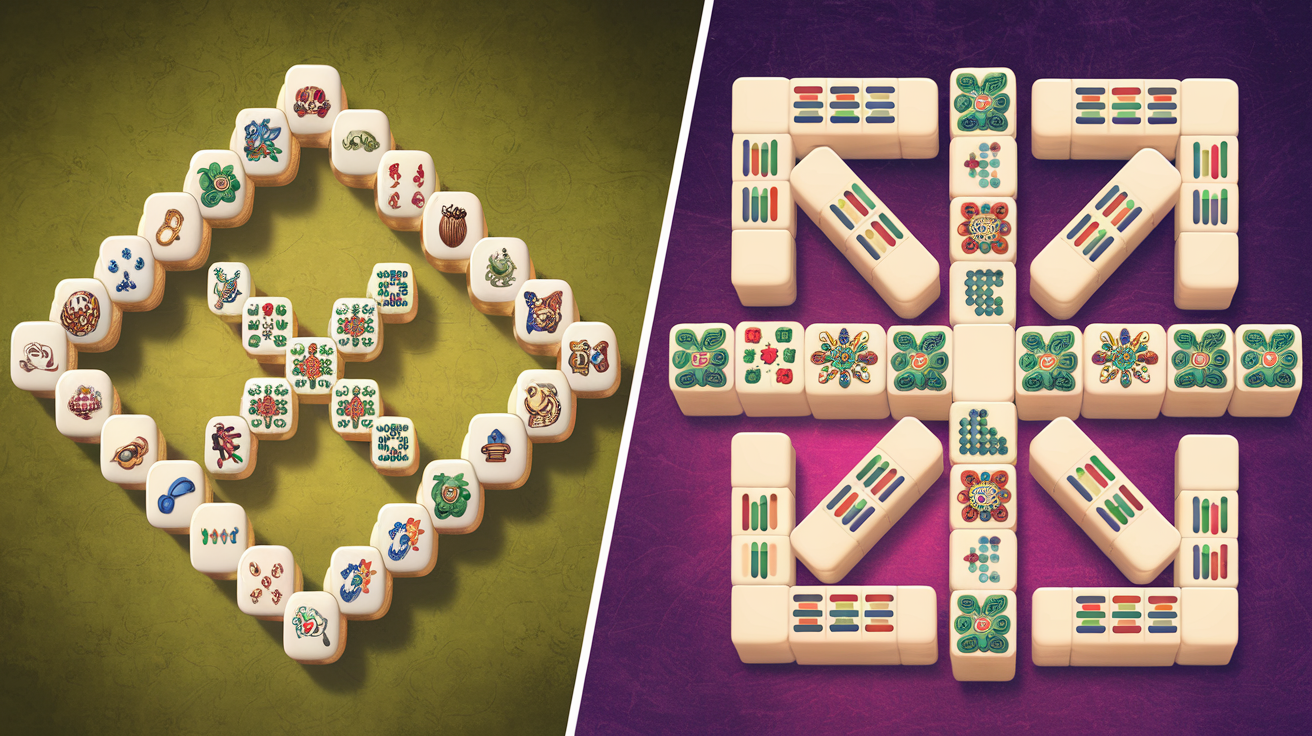
Mahjong Solitaire vs. Traditional Mahjong: Understanding Two Completely Different Games
If you've played mahjong solitaire on themahjong.io or encountered the classic Windows game "Shanghai," you've likely experienced something quite different from what traditional mahjong players know. Yet both games share the name "mahjong," which creates understandable confusion. This article explains the genuine historical and mechanical differences between these two games, and why the naming conflation occurred.
The Origins: Where These Games Actually Come From
Traditional Chinese Mahjong originated in China during the 19th century, evolving from card games like dominoes and playing cards. It's a strategic, four-player game involving skill, probability, and social interaction. By the early 20th century, it had become deeply embedded in Chinese culture and spread internationally.
Mahjong Solitaire, by contrast, is a modern digital invention. In 1981, a programmer named Brodie Lockard created a software game called "Mah-Jongg" for the Apple II computer. This was a tile-matching puzzle game with no connection to traditional mahjong gameplay—Lockard simply used mahjong tiles as visual elements because they were distinctive and graphically interesting for early computing.
Lockard's game was not trying to replicate traditional mahjong. Instead, it borrowed the aesthetic (the beautiful, patterned tiles) and applied a completely different game mechanic: matching pairs of adjacent tiles on a two-dimensional pyramid layout until no moves remained.
How "Shanghai" Became Ubiquitous
The real turning point came in 1986 when Microsoft licensed and modified Brodie Lockard's game, renaming it "Shanghai" and bundling it with Windows. This was a masterstroke for casual gaming adoption. Suddenly, millions of computer users had access to this tile-matching puzzle, and it became synonymous with PC gaming for decades.
The name "Shanghai" helped obscure the connection to traditional mahjong, yet the confusion persisted because:
- The tiles look identical to traditional mahjong tiles
- The game still used the word "mahjong" in marketing and descriptions
- Most Western players had no reference point for what traditional mahjong actually was
When online gaming exploded in the 2000s, tile-matching solitaire variants proliferated under various names—"Mahjong," "Mahjong Solitaire," "Mahjong Connect," and "Mahjong 3D." By then, the naming confusion was thoroughly embedded in casual gaming culture.
What These Games Actually Share
Before diving into differences, let's acknowledge genuine similarities:
- The tiles: Both games use the same traditional tile set—bamboos, characters, honors, flowers, seasons, and dragons
- The aesthetic: The visual language and satisfaction of manipulating beautiful tiles
- Cultural connection: Both games carry a thread of Chinese cultural heritage, even if applied very differently
- Puzzle appeal: Both require pattern recognition, though in different contexts
Where They Diverge Fundamentally
Game Structure
Traditional Mahjong:
- Four active players simultaneously
- Turn-based draw-and-discard gameplay
- Goal: Be first to form a winning hand of 14 tiles in specific combinations (melds)
- Game concludes when someone "goes out" (wins) or when all playable tiles are exhausted
Mahjong Solitaire:
- One player, no opponents
- No turns—you control the pace entirely
- Goal: Match and remove all tiles by finding adjacent pairs
- Game concludes when either all tiles are cleared (win) or no more pairs exist (loss)
Strategy Type
Traditional Mahjong involves:
- Probability calculations (what tiles might others hold)
- Bluffing and reading opponents' intentions
- Hand management and discard strategy
- Risk assessment (when to pursue vs. when to defend)
- Social and psychological elements
Mahjong Solitaire involves:
- Spatial reasoning and pattern recognition
- Planning ahead to avoid dead-ends
- Puzzle-solving logic
- No opponent interaction or luck beyond initial tile layout
Skill Factors
Traditional mahjong masters spend years developing:
- Memory for discarded tiles
- Statistical intuition about remaining hands
- Timing and game-reading skills
- Understanding of regional rule variations
Mahjong solitaire experts develop:
- Lookahead planning (seeing three to five moves ahead)
- Spatial visualization
- Tile-layer navigation awareness
- Puzzle optimization
Why the Confusion Persists
The naming conflation isn't accidental or malicious—it's simply how games evolve in the digital age. "Shanghai" and its variants introduced millions to a genuinely fun, accessible game using culturally resonant tile imagery. Many players never encountered traditional mahjong and have no reason to seek it out; they're satisfied with the solitaire variant.
Conversely, traditional mahjong players sometimes view solitaire variants as appropriative or "not real mahjong," which is understandable from a cultural preservation perspective. Both reactions are valid.
The Modern Landscape
Today, both games thrive in parallel:
- Traditional mahjong is played competitively worldwide, with tournament scenes in Asia, North America, and Europe
- Mahjong solitaire remains one of the most popular casual puzzle games online, with endless variations
Themahjong.io and similar sites continue this tradition of solitaire variants, offering free, accessible puzzle entertainment to millions.
Conclusion
Understanding that mahjong solitaire and traditional mahjong are different games doesn't diminish either. They're both sophisticated in their own ways. Solitaire's appeal lies in clean puzzle logic and accessibility; traditional mahjong's appeal lies in strategic depth and social play.
The next time you encounter someone who thinks one game is an inferior version of the other, you now have the historical context to explain: they're not variations on the same game—they're two distinct games that happen to share a name and some visual elements. One emerged from 19th-century Chinese culture; the other from 1980s computer programming. Both are worthy of appreciation.
If you enjoy mahjong solitaire, embrace it for what it is: a brilliant puzzle game with elegant mechanics. And if you're curious about traditional mahjong's strategic complexity, there's a whole world to explore there too. Understanding the difference is simply good gaming literacy.
