

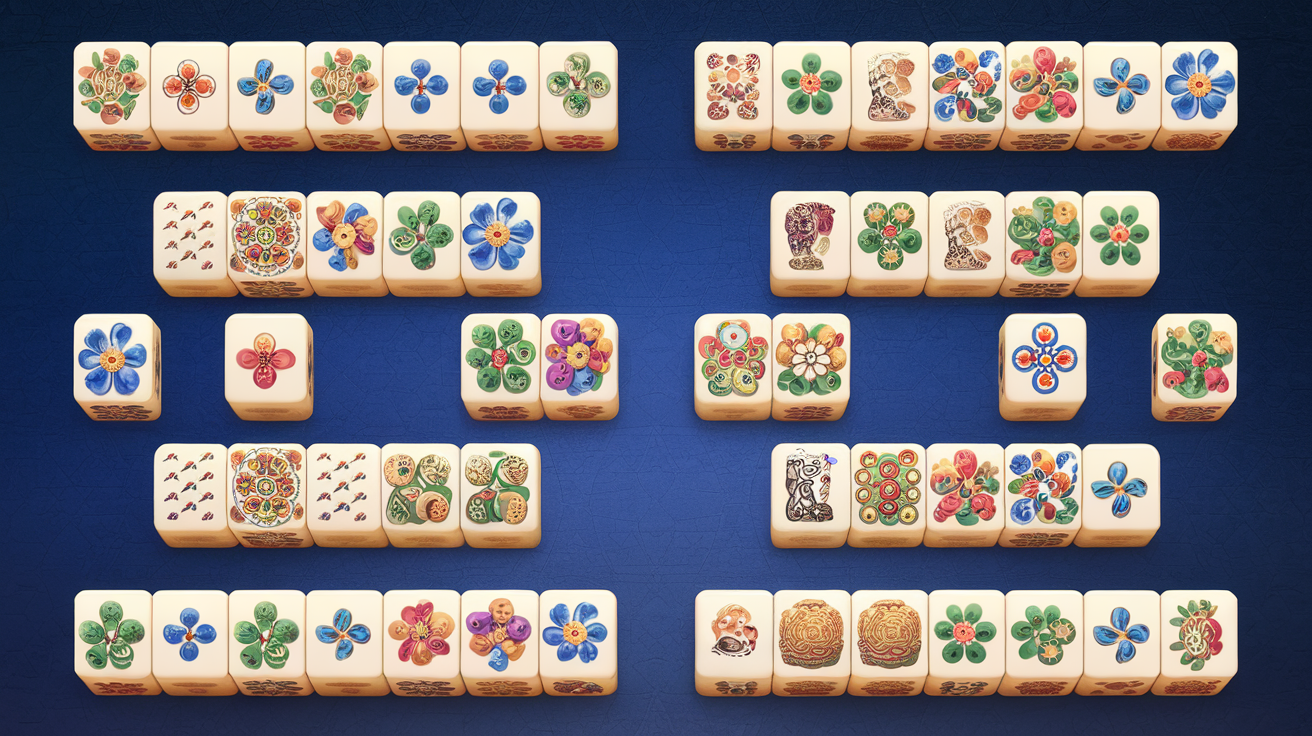
Mahjong Solitaire vs. Traditional Mahjong: Understanding Two Completely Different Games
If you've played mahjong solitaire online or on your computer, you might assume you're playing a simplified version of the traditional Chinese game. The truth is more interesting: mahjong solitaire is a completely separate game that borrowed mahjong's tiles but created entirely new rules and objectives. Understanding this distinction helps us appreciate both games on their own terms.
What They Share: The Tiles
Both games use the beautiful and symbolic mahjong tile set, typically consisting of:
- Suited tiles: Characters (万), Bamboos (筒), and Dots (索)
- Honor tiles: Winds (East, South, West, North) and Dragons (Red, White, Green)
- Special tiles: Flowers and Seasons (in traditional play)
These tiles carry centuries of Chinese culture and symbolism. When you match tiles in solitaire, you're working with pieces that connect to genuine historical tradition—that shared heritage is real and meaningful.
The Origin Story: How Solitaire Was Born
Here's where the paths diverge dramatically. In 1981, computer programmer Brodie Lockard created the first digital mahjong tile-matching game for the Apple II computer. Lockard's innovation was elegant and practical: he took mahjong tiles and created a single-player puzzle game where the goal was to match pairs and clear the board.
Lockard's creation didn't aim to replicate traditional mahjong. Instead, it solved a real problem—traditional mahjong requires four players, strategy knowledge, and significant time commitment. His solitaire version offered something new: a relaxing, accessible puzzle game anyone could play alone.
The name choice—"Mah-Jongg"—was natural and straightforward. Lockard used the tiles that existed; calling it mahjong acknowledged that heritage without claiming to be traditional play.
Shanghai and Windows: The Mass Market Moment
The game remained relatively niche through the 1980s. Then came a pivotal moment: Microsoft included a solitaire variant called "Shanghai" in Windows 3.1 (released in 1991) and subsequent Windows versions.
This bundling with the world's dominant operating system transformed everything. Hundreds of millions of people encountered tile-matching solitaire, often as their first—and sometimes only—experience with mahjong-themed games. For many, "mahjong" became synonymous with this solitaire puzzle.
The naming confusion intensified:
- Players called it "mahjong" because it used mahjong tiles
- Developers called it "mahjong solitaire" to clarify it was single-player
- The names "Mah-Jongg," "Shanghai," and "mahjong solitaire" became used interchangeably
- Meanwhile, traditional mahjong remained less visible in Western markets
Traditional Mahjong: A Different Beast Entirely
Traditional Chinese mahjong is a four-player strategy game with these core characteristics:
Multiplayer competition: You play against three opponents, not against the board. Timing, psychology, and reading opponents matter enormously.
Drawing and discarding: Players draw tiles and discard unwanted ones in a continuous cycle. The game involves remembering what others have played and predicting their hands.
Forming melds: Rather than matching pairs, players form specific combinations—sequences (like 3-4-5 bamboo) and sets (three or four identical tiles). These combinations score differently based on complexity and rarity.
Winning conditions: You win by forming a complete hand of melds plus a pair, meeting specific pattern requirements (which vary by regional rule set).
Skill components: Traditional mahjong demands memory, probability calculation, hand management, and psychological insight. A single game can last 1-3 hours.
Mahjong Solitaire: A Puzzle Game
In contrast, mahjong solitaire operates on completely different principles:
Single-player puzzle: You're solving a problem, not competing. There's no opponent strategy to consider.
Simple matching rule: Find pairs of identical tiles. That's it. If two tiles match, you can remove them—no complex meld requirements.
Layout matters: Rather than drawing from a mixed deck, the puzzle presents a pre-arranged tile layout (often in decorative shapes). Success depends on tile placement and order of removal, not on hand-building strategy.
Accessibility: Games take 5-15 minutes. New players need seconds to understand the rules.
Puzzle characteristics: Like Sudoku or jigsaw puzzles, solitaire is about recognizing available moves and planning removal sequences.
The Genuine Strategic Elements
That said, both games do involve real strategy—just different kinds:
Traditional mahjong strategy includes:
- Calculating probabilities of useful tiles appearing
- Reading discards to infer opponents' hands
- Deciding which tiles to protect vs. risk
- Timing when to declare winning hands
- Managing tile groups as they develop
Mahjong solitaire strategy includes:
- Planning removal sequences to unlock tiles
- Recognizing which pairs to match first
- Understanding how current choices affect future options
- Discovering optimal paths through the puzzle
- Mastering different board layouts and their logic patterns
Both require thinking ahead—but they're solving different problems.
Why the Confusion Persists (And Why It's Okay)
The naming overlap persists because:
- Historical inertia: Lockard chose a logical name that stuck
- Marketing simplicity: "Mahjong" is a recognized brand
- Tile heritage: Using authentic mahjong tiles creates a genuine cultural connection
- Regional differences: Traditional mahjong itself has many regional variants, making precise terminology complex
This confusion isn't malicious or ignorant—it's natural linguistic evolution. When new games adopt existing tiles and cultural elements, some naming ambiguity is inevitable.
Why It Matters to Recognize the Difference
Understanding the distinction is valuable for several reasons:
If you're interested in learning traditional mahjong, solitaire won't prepare you. Traditional games require studying regional rules, hand combinations, and multiplayer strategy.
If you enjoy solitaire, you now understand you're playing a legitimate modern puzzle game—not a "simplified" or "casual" version of something more authentic. It's its own complete category.
If you're curious about mahjong's cultural heritage, recognizing that both games draw from genuine Chinese traditions while being separate creations is historically accurate and respectful.
For game designers, the success of tile-matching solitaire demonstrates that good game mechanics work across time and technology—from Brodie Lockard's 1981 innovation to today's online platforms.
The Bottom Line
Playing mahjong solitaire at themahjong.io connects you to actual mahjong tile traditions while engaging with a game that originated in computer programming innovation. That's not contradiction—it's history.
Both games deserve appreciation on their own merits. Traditional mahjong offers social strategy and deep cultural meaning. Mahjong solitaire offers elegant puzzle design and accessible entertainment.
They share tiles and heritage. They're entirely different games. And understanding that distinction enriches appreciation of both.
