

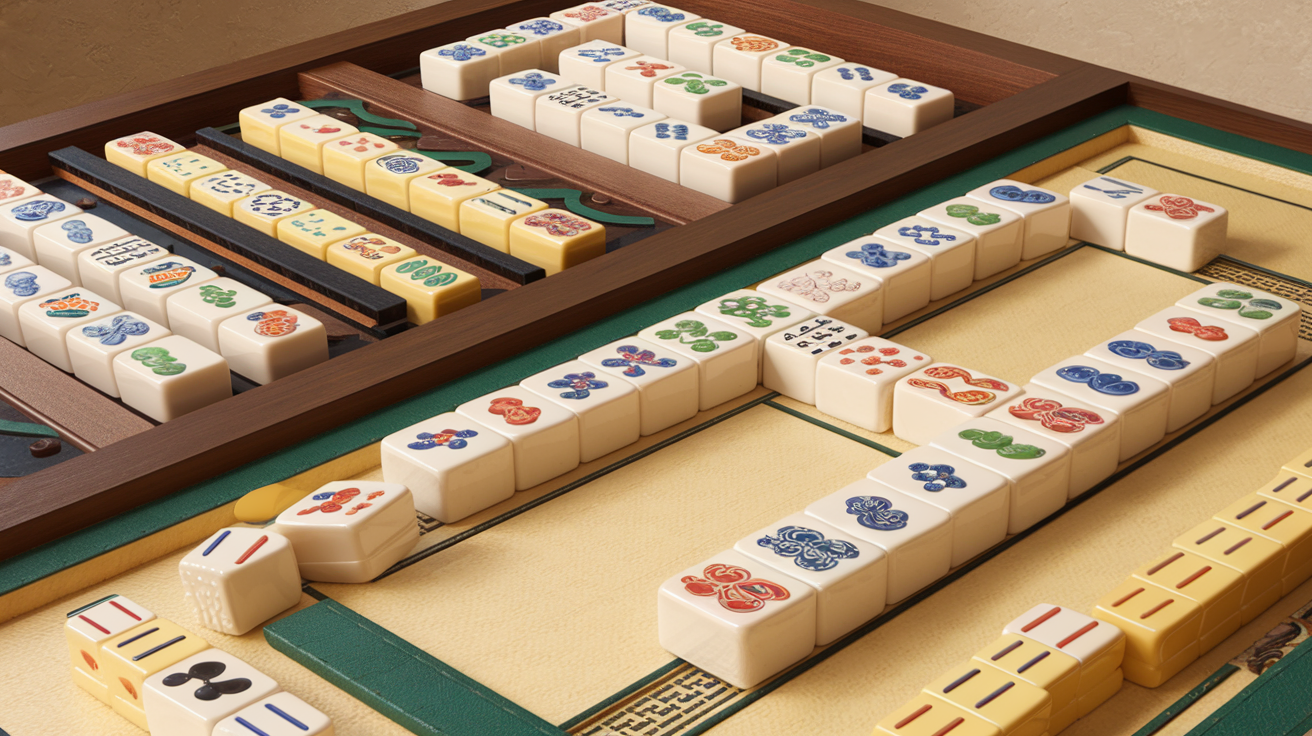
Mahjong Solitaire vs Traditional Mahjong: Understanding Two Completely Different Games
If you've played mahjong solitaire on themahjong.io or enjoyed Shanghai on Windows, you've experienced a game that shares a name—but remarkably little else—with traditional Chinese mahjong. The confusion is understandable and surprisingly recent in gaming history. This article explains the genuine historical origins of these two distinct games, what they share, and where they diverge.
The Origins: Two Games, Separated by a Century
Traditional Mahjong emerged in 19th-century China as a gambling and strategy game played by four players simultaneously. It combines elements of card games and dominoes, involving tile drawing, discarding, and the formation of melds (combinations) to complete winning hands. The game arrived in America in the 1920s and remains popular worldwide, particularly in Chinese communities, where it serves both as entertainment and serious competitive play.
Mahjong Solitaire, by contrast, is a computer-age invention. In 1981, Brodie Lockard created a software game called Mah-Jongg for the Apple II computer. Lockard's game was a tile-matching puzzle: players viewed a pyramid or arrangement of tiles and clicked to match pairs that shared identical images. It required no opponents, no hand formation, and no strategy in the traditional sense—just pattern recognition and spatial reasoning.
The game was brilliant in its simplicity, and it became widely distributed. When Microsoft bundled a nearly identical version with Windows 3.0 under the name Shanghai (created by Brodie Lockard and Nвластелинко), it reached millions of casual PC users who had never encountered traditional mahjong. The name "mahjong" stuck to the solitaire variant, creating a persistent naming collision that confuses players to this day.
What They Share: Aesthetics and Tile Names
Both games use the same tile imagery: winds (East, South, West, North), dragons (Red, Green, White), bamboos, circles, characters, and season or flower tiles. A traditional mahjong set contains 144 tiles; mahjong solitaire boards typically display 36 to 72 tiles depending on difficulty.
That's where the similarities largely end. The shared nomenclature creates a false impression of kinship. In traditional mahjong, tiles represent numerical and categorical values used in strategic combinations. In solitaire, tiles are merely visual symbols used for matching—a bamboo and a bamboo match because they look alike, not because they form a meaningful meld.
The Core Differences: Structure and Strategy
Traditional Mahjong
- Four players compete simultaneously
- Hand management: Players draw and discard tiles strategically, trying to form winning combinations (like three identical tiles or sequences)
- Social interaction: Real-time communication, observation of opponents' discards, and reading their intentions
- Luck and skill: While chance governs which tiles appear, experienced players make calculated decisions based on incomplete information
- Variable duration: Games can last 30 minutes to several hours
- Complex rules: Different regional variations exist (Cantonese rules differ from Shanghai, Hong Kong, or Taiwanese versions)
Mahjong Solitaire
- Single player against the puzzle itself
- Tile matching: Click two identical tiles to remove them; unblocked tiles are those with at least one exposed long side
- No social component: You're solving a pre-arranged puzzle
- Pure logic: Once you see the board, the optimal solution is theoretically determinable (though finding it requires planning ahead)
- Brief, discrete rounds: Most games conclude in 5–15 minutes
- Standardized rules: Matching rules are identical across all digital versions
Why the Confusion Persists
The naming conflation is a genuine historical accident amplified by digital distribution. Several factors cement the confusion:
- Windows Bundling: Millions learned "mahjong" from Shanghai, making the solitaire version the reference point for casual players
- Shared Aesthetics: The beautiful tile artwork creates a visual link
- Marketing Inertia: Developers continued calling solitaire variants "mahjong" because players searched for that term
- Geographic Separation: In Western contexts, mahjong solitaire dominates awareness; traditional mahjong remains stronger in Asian communities
The Actual Relationship
Think of it this way: mahjong solitaire is to traditional mahjong what solitaire (card game) is to bridge. They use the same or similar components, but the gameplay is fundamentally different. Someone excellent at bridge would find solitaire trivial, and vice versa. A master of traditional mahjong might enjoy solitaire, but the skills don't transfer—strategy, reading opponents, and hand calculation are irrelevant in tile-matching.
Appreciating Both Games on Their Own Terms
Neither game is "right" or "wrong." Traditional mahjong offers rich social gameplay and strategic depth. Mahjong solitaire provides accessible, meditative puzzle-solving. The confusion only matters if you're seeking a particular experience—if you want to learn traditional mahjong for competition or cultural connection, starting with solitaire won't teach you the fundamentals. Conversely, if you enjoy puzzle games, traditional mahjong's complexity might frustrate rather than entertain.
Themahjong.io and similar platforms offer the solitaire experience—a legitimate, enjoyable game with its own puzzle logic and appeal. Understanding that it's a different beast entirely from its namesake simply helps you appreciate what each game genuinely offers.
Conclusion
The naming confusion between mahjong solitaire and traditional mahjong is a fascinating artifact of digital history. Brodie Lockard's 1981 creation was innovative precisely because it transformed mahjong tile aesthetics into an entirely new genre. Both games deserve respect for what they are, not for what they claim to be. Knowing the difference enriches your appreciation of either one.
