

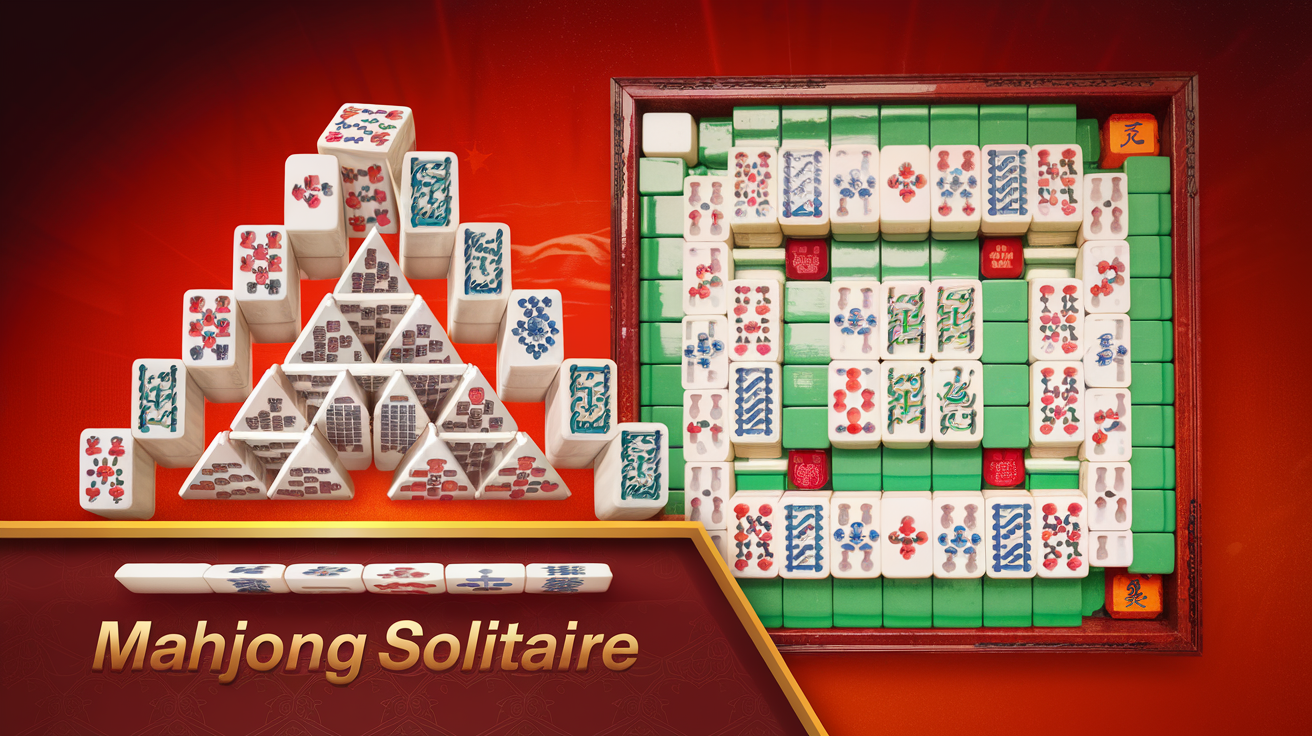
Mahjong Solitaire vs. Traditional Mahjong: Understanding Two Completely Different Games
If you've played mahjong solitaire online or on your computer, you might assume you're playing a digital version of the classic Chinese game your grandmother mentioned. In reality, these are two entirely separate games that happen to use similar-looking tiles. Understanding the distinction helps appreciate what makes each game unique.
The Origin of Mahjong Solitaire: A Modern Creation
Unlike traditional mahjong, which evolved in 19th-century China, mahjong solitaire is a modern invention from the computer age. In 1981, Brodie Lockard created a computer game called Mah-Jongg that fundamentally reimagined how mahjong tiles could be used.
Lockard's innovation was elegantly simple: instead of creating a multiplayer strategy game, he designed a single-player puzzle where the objective was to match and remove pairs of identical tiles from a carefully arranged layout. This wasn't an adaptation of traditional mahjong rules—it was an entirely new game concept that borrowed the visual vocabulary of mahjong tiles as its foundation.
The game proved popular among early computer enthusiasts, but it became a household name when Microsoft bundled a version called Shanghai with Windows 3.0 in 1990. Suddenly, millions of computer users had access to this addictive tile-matching puzzle, and it became synonymous with "mahjong" for an entire generation of casual gamers.
How Microsoft's Shanghai Cemented the Confusion
The bundling with Windows was both a blessing and a curse for clarity. Millions played Shanghai without ever knowing about traditional mahjong, and when they encountered the name "mahjong" attached to this tile-matching puzzle, they naturally assumed this was the game.
This is where the naming conflation begins. The game's marketing and cultural presence created an association that persists today: for many people, "mahjong" means the solitaire version. When themahjong.io or other platforms offer mahjong solitaire, players aren't confused by the name—they know exactly what they're getting. But this same naming choice can genuinely mislead someone seeking to learn the traditional multiplayer game.
The Games' Actual Mechanics: Where They Diverge Completely
Traditional Chinese Mahjong
Traditional mahjong is a four-player game combining elements of strategy, skill, and chance. Key characteristics include:
- Players and Turns: Four players take turns drawing and discarding tiles
- Tile Sets: Players form melds (groups of three or four tiles) following specific hand patterns
- Objective: The first player to complete a valid hand wins the round
- Strategy: Players must read opponents, manage risk, decide which tiles to discard, and recognize winning patterns
- Luck: Drawing the right tiles matters, but skill determines who wins consistently
- Social Element: Traditionally played with real people, often for stakes or simply social enjoyment
- Rules Variation: Numerous regional variations exist with different scoring systems and hand requirements
Traditional mahjong resembles a hybrid of poker (reading opponents, managing risk) and rummy (forming melds, recognizing patterns).
Mahjong Solitaire
By contrast, mahjong solitaire is a puzzle game with these characteristics:
- Single Player: You play entirely alone against the tile layout
- No Deck Management: All tiles are visible from the start; no drawing from a hidden deck
- Matching Rule: You remove pairs of identical tiles by clicking/tapping them
- Accessibility Rule: Typically, you can only remove tiles that are "free"—unblocked on both sides
- Objective: Clear the entire board by matching all tile pairs
- Strategy: Pure logic—determine which tile removals open up other pairs and lead to a complete board clearance
- Luck: None. Every game with the same tile layout has identical possible solutions
- Puzzle Nature: More similar to Tetris or Candy Crush than to poker or rummy
What They Actually Share
While mechanically different, these games do share genuine connections:
Tile Design and Aesthetics: Both use the same visual tile set—characters, circles, bamboo, honors tiles, and special tiles. The beautiful, intricate design is consistent, making them visually related even if functionally distinct.
Cultural Resonance: Both games draw from or reference Chinese cultural traditions, which gives them a shared aesthetic identity and cultural heritage.
Skill Recognition: Both reward attentiveness and pattern recognition, though in different ways. Traditional mahjong players develop tile reading and memory skills; solitaire players develop spatial reasoning and planning abilities.
Names and Tiles: The word "mahjong" and the tile set itself are shared intellectual property. Calling the solitaire version "mahjong" isn't technically wrong—it's a game using mahjong tiles—but it does obscure the fact that the underlying game is original.
Why the Naming Confusion Persists—And Why It's Okay
The naming conflation persists for practical reasons:
- Historical Precedent: Shanghai was the dominant computer version for decades, establishing "mahjong" in the public mind as the solitaire puzzle
- Tile Recognition: Since the solitaire version uses authentic mahjong tiles, calling it "mahjong" feels justified
- Marketing Simplicity: "Mahjong solitaire" is clearer than "Shanghai-style tile-matching puzzle"
- User Intent: Most players seeking online mahjong want the solitaire experience, so the naming serves them well
It's worth noting that this isn't disrespectful to traditional mahjong. Rather, it reflects how technology and casual gaming created a new use for an existing cultural artifact. Just as "chess" can refer to the ancient game or modern online variations, "mahjong" has expanded in meaning.
For Players: Which Game Are You Playing?
If you enjoy mahjong solitaire, you're playing a logic puzzle where all information is visible, luck doesn't apply, and success comes from planning and pattern recognition.
If you've learned traditional mahjong, you're playing a strategic, social game where hidden information, opponent reading, and calculated risk matter enormously.
Both are valuable, entertaining, and rewarding in different ways. The key is understanding which you're playing—and why.
Conclusion
The relationship between mahjong solitaire and traditional mahjong is best understood as cultural evolution rather than game corruption. Microsoft's Shanghai didn't ruin mahjong's reputation; it created an entirely new game category that millions have enjoyed. Traditional mahjong remains vibrant in Asia and increasingly popular worldwide among those seeking its strategic depth.
The next time someone mentions "mahjong," it's worth asking: are they talking about the contemplative solo puzzle, or the strategic multiplayer game? Both deserve their place—they're just not the same game.
