

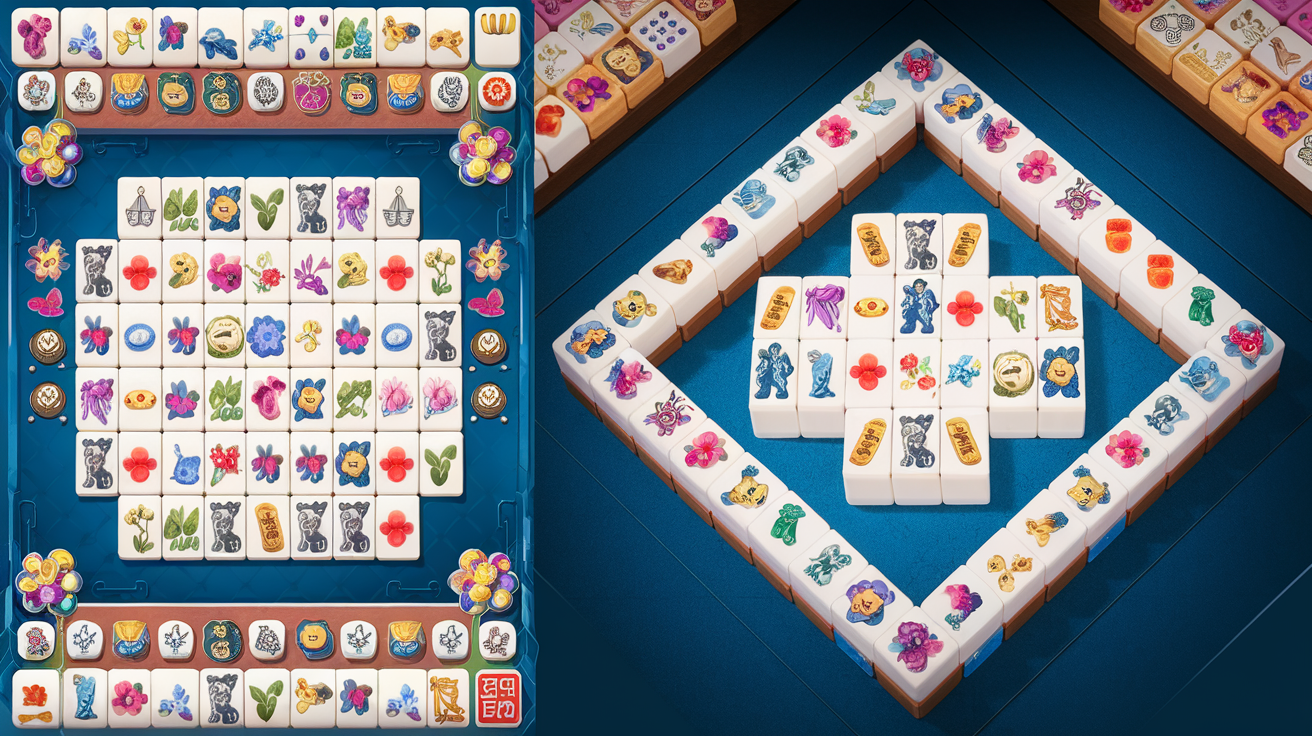
Mahjong Solitaire vs. Traditional Mahjong: Understanding Two Very Different Games
If you've ever played mahjong on your computer or phone, you've likely encountered a tile-matching puzzle game where you clear pairs of identical tiles from a pyramid, tower, or other interlocking arrangement. You may have wondered: is this the same game that millions of people play around tables across China, Taiwan, and beyond? The short answer is no—though both games share historical roots and tiles, they are fundamentally different games with distinct rules, strategies, and origins.
Understanding this distinction matters not because one game is superior, but because it clarifies gaming history and helps players appreciate what they're actually playing.
What Is Traditional Mahjong?
Traditional mahjong is a four-player strategy game that has been played in China for centuries. Modern research traces its origins to games played in 19th-century China, evolving from earlier card games and domino-like pastimes.
In traditional mahjong, players:
- Draw and discard tiles strategically
- Build specific hand combinations (melds)
- Compete to achieve winning hands before opponents
- Engage in bidding, prediction, and reading opponents' intentions
- Play with skill that rivals poker or bridge
The game involves significant memory, probability assessment, and psychological tactics. Regional variations exist across China, Taiwan, Hong Kong, and other areas, each with unique rule sets and scoring systems. Traditional mahjong requires table presence, observation, and real-time decision-making under pressure.
The Birth of Mahjong Solitaire (1981)
The tile-matching game now known as "mahjong solitaire" has a much more recent and documented origin story.
In 1981, computer programmer Brodie Lockard created a digital solitaire game that used mahjong tiles as its visual elements. Working on early personal computers, Lockard designed a puzzle game where players matched identical pairs of tiles arranged in a specific formation, clearing the board by systematic pairing. This was a completely new invention—not an adaptation of traditional mahjong rules, but a solitaire puzzle game that borrowed the aesthetic of mahjong tiles.
Lockard's game was called "Mah-Jongg" (with hyphenation), and it found an enthusiastic audience among early computer users. The choice of mahjong tiles was largely visual and thematic; they provided an attractive, familiar game aesthetic rather than a mechanical connection to traditional gameplay.
The Shanghai Effect and Windows Integration
In the mid-1980s, a version of this tile-matching game called "Shanghai" was developed and eventually bundled with Microsoft Windows 3.0 in 1990. This was a pivotal moment in gaming history.
By including Shanghai as a built-in game on millions of computers worldwide, Microsoft ensured that the tile-matching puzzle variant reached an enormous audience. Most people who played "mahjong" on their computer in the 1990s and 2000s were actually playing this solitaire variant, not traditional mahjong.
The naming—calling it mahjong or mahjong solitaire—stuck, even though the game mechanics had no relation to traditional rules. This created lasting confusion that persists today. Many players grew up calling the tile-matching game "mahjong" without ever encountering the four-player strategy game.
What the Games Share
Despite their differences, both games do share genuine connections:
Tiles and Symbolism: Both use the same tile designs—characters (numbers in suit), winds, dragons, flowers, and seasons. These carry cultural significance in both contexts.
Brain Engagement: Both games challenge the mind, though in different ways. Traditional mahjong demands strategic thinking and social psychology; solitaire demands pattern recognition and spatial reasoning.
Cultural Identity: Both are associated with East Asian gaming culture and carry a sense of tradition and elegance.
Accessibility: Traditional mahjong is complex to learn; solitaire mahjong is intuitive. This is why solitaire became so popular digitally.
Where They Diverge
The differences are substantial:
| Aspect | Traditional Mahjong | Mahjong Solitaire |
|---|---|---|
| Players | 4 players (sometimes 3) | 1 player (solitaire) |
| Gameplay | Draw, discard, build melds strategically | Match identical pairs from a layout |
| Luck vs. Skill | Significant skill with luck elements | Almost entirely based on pattern recognition |
| Interaction | Heavy social and competitive element | Puzzles against a static board |
| Winning Condition | First to valid hand combination | Clear all tiles or achieve specific goal |
| Complexity | High—takes years to master variants | Moderate—accessible within minutes |
| Duration | 30 minutes to several hours | 5-15 minutes typically |
Why the Naming Persists
The term "mahjong" stuck to the solitaire game for practical reasons:
- Recognition: Using an established name helped marketing and user interest
- Tile Design: The visual connection to mahjong tiles was genuine
- Historical Accident: Once millions learned it as "mahjong," changing the name became impractical
- Regional Confusion: In many Western countries, few people knew about traditional mahjong, so there was no competing reference point
Today, you'll find the solitaire game called various names: Mahjong Solitaire, Mahjong, Shanghai, Taipei, or simply the tile-matching game. Different developers and websites use different terminology.
Playing Both Games
The good news? You don't have to choose. Both games offer genuine pleasure:
Play Mahjong Solitaire if you enjoy puzzle-solving, relaxation, pattern recognition, and games you can complete in short sessions. The game rewards observation and methodical thinking.
Learn Traditional Mahjong if you want a deeper strategic experience, social interaction, and a connection to centuries of gaming culture. Local mahjong groups, online platforms, and instructional resources can teach you regional variants.
Conclusion
Mahjong solitaire and traditional mahjong are different games with separate histories. One is a 1981 computer invention that became a beloved casual game; the other is a centuries-old strategy game still actively played by millions. Both are worthy of their own appreciation.
Understanding this distinction doesn't diminish either game—it simply clarifies what each offers. When you play mahjong solitaire at themahjong.io or elsewhere, you're enjoying a well-designed puzzle game with an elegant interface. And if you ever try traditional mahjong, you'll discover an entirely different world of strategy, culture, and social play.
Both deserve their place in gaming history, and there's room at the table for both.
