

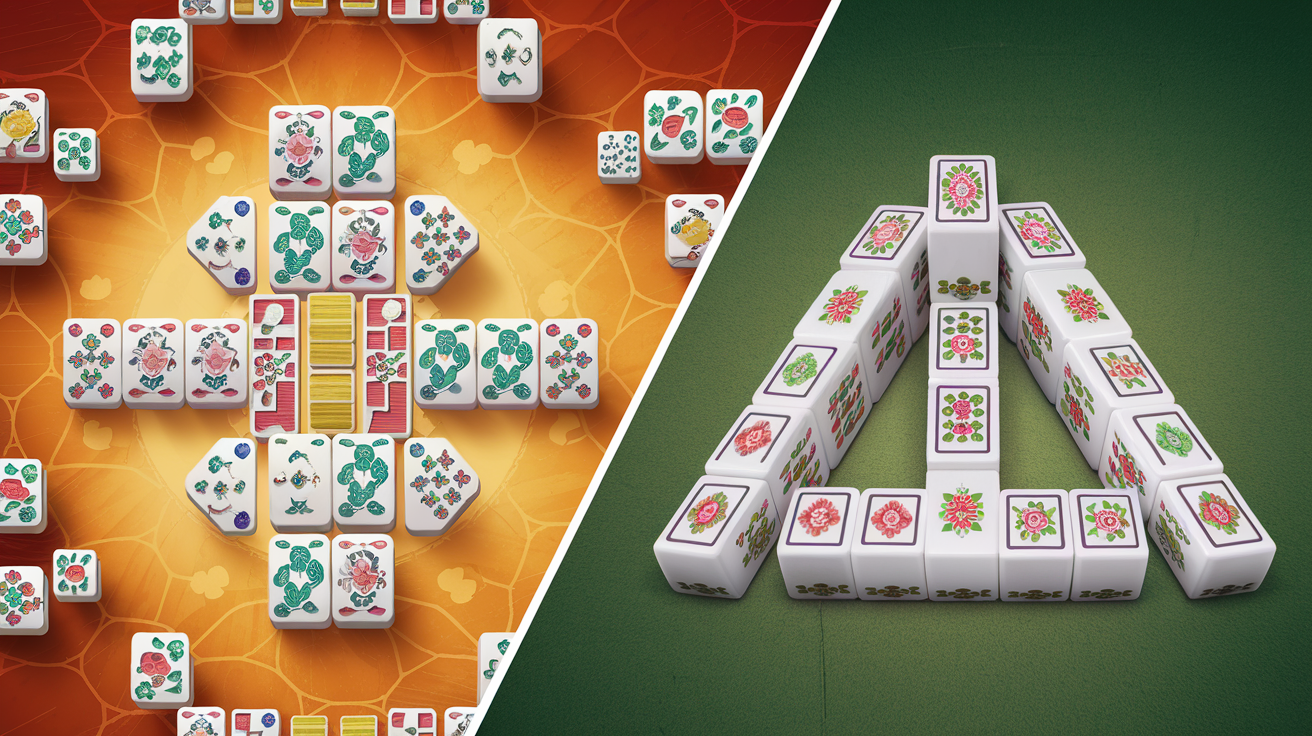
Mahjong Solitaire vs. Traditional Mahjong: Understanding Two Completely Different Games
When you're playing mahjong solitaire on themahjong.io, matching pairs of tiles, you might assume you're playing a simplified version of traditional Chinese mahjong. In reality, you're playing something entirely different—a game that only looks related to its namesake. Understanding this distinction helps you appreciate both games for what they truly are.
The Two Games at a Glance
Traditional Chinese Mahjong is a 4-player strategy game involving hand management, pattern recognition, and complex scoring rules. Players draw and discard tiles to form winning combinations called melds. It's competitive, involves memory and psychology, and has been played for over a century in Asia.
Mahjong Solitaire is a single-player puzzle game where you match pairs of identical or related tiles from a layout, gradually clearing the board. There's no hand management, no opponents, and typically no scoring complexity. It's meditative, deterministic, and winnable through logic and observation.
They share tiles and aesthetics. They share almost nothing else.
The True Origin: Brodie Lockard's 1981 Innovation
The story of mahjong solitaire begins not in China, but in the computer labs of the early 1980s. In 1981, a programmer named Brodie Lockard created a solitaire game called Mah-Jongg for the Apple II computer. This was a tile-matching puzzle game, inspired by the visual language of mahjong tiles but unrelated to the traditional 4-player game's rules.
Lockard's insight was clever: mahjong tiles were aesthetically rich, culturally interesting, and visually distinct from playing cards. Why not use them for a different kind of puzzle? His version involved a specific layout of tiles (typically in a pyramid or interlocking pattern) where players matched pairs of identical tiles. When a match was made, those tiles disappeared. The goal was simple: clear the entire board.
This was genuinely innovative for its time, and it worked. The game found an audience because it was approachable, required no knowledge of traditional mahjong rules, and offered a satisfying puzzle experience.
How Shanghai Created the Confusion
The naming conflation we live with today largely stems from one decision made by Brodie Lockard: he named his game Mah-Jongg, deliberately evoking the traditional game despite the rules being completely different. Whether this was clever marketing or a genuine desire to honor the tile tradition is unclear from historical records.
But the real explosion happened in 1994. Activision released Shanghai for Windows and Macintosh, and—crucially—a variant called Shanghai: Great Moments was bundled with Microsoft Windows 95 as a pre-installed game. Windows 95 became ubiquitous in homes and offices worldwide. Millions of people played Shanghai without ever having heard of traditional mahjong or the earlier Mah-Jongg software.
The result was inevitable: generations of players came to associate the word "mahjong" with a tile-matching puzzle game, rather than with the complex 4-player strategy game traditional players had enjoyed for decades.
What They Actually Share
It's worth noting that these games aren't completely unrelated—there are genuine connections, even if they're thematic rather than mechanical.
Shared tiles: Both use the same tile symbols—bamboo, characters, dots, winds, dragons, and seasons. A player who learns one game's tile types has encountered the other game's visual language.
Pattern recognition: Both games reward observing patterns. In traditional mahjong, you recognize which melds are possible; in solitaire, you recognize which pairs match.
Calm, contemplative play: Both games attract players seeking a thoughtful, methodical experience rather than action or chaos.
Cultural heritage: Both games celebrate Chinese cultural aesthetics and are gateways to understanding mahjong's rich tradition.
Where Strategy Diverges
This is where the differences become stark.
Traditional Mahjong Strategy involves:
- Predicting opponent moves based on discards
- Managing your hand while blocking opponents
- Understanding complex scoring bonuses and penalties
- Remembering which tiles have been discarded
- Making probabilistic decisions with incomplete information
- Social and psychological elements with your fellow players
Mahjong Solitaire Strategy involves:
- Identifying which pairs are accessible (not blocked by other tiles)
- Planning ahead to avoid creating unmatched tiles
- Sometimes trial-and-error or backtracking
- Pure logic—every move is knowable in advance, no hidden information
- No opponent interaction or psychology
Traditional mahjong is a game of imperfect information against opponents. Mahjong solitaire is a puzzle with perfect information where you're solving against yourself.
Why the Confusion Persists
The naming confusion isn't going away anytime soon, and honestly, that's okay. Here's why it persists:
Historical momentum: Brodie Lockard's naming choice stuck, and decades of commercial success (Shanghai, Windows bundles, mobile apps) have cemented it.
Visual familiarity: The tiles are mahjong tiles. To someone unfamiliar with either game, calling a mahjong tile–based puzzle "mahjong" feels natural.
Simplicity: "Mahjong solitaire" is easier than "tile-matching solitaire," and "mahjong" alone is snappier than "traditional mahjong."
No deliberate deception: Neither game is being mislabeled out of malice. It's a genuine, understandable historical accident.
Respecting Both Games
The key insight is this: both games are legitimate and valuable, and neither is "correct" or "incorrect." Traditional mahjong players have every right to note the distinction, but they needn't be dismissive of solitaire players. Solitaire players have every right to enjoy their game without feeling they're playing "mahjong wrong."
If you're playing solitaire on themahjong.io, you're engaging with a direct descendant of Brodie Lockard's 1981 innovation—a game that borrowed tiles but forged its own puzzle identity. If you're curious about traditional mahjong, you're exploring a rich, complex game with entirely different strategic depth.
They're both mahjong in name. They're partners only in aesthetics and spirit.
Conclusion
Understanding the difference between mahjong solitaire and traditional mahjong enriches your appreciation of both. You're not playing a simplified version of something else—you're playing a single-player puzzle game with its own elegant logic, one that emerged from computer innovation in the 1980s and found its way into millions of homes through Windows 95. That's a worthy origin story all its own.
So whether you're matching tiles in solitaire or reading about traditional mahjong strategy, you're engaging with distinct games that happen to share a name and a tile set. And that's perfectly fine.
