

Mahjong Solitaire vs Traditional Mahjong: Understanding Two Completely Different Games
If you've ever played mahjong solitaire online or on your phone, you might be surprised to learn that the game you're enjoying has almost nothing in common with traditional mahjong—the ancient Chinese game that's been played competitively for centuries. While both games use decorated tiles and share a name, they're fundamentally different in gameplay, strategy, and origin. Understanding this distinction enriches your appreciation of both games.
What They Share: The Tiles
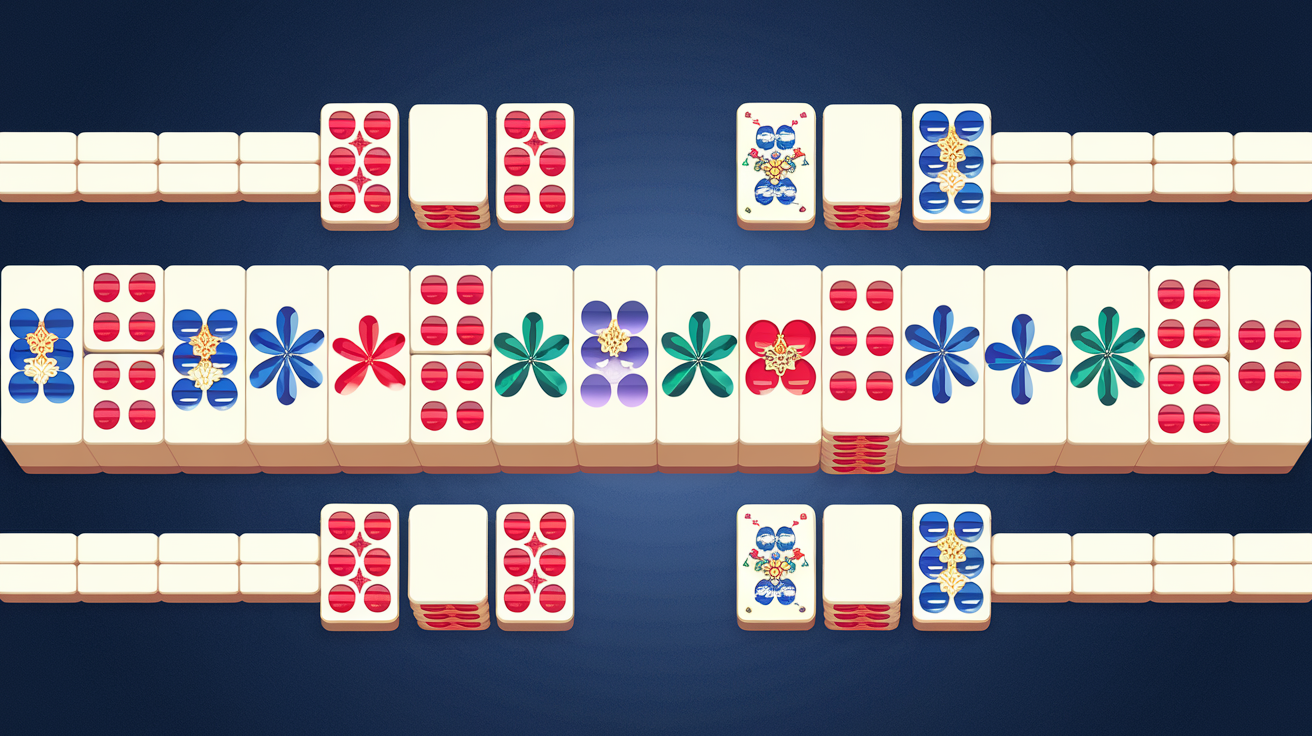
Both games use similar tile sets featuring bamboo, circles, characters, and honor tiles. This visual connection is the primary reason for the naming overlap. Traditional mahjong tiles are rich with cultural symbolism and aesthetic beauty, and when digital solitaire adopted these recognizable designs, they created a natural visual bridge between the two games.
However, sharing tile imagery is where the similarities largely end.
Traditional Chinese Mahjong: The Original
Traditional mahjong is a four-player strategy game with roots dating back to the 19th century in China. It's a game of:
- Simultaneous play: All four players engage with the game at the same time
- Drawing and discarding: Players draw tiles and strategically discard them
- Hand formation: The goal is to complete specific winning patterns (melds) before opponents
- Reading opponents: Success depends partly on observing what tiles others are discarding and predicting their strategies
- Probability and memory: Players must remember which tiles have been played
- Social engagement: Traditional mahjong is inherently a social, competitive game
Playing traditional mahjong requires learning complex rule variations (which differ by region), understanding hand scoring systems, and developing strategic intuition honed through experience.
Mahjong Solitaire: The Digital Innovation
In stark contrast, mahjong solitaire is a single-player puzzle game with a much more recent history. The game was created in 1981 by Brodie Lockard as computer software named Mah-Jongg. This was a genuine innovation—a completely new concept that borrowed the aesthetic of mahjong tiles but created an entirely new game mechanic.
Mahjong solitaire features:
- Solo gameplay: One player, no opponents
- Tile matching: The core mechanic is matching pairs of identical tiles
- Pyramid layouts: Tiles are stacked in formations where only exposed tiles can be matched
- Limited choices: At any given moment, you have a specific set of valid moves
- Puzzle logic: Success depends on spatial reasoning and foresight
- Clear win conditions: Remove all tiles or reach a dead state with no remaining moves
- Relaxation and focus: The game emphasizes individual satisfaction and mental exercise
How Solitaire Became Mainstream: The Shanghai Connection
While Lockard's Mah-Jongg existed in 1981, mahjong solitaire didn't achieve massive cultural penetration until the 1990s. A key moment came when a variation called Shanghai was bundled with Windows 3.1 and later Windows 95. Millions of computer users encountered this tile-matching puzzle game, many for the first time, and it became a cultural touchstone—the solitaire game that shipped on office computers worldwide.
The bundling with Windows under a different name (Shanghai) inadvertently cemented the confusion. While tech-savvy players understood the distinction, casual users often assumed they were playing "mahjong" because the tiles looked familiar. The name Shanghai eventually faded from common parlance, and the game reverted to being called "mahjong solitaire," which both accurately described the gameplay and accidentally conflated it with traditional mahjong.
Key Strategic Differences
Traditional Mahjong demands:
- Adaptive thinking in response to opponent behavior
- Risk assessment (should I take this discard or wait?)
- Pattern recognition across multiple valid hand types
- Memory of discarded tiles
- Understanding of probability
Mahjong Solitaire demands:
- Spatial visualization and forward planning
- Recognition of tile pairs and game state
- Puzzle-solving logic (which moves lead to dead ends?)
- Attention to detail in tile-matching
- Mental focus without interpersonal dynamics
Why the Confusion Persists
Several factors explain why people still conflate these games:
- Visual similarity: The tile sets are genuinely similar
- Historical bundling: Generations learned "mahjong" from Windows solitaire
- Marketing inertia: The solitaire version is called "mahjong solitaire," which can seem to suggest it's a variant of traditional mahjong
- Accessibility: Solitaire is far easier to pick up than traditional mahjong, so it's the version most people encounter first
- Cultural distance: Traditional mahjong requires learning region-specific rules, while solitaire needs almost no learning curve
Both Games Have Value
There's no hierarchy here. Traditional mahjong is a rich, strategic game with deep cultural significance and genuine competitive depth. Mahjong solitaire is an elegant puzzle that provides genuine cognitive benefits—improving spatial reasoning, pattern recognition, and planning.
Understanding the difference helps you:
- Appreciate what each game offers
- Choose the right game for your mood and available time
- Explain to curious friends why they're distinct
- Respect the centuries of tradition behind traditional mahjong while enjoying the modern innovation of tile-matching solitaire
Conclusion
Mahjong solitaire and traditional mahjong are two genuinely different games that share an aesthetic heritage. Rather than viewing this as a point of confusion, it's actually a beautiful example of how a visual tradition can inspire entirely new forms of play. Whether you're drawn to the strategic depth of traditional mahjong or the meditative puzzle-solving of solitaire, both deserve appreciation for what they uniquely offer.
