

Mahjong Solitaire vs. Traditional Mahjong: Understanding Two Different Games
When people encounter mahjong games online or on their computers, they're often surprised to learn that what they're playing bears only a passing resemblance to the traditional Chinese mahjong their grandparents might have played. This confusion isn't accidental—it stems from a specific historical moment in 1981 that fundamentally shaped how digital mahjong would develop. Understanding the distinction between these two games enriches your appreciation for both.
The Traditional Game: Four Players, Complex Strategy
Traditional Chinese mahjong is a game with roots stretching back to the 19th century, though some scholars trace conceptual precursors even earlier. It's fundamentally a four-player game where strategy, probability calculation, and psychological awareness intersect. Players draw and discard tiles, attempting to form winning hand combinations called "melds." The game involves:
- Active decision-making: Every discard is a strategic choice with consequences
- Reading opponents: Inferring what tiles others need and adjusting play accordingly
- Risk management: Deciding when to declare victory and when to continue pursuing higher-scoring hands
- Real-time interaction: Games involve direct competition and negotiation among players
- Variable hand composition: Players don't know what tiles others hold, creating uncertainty
The original tile set consists of 144 tiles organized into specific suits and honor tiles, and winning hands follow particular patterns. Traditional mahjong remains enormously popular across Asia and among diaspora communities worldwide.
The 1981 Origin: Brodie Lockard's Innovation
The story of mahjong solitaire begins not in ancient China but in 1980s Silicon Valley. Brodie Lockard, a programmer, created a solitaire variant using mahjong tiles as his inspiration for a computer game. Released in 1981 under the name "Mah-Jongg," this game took the visual elements of mahjong tiles but reimagined the fundamental gameplay into a single-player tile-matching puzzle.
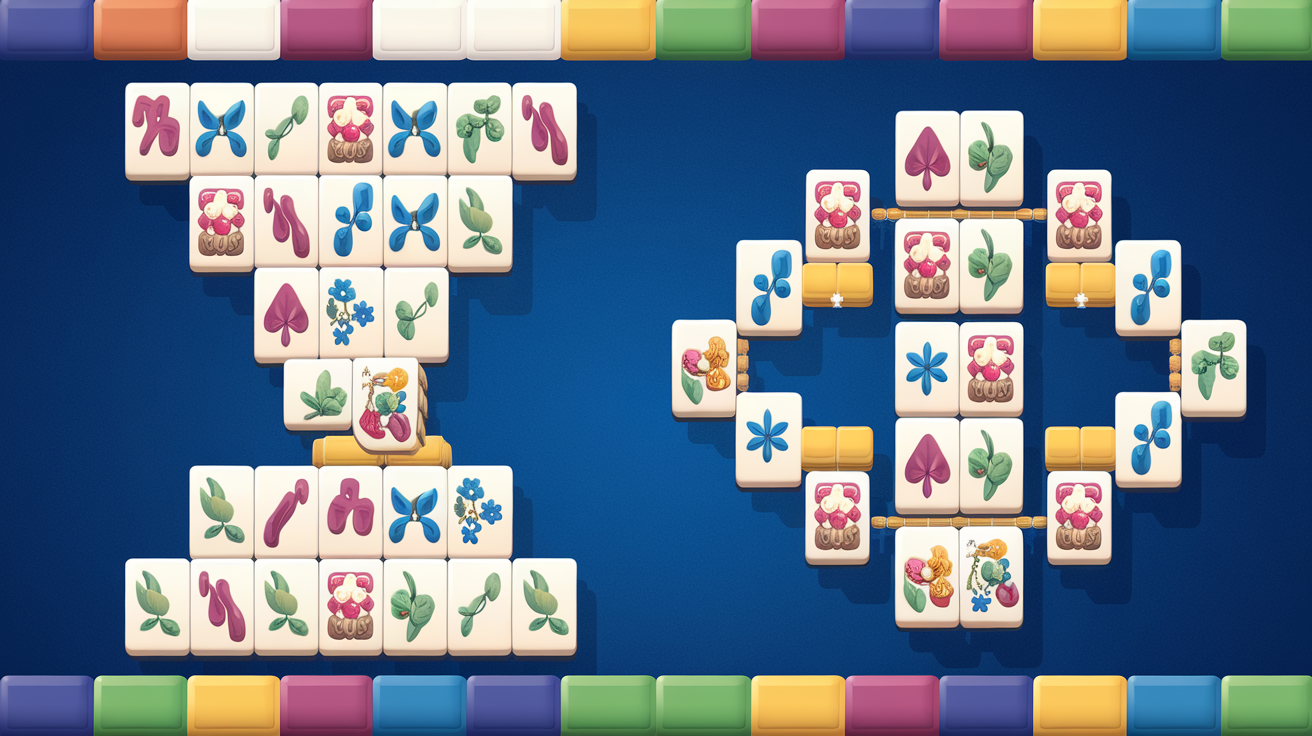
Lockard's innovation was elegant and significant: instead of the complex strategic interaction of traditional mahjong, players faced a static layout of tiles and attempted to match identical pairs, removing them from the board until—ideally—all tiles were cleared. The game required:
- Pattern recognition: Identifying matching tiles among many
- Spatial reasoning: Understanding which tiles are accessible (playable) given their position
- Planning ahead: Considering whether removing a pair now would block clearing other tiles later
- Patience and observation: Working methodically through the puzzle
This was fundamentally a solitaire puzzle game using mahjong tile imagery, not a reimagining of traditional mahjong rules.
Shanghai and Windows: How the Confusion Took Root
Lockard's game found modest success, but its real explosion into mainstream consciousness came through an unexpected route. Microsoft licensed a version of the game and bundled it with Windows 3.0 in 1990 under the name "Shanghai." Millions of computer users encountered it as a bundled game, and it became one of the most widely played computer games of the 1990s.
Here's where the naming confusion became entrenched: while the game used mahjong tiles and sometimes was called a "mahjong game," most people who played it on Windows knew it as "Shanghai," and the connection to traditional mahjong remained obscure for casual players. When new digital versions emerged, they inherited both the tile set from traditional mahjong and the solitaire gameplay, but often kept the "mahjong" label—creating lasting confusion.
The enduring presence of solitaire mahjong in digital gaming, from mobile apps to web browsers, means that many people's primary encounter with "mahjong" is actually this tile-matching solitaire variant, even though it bears little resemblance to what the game's name historically referenced.
What They Share: The Tiles
Despite their gameplay differences, the two games do share common ground. Both use the same basic tile set:
- Suit tiles: Bamboo, characters (dots), and circles, numbered 1-9
- Honor tiles: Winds (East, South, West, North) and Dragons (Red, Green, White)
This shared vocabulary and visual aesthetic creates an intuitive connection. If you know traditional mahjong, you'll recognize the tiles immediately in solitaire. However, recognizing the tiles doesn't mean the games play similarly.
Strategic Differences: Puzzle vs. Game
The strategic demands differ profoundly:
Mahjong Solitaire is fundamentally a puzzle with an optimal solution. Every board state has a correct answer—either all tiles can be cleared or they cannot. Success depends on pattern recognition, spatial awareness, and logical thinking. There's no opponent, no luck factor in drawing tiles, and no negotiation. You either solve the puzzle or you don't.
Traditional Mahjong is a game where probability, psychology, and incomplete information drive play. The same tiles dealt to different players would lead to entirely different games based on how players read situations, manage risk, and adapt to opponents' moves. There's genuine uncertainty and strategic depth that emerges from player interaction.
Why the Confusion Persists
Several factors keep these games conflated:
- Shared nomenclature: Both use the word "mahjong" despite very different mechanics
- Identical tile sets: Visual familiarity masks gameplay differences
- Historical accident: Microsoft's Shanghai bundle introduced millions to solitaire mahjong without context for traditional mahjong
- Cultural distance: For many Western players, traditional mahjong remains unfamiliar, making the distinction less obvious
- Digital standardization: Most online mahjong variants follow the solitaire model, making it the default experience
A Respectful Distinction
Understanding that mahjong solitaire and traditional mahjong are different games isn't a criticism of either. Solitaire mahjong is a genuinely satisfying puzzle game with its own appeal—it's meditative, requires genuine thinking, and offers real challenge. Traditional mahjong offers different pleasures: social interaction, strategic depth, and the thrill of competitive play.
If you've enjoyed mahjong solitaire and are curious about the traditional game, approaching it as a completely different experience will serve you better than expecting familiar tile-matching mechanics. Conversely, if you play traditional mahjong competitively, mahjong solitaire offers a relaxing alternative rather than a simplified version of what you know.
The games share a name and a tile set, but their histories, mechanics, and appeals are distinctly their own. Recognizing this distinction enriches both experiences and honors the genuine traditions underlying each variant.
