

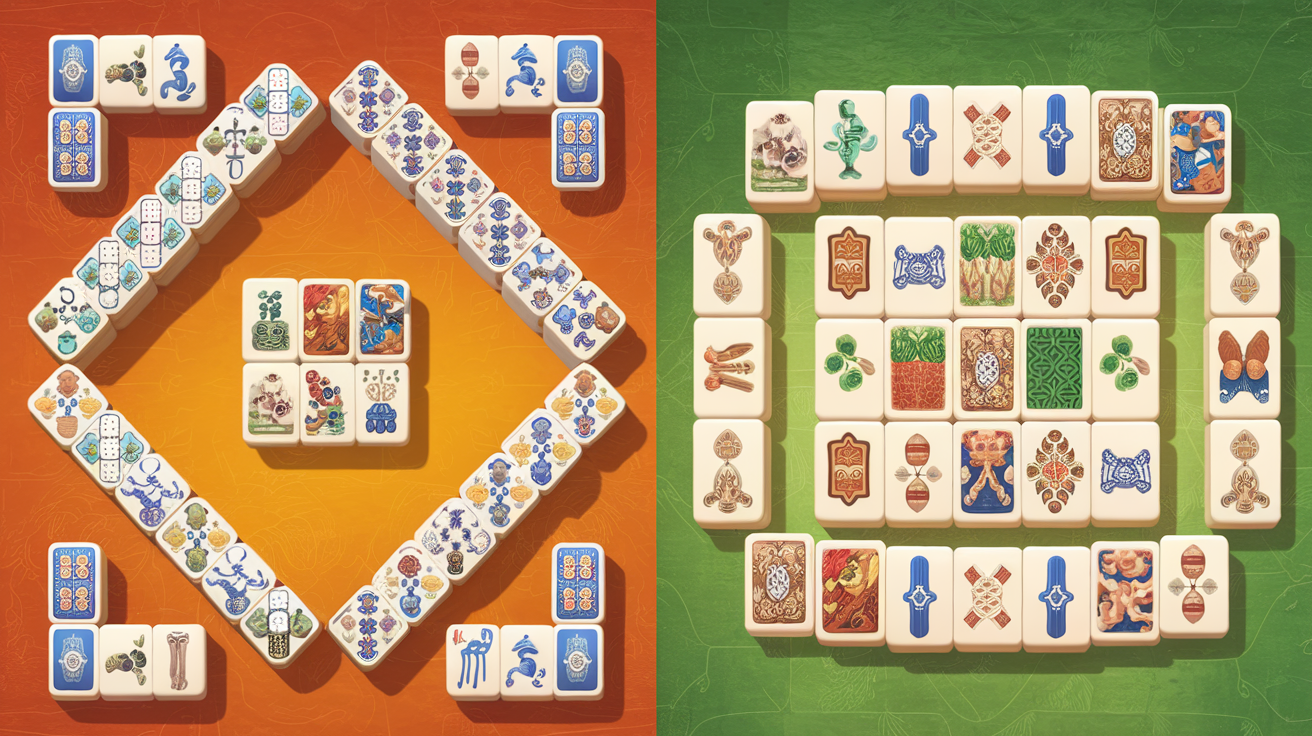
Mahjong Solitaire vs. Traditional Mahjong: Understanding Two Completely Different Games
If you've played mahjong solitaire on themahjong.io or enjoyed Shanghai on an older Windows computer, you might assume you're playing traditional mahjong. In reality, these are two entirely separate games that merely share aesthetic elements—tiles with Chinese characters and symbols. Understanding the distinction helps appreciate what makes each game unique.
The Origin Story: 1981 and Brodie Lockard's Innovation
The tile-matching solitaire game we know today didn't emerge from ancient Chinese gaming traditions. Instead, it was created in 1981 by Brodie Lockard, a computer programmer who designed a digital solitaire game using mahjong tiles as the visual foundation. Lockard's game, titled "Mah-Jongg," was published by Activision and ran on early personal computers.
Lockard's insight was elegant: why not use the rich visual language of mahjong tiles to create a single-player puzzle game based on matching pairs? The tiles provided clear visual distinction, cultural interest, and aesthetic appeal. The gameplay mechanics, however, had nothing to do with traditional mahjong strategy.
Windows Shanghai: The Moment Everything Changed
The real turning point came in the early 1990s when Microsoft bundled a version of this tile-matching game with Windows 3.1 under the name "Shanghai." This decision had enormous consequences for how people understood mahjong globally.
Shanghai was ubiquitous. It came pre-installed on millions of computers. It was intuitive, relaxing, and required no special knowledge of Chinese games or culture. Players loved it—but many assumed they were playing an authentic form of mahjong.
This single distribution decision created a naming confusion that persists nearly three decades later. For countless people, "mahjong" became synonymous with matching tiles, not the four-player strategy game it actually describes in its traditional context.
Traditional Mahjong: The Strategy Game
Traditional mahjong, played primarily in China, Taiwan, Hong Kong, and among diaspora communities worldwide, is a completely different animal.
Core characteristics:
- Four players seated around a table
- Draw and discard mechanics similar to rummy
- Complex hand-building strategy involving sequences (chows), triplets (pungs), and specific winning combinations
- Risk and social dynamics inherent in multiplayer gameplay
- Regional variations in rules and scoring that can be substantial
- Skill-based competition where experienced players consistently outperform novices
Traditional mahjong requires memory, probability assessment, reading opponents, and strategic thinking about which tiles to keep and which to discard. It's mentally demanding and socially engaging.
Mahjong Solitaire: The Puzzle Game
Solitaire mahjong (the game you'll find at themahjong.io) operates on entirely different principles:
Core characteristics:
- Single player with no opponents
- Fixed board with tiles arranged in a specific pattern
- Simple matching mechanic: find pairs of identical tiles that are exposed on at least one side
- Pure puzzle logic with no luck beyond the initial tile arrangement
- Relaxation-focused rather than competitive
- Universal rules that don't vary significantly between implementations
Solitaire mahjong is about visual perception, spatial reasoning, and planning ahead. You're solving a puzzle, not competing against opponents or managing hidden information.
What They Actually Share
Beyond the surface-level tile aesthetics, the games do share some genuine connections:
Tile Design: Both use the same traditional mahjong tile set—bamboo, circle, and character suits, plus winds, dragons, and flowers. This creates visual continuity even if gameplay differs completely.
Cultural Aesthetic: Both games leverage the visual richness and cultural significance of Chinese gaming traditions, even if they use that foundation differently.
Community Engagement: Both foster communities of players who enjoy the social aspects (though in very different ways—traditional mahjong at tables together, solitaire mahjong through online platforms and apps).
Why the Confusion Persists
Several factors explain why many people don't realize these are different games:
- Microsoft's naming choice with Shanghai created the initial conflation
- Digital distribution of solitaire mahjong reached vastly more people than traditional mahjong ever has
- No marketing imperative to clarify the distinction—both games sell/engage people happily
- Shared visual language makes casual players assume shared mechanics
- Cultural distance: Most Western players never encounter traditional mahjong, so they have no comparison point
The Bottom Line: Both Games Have Merit
It's worth emphasizing that neither game is more "authentic" or valuable than the other in any meaningful sense. Traditional mahjong is a sophisticated strategy game with centuries of cultural resonance. Solitaire mahjong is a clever puzzle game that's brought relaxation and enjoyment to millions who might never encounter traditional mahjong.
The confusion is understandable—the shared tiles create a real visual and linguistic bridge. But recognizing them as distinct games helps players appreciate what each one actually offers. If you enjoy solitaire mahjong, you're engaging with a game that traces its lineage to 1981 software design, not ancient China. And there's nothing wrong with that. It's a well-designed, satisfying puzzle game in its own right.
Whether you're playing traditional mahjong with friends or enjoying the meditative tile-matching experience of solitaire mahjong online, you're participating in games with genuine appeal—they're just fundamentally different experiences.
