

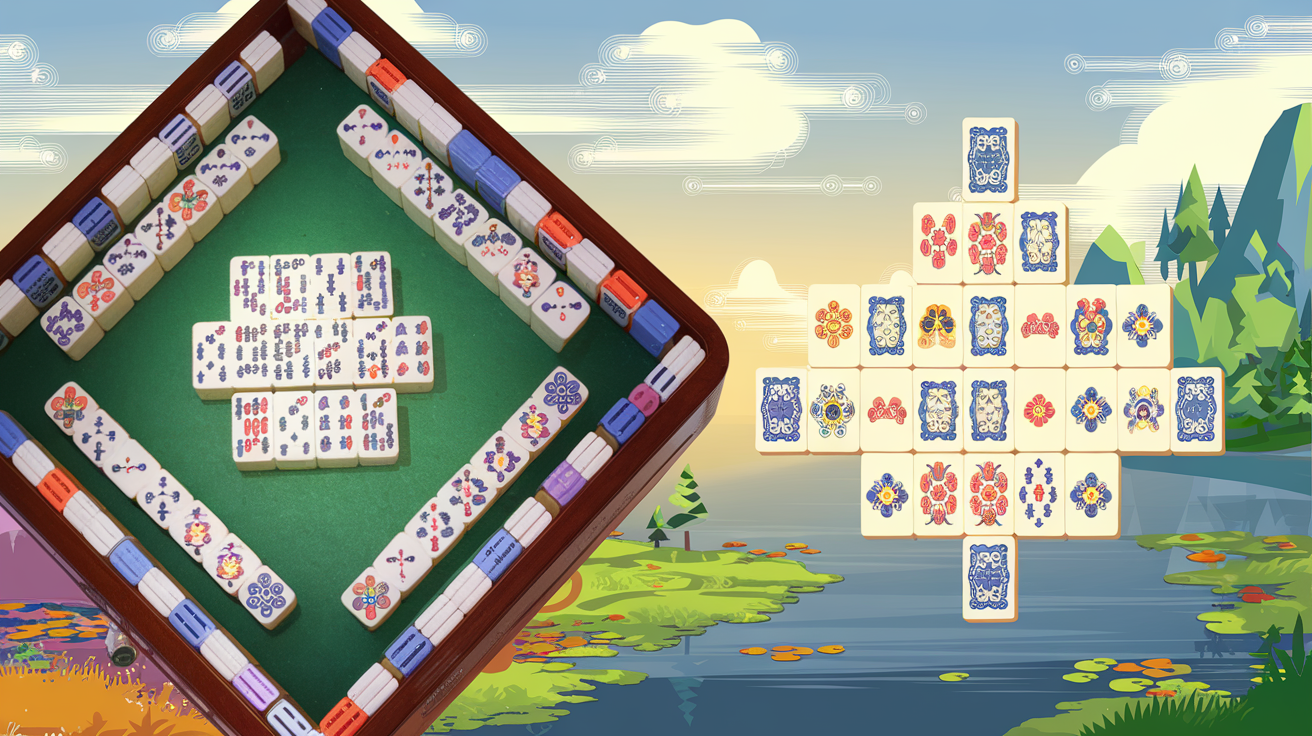
Mahjong Solitaire vs. Traditional Mahjong: Understanding Two Different Games
If you've played mahjong on your computer or phone, you've likely encountered a puzzle game where you match identical tiles by clicking pairs until the board clears. But if you've watched someone play traditional mahjong in a family setting, you've seen something completely different—a fast-paced, competitive four-player game involving melds, discards, and strategic hand management.
These are two entirely different games that happen to share the same name and tiles. Understanding the distinction matters not because one is "less real" than the other, but because they represent genuinely separate gaming traditions with different origins, rules, and skill sets.
The Origins: Where Did Mahjong Solitaire Actually Come From?
Traditional mahjong emerged in 19th-century China and spread throughout East Asia and beyond. It's a complex rummy-like game played by four players simultaneously, with real-time play, psychological bluffing, and intricate tile combinations.
Mahjong solitaire has a much more recent origin story. In 1981, American programmer Brodie Lockard created a computer game called "Mah-Jongg" for the Apple II. Lockard designed a single-player puzzle game using traditional mahjong tiles, but invented completely new mechanics: players simply matched pairs of identical tiles until the board was clear.
Lockard's game didn't claim to be traditional mahjong—it was clearly positioned as a solitaire puzzle. But the visual aesthetic of the tiles, combined with the mahjong name, created a lasting association that persists today.
The game's popularity exploded in 1986 when a developer called Noel Llopis created "Shanghai" for the Amiga computer. Shanghai introduced the distinctive pyramid-stacked tile layout (rather than Lockard's original patterns) that most players recognize today. When Microsoft included a version of Shanghai as a pre-installed game in Windows 95, the tile-matching puzzle reached millions of casual players worldwide.
What Actually Happened: The Naming Conflation
Here's where the confusion originated and why it persists: the game used traditional mahjong tiles, so it was logical (if imprecise) to call it "mahjong." Players who encountered it on their computers had no previous exposure to actual mahjong, so they accepted "mahjong" as the name of this tile-matching puzzle. Computer game developers continued the convention, and three decades later, the conflation is so complete that many players genuinely believe mahjong solitaire is mahjong.
Neither Lockard nor Microsoft intended deception. They simply applied an existing visual vocabulary to a new game type. But the result was a widespread misunderstanding about what "mahjong" means.
What They Share: The Tiles
Tradition mahjong and mahjong solitaire do share genuine commonalities:
- The 144-tile set: Both use the same tiles, including bamboos, characters, dots, and honor tiles (winds and dragons)
- The aesthetic: The beautiful, distinctive tile design is identical
- Basic tile recognition: Players in both games need to identify matching tiles
- Cultural connection: Mahjong solitaire allows players to become familiar with tile symbols, which can serve as a gateway to learning traditional mahjong
These shared elements explain why solitaire players often enjoy traditional mahjong and vice versa—there's a real aesthetic and symbolic continuity between them.
Where They Diverge: The Actual Gameplay
The differences, however, are profound:
Player Count and Speed
- Traditional mahjong: Played by exactly four players simultaneously, with rapid-fire turns and real-time decision-making
- Mahjong solitaire: Single-player puzzle with no time pressure (unless you set one yourself)
Rules and Winning Conditions
- Traditional mahjong: Complex scoring systems, specific winning hand combinations (melds), and multiple ways to score points. Games involve strategy, probability, and reading opponents
- Mahjong solitaire: One simple goal—clear all tiles by matching pairs. There's one winning condition and no scoring variation
Strategic Depth
- Traditional mahjong: Decisions involve which tiles to discard, reading what opponents might be collecting, remembering discards, managing your hand, and calculating probabilities. Success requires memory, observation, and strategic thinking under pressure
- Mahjong solitaire: The core strategy involves understanding which tile pairs can be accessed and planning move sequences. It's more like solving a puzzle than playing a competitive game
Interaction
- Traditional mahjong: A social game built on interaction, tension, and sometimes luck (the deal determines initial hands)
- Mahjong solitaire: A solo meditation or mental exercise with no luck involved once the tiles are dealt
Why the Confusion Persists
The naming confusion endures because:
- Precedent matters: Calling it mahjong solitaire from the start would have required educating millions of players about the distinction
- Casual gaming culture: Most people who play mahjong solitaire have no connection to the traditional game and don't need to know the difference
- It's not inaccurate, just incomplete: "Mahjong solitaire" isn't wrong—it accurately describes a solitaire game using mahjong tiles
- Language evolution: Over 40 years, "mahjong" has legitimately come to mean both the traditional game and the tile-matching puzzle in common usage
The Real Value of Understanding the Difference
Knowing that these are different games matters if you:
- Want to learn traditional mahjong: Don't expect the skills to transfer directly. Traditional mahjong requires learning entirely new rules and strategic frameworks
- Enjoy mahjong solitaire but wonder why it seems so different from what others describe: Now you have the real answer
- Are teaching either game: Be clear about which version you're teaching
- Appreciate gaming history: Understanding that solitaire emerged from a programmer's creative use of tiles, not from ancient tradition, adds interesting context
Moving Forward
Both games have their own integrity and value. Traditional mahjong is a rich strategic game with deep cultural history. Mahjong solitaire is an elegant puzzle with genuinely satisfying gameplay and a legitimate origin story in computer game design.
There's nothing wrong with enjoying mahjong solitaire without knowing anything about traditional mahjong. But understanding that they're different games—with different rules, different histories, and different skill requirements—enriches appreciation of both. It's not about one being "real" and the other being fake. It's about recognizing that the same beautiful tiles can serve as the foundation for entirely different games.
