

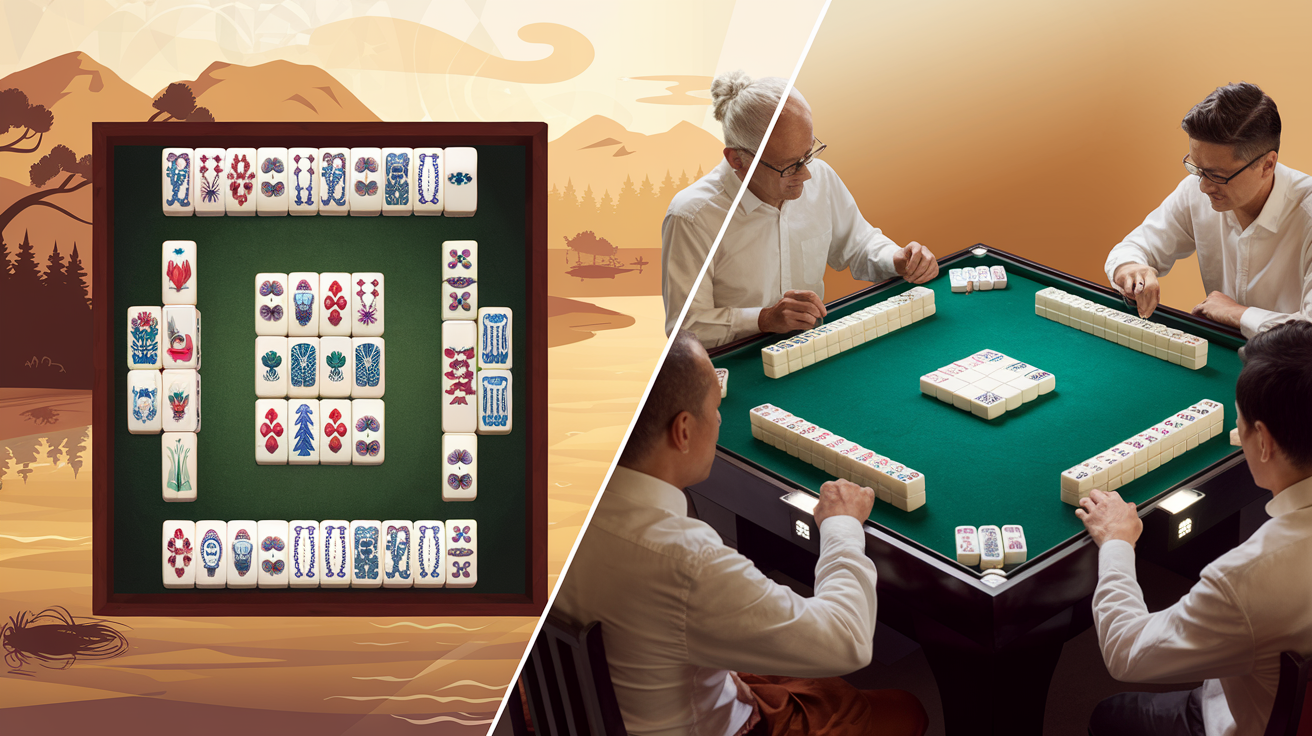
Mahjong Solitaire vs Traditional Mahjong: Understanding Two Very Different Games
When someone says they're playing "mahjong," they could mean one of two entirely different games—and that's not their fault. The naming confusion between mahjong solitaire and traditional Chinese mahjong is a genuine historical quirk worth understanding. Both use beautiful tiles, both are engaging, but they operate on completely different rules, strategies, and social contexts.
What They Share: The Tiles and the Aesthetic
Let's start with what connects them. Both games use the iconic tile sets featuring dragons, winds, flowers, bamboo, and numbered suits. The visual language is the same: the elegant design, the satisfying click of tiles, the tradition embedded in the artwork. This shared aesthetic heritage is why the name confusion happened in the first place.
Traditional Chinese mahjong developed over centuries, with the earliest evidence pointing to 19th-century China. The tile set evolved from playing cards and domino games, eventually settling into the 144-tile configuration we recognize today (in most regional variations).
But beyond the tiles themselves, the similarities largely end.
Traditional Mahjong: A Four-Player Strategy Game
Traditional mahjong is a four-player game fundamentally based on hand-building, tile drawing, and discarding. Players sit around a table in real-time, drawing tiles from a wall, building combinations called "melds" (pung, kong, chow), and attempting to complete a winning hand according to specific pattern rules. The game involves:
- Real-time interaction: Discarded tiles can be claimed by other players, creating moments where strategy shifts instantly
- Memory and calculation: Tracking which tiles have been played, calculating probabilities, remembering opponent tendencies
- Psychology: Reading opponents, deciding when to go for certain melds, recognizing when to change strategy
- Regional variations: Different regions—Cantonese, Shanghai, Sichuan—have meaningfully different rules
- Scoring complexity: Points depend on hand composition, difficulty level, and regional systems
Traditional mahjong is social, competitive, and often played for stakes. It's a game where skilled players win consistently against novices.
Mahjong Solitaire: A Single-Player Pattern-Matching Puzzle
Now we come to the historical fork. In 1981, programmer Brodie Lockard created a computer game called "Mah-Jongg" for the Apple II. Lockard's innovation was elegant: instead of building hands, players would match pairs of identical tiles on a digital board, clearing them until none remained. It's tile-matching, not hand-building. It's single-player, not multiplayer. It's puzzle-solving, not strategy in the traditional sense.
Lockard's game borrowed the tile aesthetics from traditional mahjong but discarded nearly everything about how the game actually works. This wasn't a computerization of traditional mahjong—it was a brand-new game wearing mahjong's visual identity.
The game found massive audiences, especially after Microsoft bundled a version called "Shanghai" with Windows 3.1 in the early 1990s. Millions of people encountered mahjong-the-computer-game without ever knowing about mahjong-the-centuries-old-strategy-game. The name stuck, the confusion took root, and it's persisted ever since.
Why the Confusion Happened (And Why It Matters)
This isn't a matter of someone making an error. Lockard's game was called "Mah-Jongg" because it used mahjong tiles. That was genuinely respectful of the source material. The problem emerged when the game became so dominant in the computer gaming world that "mahjong" started referring exclusively to the solitaire version for millions of people.
Today, someone typing "mahjong" into a search engine is far more likely to find solitaire games than information about the traditional game. Algorithms and market dominance have made one version of "mahjong" invisible to casual searchers, even though it's the actual historical original.
It's similar to how many people think "Pac-Man" is the oldest arcade game (it isn't), or how "Google" became synonymous with "search the internet" (even for other search engines). The more recent, more visible version of a thing can eclipse the original in public consciousness.
The Games Compared: Strategy, Skill, and Outcomes
Let's examine the actual gameplay differences:
Mahjong Solitaire:
- Single player against the puzzle
- Complete information (all tiles are visible, though some are blocked)
- Success depends on pattern recognition, spatial reasoning, and luck
- Perfect information means some boards are solvable, others aren't—strategy has real limits
- No memory demand for opponent behavior
- Skill matters, but luck matters more
Traditional Mahjong:
- Four players competing simultaneously
- Incomplete information (you don't see opponents' hands or the remaining wall tiles)
- Success depends on hand-building strategy, psychology, memory, and probability calculation
- Memory for discarded tiles directly impacts winning potential
- Reading opponents is crucial
- Skill can overcome luck over hundreds of hands
They're genuinely different games in ways that matter. Calling them both "mahjong" is like calling both chess and checkers "chess" because they're played on the same board.
Both Games Are Legitimate
None of this is meant to suggest that mahjong solitaire is somehow inferior or inauthentic. Brodie Lockard created something wonderful and addictive. Millions of people have enjoyed it. The game works perfectly well and has its own design elegance.
The point is simply clarity. If you're playing themahjong.io, you're engaging with a clever puzzle game that happens to use traditionally styled tiles. If you're learning traditional mahjong from a friend's grandmother in Beijing, you're learning a complex strategy game with centuries of depth.
Knowing the difference helps you appreciate what each game actually offers.
Moving Forward
Historically, we might call Lockard's creation more precisely "tile-solitaire" or use the Microsoft branding "Shanghai" to distinguish it. But naming conventions are shaped by millions of people and billions of searches, and "mahjong" has become vernacular for the solitaire version in English-speaking countries.
The best approach is simply to be aware of both meanings and to appreciate each game on its own terms. Mahjong solitaire deserves recognition as the clever puzzle game it is, and traditional mahjong deserves recognition as the strategic social game it's always been.
If you enjoy mahjong solitaire, that enjoyment is completely valid. And if you're curious about the original game, that curiosity is well-placed too. They're both worth experiencing—just for different reasons.
