

Mahjong Solitaire vs. Traditional Mahjong: Understanding Two Very Different Games
If you've spent time playing mahjong solitaire at themahjong.io, matching pairs of tiles to clear the board, you might assume you're playing a variant of the traditional Chinese game. But here's the truth: mahjong solitaire and traditional mahjong are essentially two separate games that simply share the same beautiful tiles. Understanding the difference helps appreciate both for what they truly are.
What They Share: The Tiles (And That's About It)
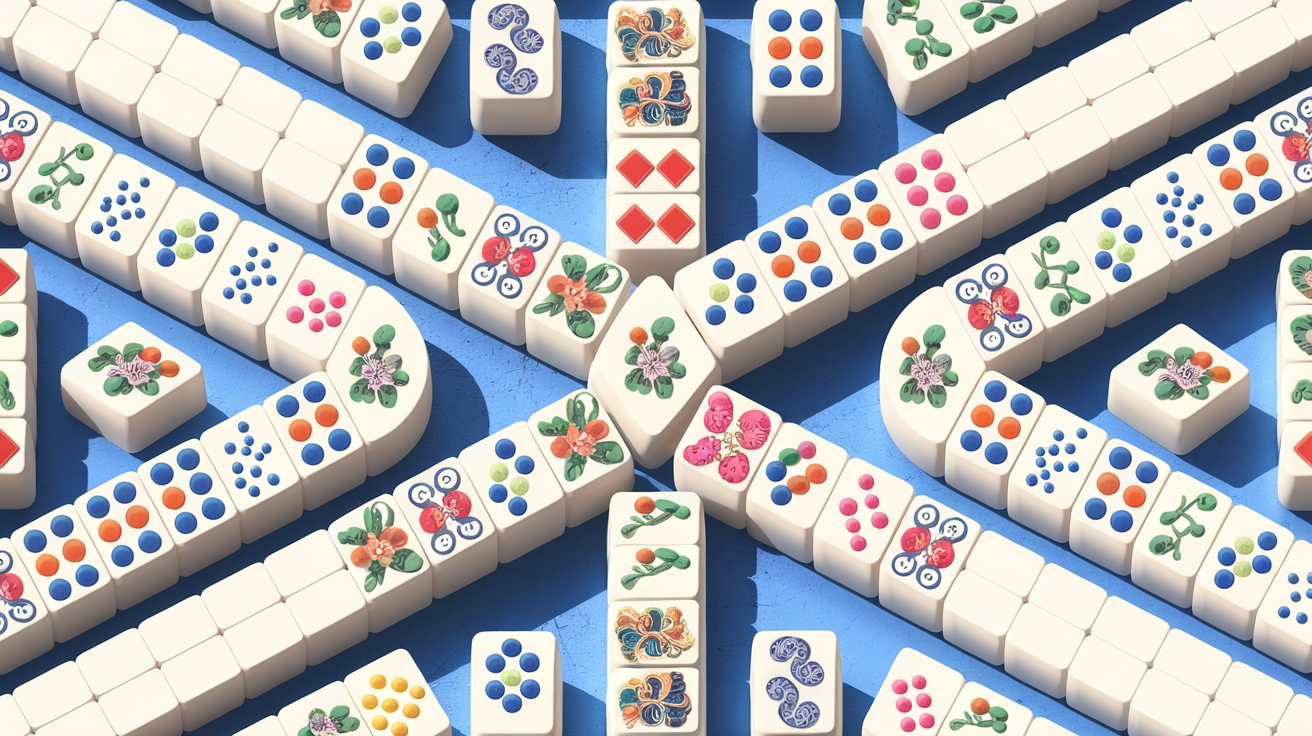
Both games use tiles decorated with Chinese characters, bamboos, circles, dragons, and winds. Both have versions that come in elegant sets. That's where the similarity largely ends.
Traditional Chinese mahjong is a four-player game involving bidding, melds, hand management, and real-time competition. It's been played for centuries, evolving across regions of China with different rule sets (Cantonese, Shanghainese, Sichuan, and others all have distinct variations).
Mahjong solitaire, by contrast, is a single-player tile-matching puzzle. You match pairs of identical tiles until the board is clear—or until you get stuck. No opponents, no melds, no bidding. It's essentially Solitaire (the card game) but with mahjong tiles instead of cards.
The Real History: 1981 and Brodie Lockard's "Mah-Jongg"
The origin of mahjong solitaire is surprisingly recent and entirely digital. In 1981, Brodie Lockard, a computer programmer, created a tile-matching solitaire game and named it "Mah-Jongg." Running on early home computers, it was conceptually simple but visually appealing: match adjacent identical tiles to remove them from the board.
Lockard's creation wasn't designed to be authentic to traditional mahjong. Rather, he took the recognizable and aesthetically pleasing mahjong tiles and applied them to a solitaire puzzle format—a genre already familiar to computer users through card-based solitaire games.
The naming choice—"Mah-Jongg"—was partially practical. The tiles were visually distinctive and culturally resonant, making them more interesting than plain shapes or numbers. It was catchy, memorable, and immediately communicated something about the game's aesthetic.
The Windows "Shanghai" Era: When One Game Became Many
What really cemented mahjong solitaire in global popular culture was Microsoft. When Windows 3.0 was released in 1990, it included a bundled version of the Lockard-style game—but Microsoft called it "Shanghai," likely avoiding potential naming conflicts or licensing issues.
Windows Shanghai became ubiquitous. For decades, whenever someone bought a computer, they got a free mahjong solitaire game. This distribution was transformative. Millions of people encountered mahjong solitaire without ever knowing it had a specific creator or that it bore only a surface-level connection to traditional mahjong.
The bundled success created a naming dilemma that persists today: many players use "mahjong" and "mahjong solitaire" interchangeably, even though they refer to different games.
Why the Confusion Endures
Several factors keep the naming conflation alive:
1. Visual Continuity – The tiles look identical to those in traditional mahjong, so the assumption feels logical.
2. Casual Dominance – Mahjong solitaire vastly outnumbers traditional mahjong players in Western markets. When most English speakers think of "mahjong," they think of tile-matching.
3. Naming Inertia – Decades of Windows bundling, computer magazines, mobile apps, and websites all using "mahjong" for solitaire created a self-reinforcing pattern.
4. Lack of Clarification – Many game developers and websites don't distinguish between the two, further embedding the confusion.
The Strategic Differences: Why They're Not Interchangeable
If you played traditional mahjong, mahjong solitaire would feel alien—not just in rules, but in how you think strategically.
Traditional Mahjong:
- Draw and discard tiles in real-time
- Form melds (sets and sequences) with other players' contributions
- Read opponents, manage risk, and adapt to changing circumstances
- Success depends on hand luck and tactical play
- Requires simultaneous attention to multiple evolving situations
Mahjong Solitaire:
- All tiles visible at the start (or revealed as you play)
- Match pairs based on position and adjacency rules
- Victory or defeat is determined before you begin (most layouts have a solution)
- Success depends on pattern recognition, memory, and logical thinking
- Pure single-player puzzle solving
In traditional mahjong, you're competing against three opponents with imperfect information. In mahjong solitaire, you're solving a deterministic puzzle.
Respecting Both Games for What They Are
There's no shame in preferring mahjong solitaire, nor in preferring traditional mahjong. They're entirely different leisure activities.
Mahjong solitaire is a relaxing, contemplative puzzle game—perfect for unwinding, exercising pattern recognition, and enjoying beautiful tile design without the social complexity of multiplayer play.
Traditional mahjong is a rich, strategic game with deep cultural roots and tremendous variety across regional rulesets. It rewards social play, quick thinking, and nuanced decision-making.
Understanding the distinction helps both communities appreciate their games more fully. When you play mahjong solitaire at themahjong.io, you're enjoying the direct descendant of Brodie Lockard's 1981 creation and Windows Shanghai—a lineage as legitimate as any game's, even if it's not rooted in centuries of Chinese gaming tradition.
The naming confusion may linger, but the games themselves are distinct enough that the distinction is worth making clear.
