

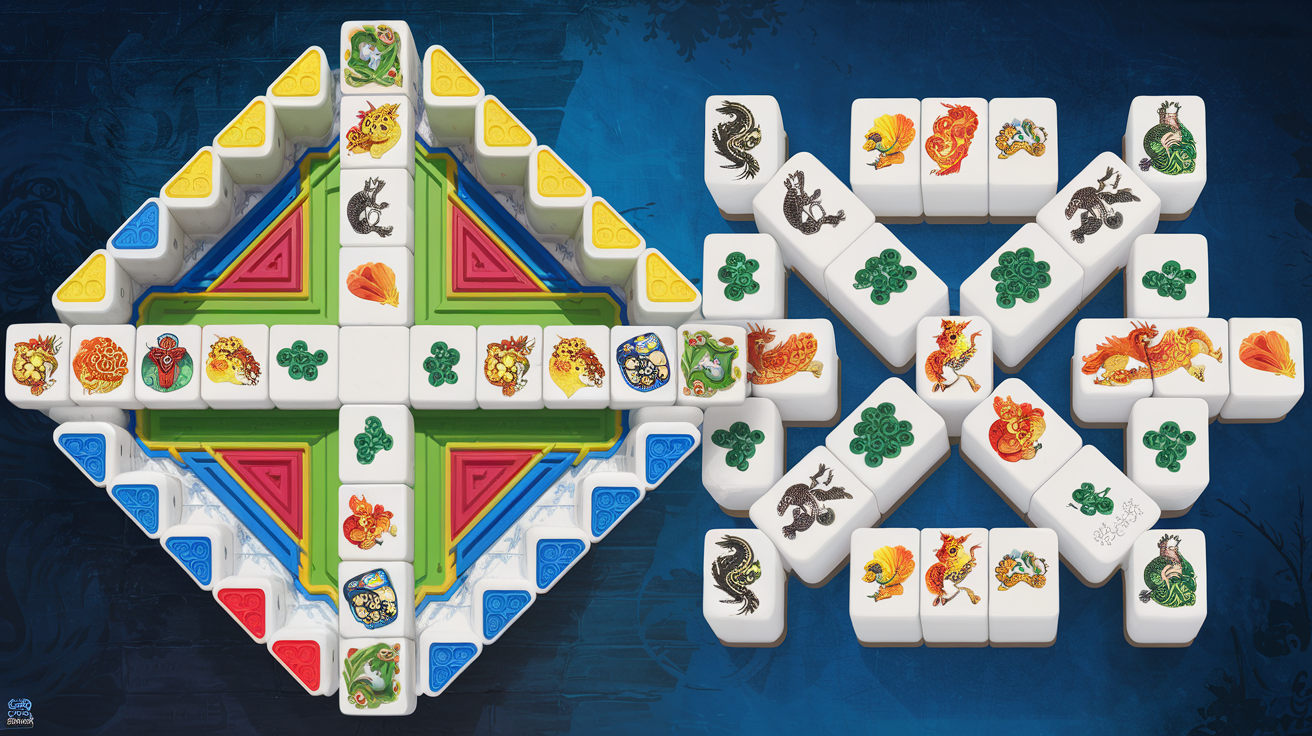
Mahjong Solitaire vs. Traditional Mahjong: Understanding Two Completely Different Games
When someone says "mahjong," most people think of one of two very different things. There's the elegant, strategic four-player game played in homes and tournaments worldwide for centuries. And then there's mahjong solitaire—the relaxing tile-matching puzzle game millions play on computers and phones. Despite sharing the same name and tiles, these are fundamentally distinct games with entirely different rules, objectives, and origins.
This confusion is understandable, even common. But understanding the distinction matters if you want to appreciate each game on its own terms.
The Real Origins of Mahjong Solitaire
Unlike traditional mahjong, which evolved gradually in 19th-century China, mahjong solitaire has a clear, documented origin: a computer programmer named Brodie Lockard created it in 1981.
Lockard developed a tile-matching puzzle game using the distinctive visual tiles from traditional mahjong, but with completely new gameplay mechanics. The game became known as "Mah-Jongg" (note the slightly different spelling, which some purists use to distinguish it from "Mahjong"). Lockard's creation was elegant in its simplicity: match pairs of identical tiles by clicking them, with the constraint that matched tiles must be free on one side (not blocked by other tiles). Clear the entire board to win.
This was entirely new. It wasn't an adaptation of mahjong rules—it was an original puzzle design that borrowed the visual language of an existing game.
The Shanghai Effect: How the Confusion Spread
The real moment that cemented the naming confusion came in 1989 when Windows 3.1 shipped with a mahjong solitaire game called "Shanghai," developed by Activision. Shanghai became ubiquitous. For millions of PC users in the 1990s and 2000s, this was their introduction to anything mahjong-related. It was bundled, free, and accessible. The name "Shanghai" faded as people naturally referred to it as "mahjong."
With no context, players didn't know about traditional mahjong—or even that Shanghai/Mah-Jongg was a relatively recent invention. The game simply became "mahjong solitaire" in common parlance, and the connection to the traditional game remained largely unexamined.
What They Share (and It's Mostly Visual)
Let's be honest: the similarities are primarily aesthetic.
Tiles: Both use mahjong tiles featuring bamboo, characters (numbers), circles, winds, dragons, flowers, and seasons. These distinctive tiles are beautiful and immediately recognizable.
Cultural resonance: Traditional mahjong carries over a century of history and cultural significance. Solitaire games tap into that aesthetic appeal, even if the gameplay diverges completely.
Theme: Both involve arranging and matching tiles in satisfying patterns.
That's largely where the overlap ends.
Where They Fundamentally Diverge
The differences are far more substantial than the similarities.
Number of Players
- Traditional mahjong: 4 players, simultaneous play
- Solitaire: 1 player, solo experience
The Core Objective
- Traditional mahjong: Form winning hands (melds and pairs) while blocking opponents and managing risk. Winning requires specific combinations, strategy, and luck with drawn tiles. The game involves bidding, scoring, and competition over multiple rounds.
- Solitaire: Clear all tiles from the board by finding matching pairs. Success is entirely deterministic—either the board layout allows you to clear it or it doesn't.
Strategy Depth
- Traditional mahjong: Incredibly complex. You must remember discarded tiles, anticipate opponents' needs, manage your hand strategically, and adapt to changing circumstances. Expert players spend years mastering it.
- Solitaire: Requires puzzle-solving and lookahead, but the strategy is primarily about pattern recognition and planning your move sequence. Once the tiles are laid out, the puzzle is fixed.
Social Component
- Traditional mahjong: Inherently social. It's played face-to-face with conversation, banter, and human interaction. The social element is central to the experience.
- Solitaire: Inherently solitary. While online versions may include leaderboards, the gameplay itself is single-player.
Luck vs. Determinism
- Traditional mahjong: Luck plays a significant role through tile draws. You can't control what tiles you receive.
- Solitaire: Pure skill and logic. Every game with the same board layout plays identically. There's no randomness in the tiles themselves, only in how you encounter them.
Why the Confusion Persists
The naming issue persists for practical reasons:
- Inertia: Decades of Windows users calling it "mahjong" created a self-reinforcing norm.
- Tile aesthetics: The visual tiles are so distinctively associated with mahjong culture that using them for a puzzle game made intuitive sense.
- Limited awareness of traditional mahjong: In many Western countries, traditional mahjong remains less known than solitaire, so people don't have a reference point.
- Marketing: Game developers and websites, including digital versions, simply called the solitaire game "mahjong" because that's what players called it.
Neither the original Lockard nor subsequent developers were trying to deceive. The naming just happened and stuck.
A Matter of Respect
Understanding the distinction doesn't diminish either game. Mahjong solitaire is genuinely engaging, requiring pattern recognition and strategic lookahead. Traditional mahjong is a sophisticated, culturally rich game of strategy and social interaction.
Knowing they're different games simply means appreciating each for what it actually is. Someone who enjoys solitaire but struggles with traditional mahjong shouldn't feel confused about their own preferences—they're enjoying different things entirely.
If you love the logic puzzles of mahjong solitaire, that's wonderful. If you're curious about the historical game, that's a separate journey altogether. Both have merit. Both deserve to be understood clearly.
Conclusion
Mahjong solitaire is not a simplified version of traditional mahjong, nor is traditional mahjong a complex version of solitaire. They're distinct games that share tiles and a name, but little else. Understanding this history—from Brodie Lockard's 1981 invention through Windows' Shanghai bundling to today's digital versions—helps us appreciate each game more fully.
Whether you're enjoying a relaxing game of solitaire at themahjong.io or learning the intricacies of traditional four-player mahjong, you're engaging with different games. And that's perfectly okay.
