

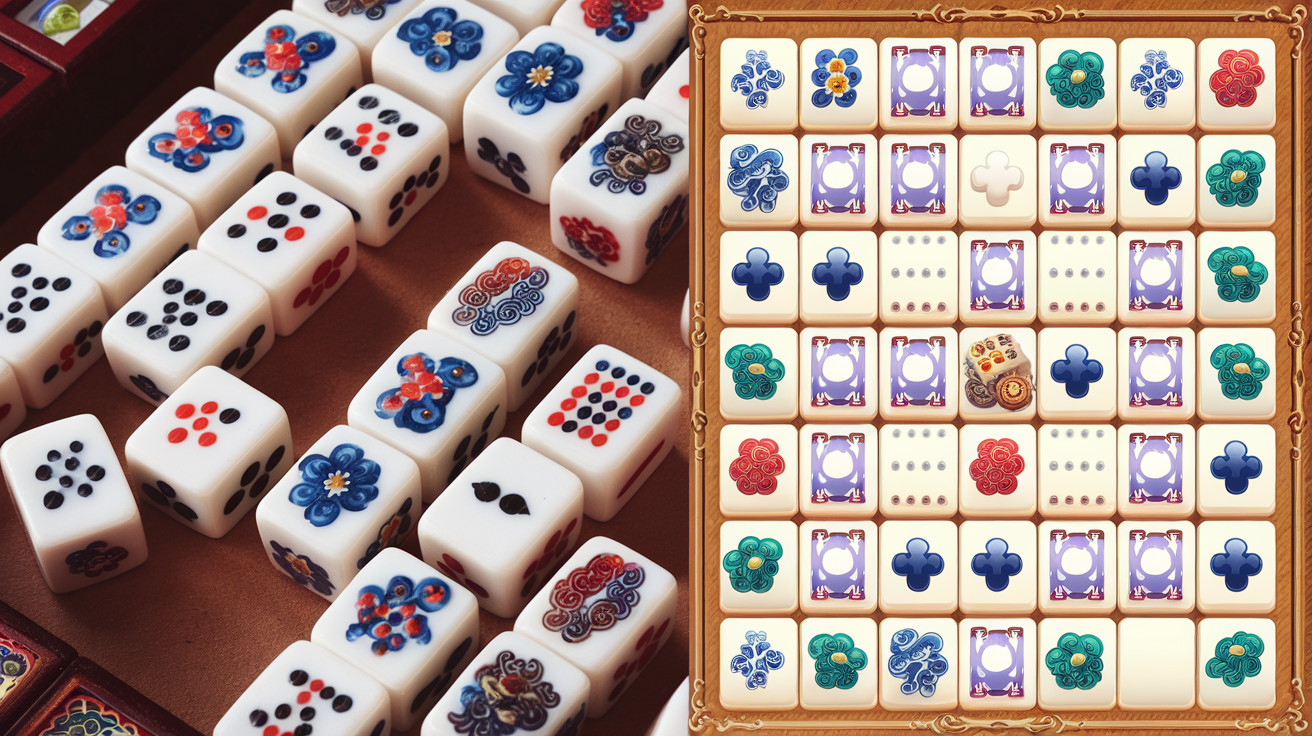
Mahjong Solitaire vs. Traditional Mahjong: Understanding Two Completely Different Games
If you've played mahjong solitaire on your computer or smartphone, you might assume you're playing the same game people have enjoyed in China for centuries. The reality is more interesting: mahjong solitaire is a modern invention that borrowed tiles and aesthetics from traditional mahjong but created something entirely new. Understanding this distinction helps you appreciate both games for what they truly are.
What They Actually Share
Let's start with the honest common ground. Both games use the iconic set of mahjong tiles featuring Chinese characters, bamboo sticks, dots, and other symbols. Both evoke the rich visual tradition of Chinese culture. Both involve matching or organizing tiles in some way. And both have become beloved pastimes around the world.
That's largely where the similarities end.
The Birth of Mahjong Solitaire: 1981
The story of mahjong solitaire begins not in ancient China, but in 1981, when American computer programmer Brodie Lockard created a software game called Mah-Jongg for the Apple II computer. Lockard's innovation was elegant and clever: he took the visual elements of traditional mahjong tiles and designed a single-player puzzle game based on matching pairs.
The concept was straightforward. Tiles were arranged in a specific pattern, and the player's goal was to remove all tiles by matching identical pairs. You could only remove a pair if at least one side of each tile was free—they couldn't be blocked by other tiles. This simple rule created surprisingly deep puzzle-solving challenges.
Lockard wasn't trying to recreate traditional mahjong; he was creating something new. And it worked. The game was accessible, satisfying, and perfect for a computer era when people wanted solo entertainment they could pick up and put down quickly.
Shanghai and Windows: How Mahjong Solitaire Became Ubiquitous
The real turning point came in 1986 when a company called Activision released Shanghai, their own version of the tile-matching puzzle game. Shanghai became massively popular, particularly after it was bundled with Windows 3.0 in the early 1990s. For millions of people, Shanghai (or simply "Mahjong") was their introduction to any mahjong-related game, and it shaped how the broader public understood the word "mahjong" itself.
By including a mahjong solitaire variant in Windows, Microsoft essentially introduced an entire generation to this puzzle game. The problem: most players didn't realize this was a different game entirely from the traditional four-player mahjong their Chinese grandparents might have played.
What is Traditional Mahjong?
Traditional mahjong is a four-player competitive card-like game that dates back to 19th-century China (not ancient times, as some imagine). It involves strategy, memory, reading opponents, managing risk, and understanding complex scoring rules. Players draw and discard tiles, trying to form specific patterns called "melds." Victory requires not just luck, but skill in hand management and psychological play.
It's genuinely social. You need four players, communication is part of the game, and skilled players can influence outcomes through strategic decisions. Traditional mahjong requires learning numerous rules, hand combinations, and variations—it's complex in ways that reward dedicated study.
Why Mahjong Solitaire Is Completely Different
Mahjong solitaire is a single-player puzzle game with no strategy in the traditional sense. There are no opponents to outmaneuver. There's no hidden information or bluffing. The outcome of any given puzzle is either possible or impossible—determined entirely by the arrangement of tiles, not by player skill at decision-making or psychological play.
In mahjong solitaire, you see all the tiles. The challenge is spatial reasoning: understanding which pairs are accessible and planning your moves to avoid getting stuck with unmatched tiles. It's more like Tetris or Sudoku than traditional mahjong. Many arrangements can be solved multiple ways, but some cannot be solved at all, regardless of skill.
The strategic depth comes from puzzle design, not from player choices against opponents.
Why the Naming Confusion Persists
The confusion between these games isn't accidental—it's understandable. Activision chose the name "Shanghai" partly to evoke the game's Asian heritage and connection to mahjong culture, even though it was fundamentally different. When Microsoft bundled it with Windows under the name "Mahjong," they solidified this conflation in popular culture.
Today, when people hear "mahjong," they're far more likely to picture the solitaire version than the traditional game. This isn't anyone's fault; it's just how cultural naming works. The more accessible, computer-based version became dominant in Western consciousness.
The Games Are Both Worth Playing
The point of understanding this distinction isn't to dismiss one game or elevate the other. Both are genuinely worthwhile:
Mahjong solitaire offers satisfying puzzle-solving, beautiful aesthetics, and relaxation. It's accessible, can be played anytime, and offers genuine intellectual challenge in optimizing your tile removal strategy.
Traditional mahjong offers social engagement, strategic complexity, competitive play, and connection to genuine cultural history. It rewards learning, memory, and interpersonal skill.
Some people enjoy both. Many excel at one and have no interest in the other. Neither preference is wrong.
Conclusion
When you play mahjong solitaire at themahjong.io, you're enjoying a clever game born from digital innovation in 1981, perfected and popularized in the 1980s and 1990s. You're not playing the centuries-old game from China—and that's perfectly fine. Both games deserve respect and recognition for what they are.
Understanding the difference actually enriches your appreciation for both. It explains why traditional mahjong enthusiasts sometimes seem puzzled by solitaire players calling their game "mahjong"—and it helps solitaire fans understand there's another, very different game sharing the same name. In the end, both games have earned their place in global culture on their own merits.
