

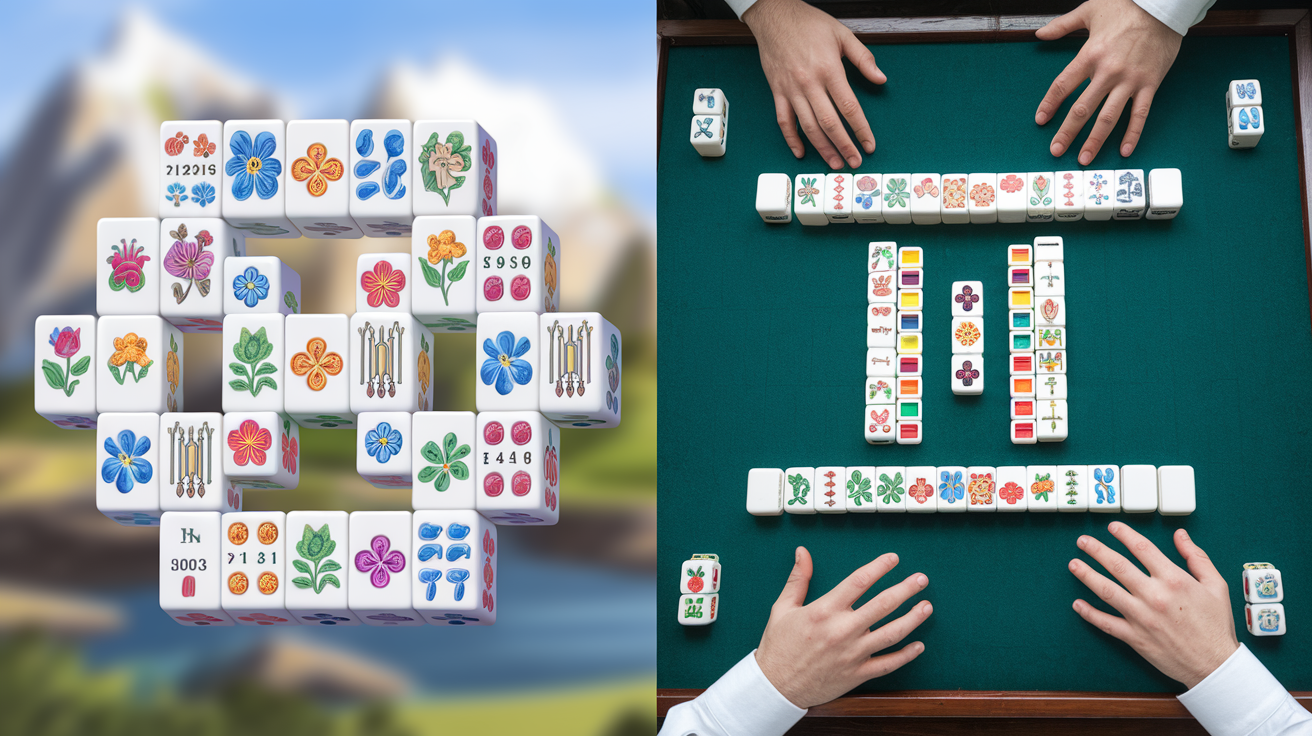
Mahjong Solitaire vs. Traditional Mahjong: Understanding Two Different Games
It's a common misconception that mahjong solitaire—the tile-matching puzzle game you can play online at themahjong.io—is the same game as traditional Chinese mahjong. While both games use similar tiles and share a cultural heritage, they are fundamentally different games with separate origins, rules, and strategies. Understanding this distinction helps players appreciate each game on its own merits.
The Real Origins: A Computer Game from 1981
The story begins not in ancient China, but in 1981 when computer programmer Brodie Lockard created a solitaire game inspired by traditional mahjong tiles. Lockard's innovation was elegant: rather than adapting the complex multiplayer strategy game for solo play, he created an entirely new puzzle format where players match pairs of identical tiles on a layout board until all tiles are cleared.
This wasn't a faithful simplification of traditional mahjong—it was a creative adaptation of the aesthetic and tile sets into a completely new game structure. Lockard's version gained popularity in computer gaming circles, but its real breakthrough came later.
Shanghai: The Game That Changed Everything
In the late 1980s and early 1990s, a version of this tile-matching game was bundled with Microsoft Windows under the name "Shanghai." This distribution decision was pivotal. Millions of personal computer users were suddenly exposed to a tile-matching puzzle game, and many naturally assumed it was "mahjong" based on the tiles they saw.
The bundling of Shanghai with Windows made it one of the most widely played digital games of the 1990s. Its popularity cemented the association between mahjong tiles and solitaire gameplay in the public consciousness. For many people worldwide, "mahjong" became synonymous with matching tiles on a computer screen.
Why the Naming Confusion Persists
The naming conflation exists for several practical reasons:
1. Shared Visual Language — Both games use the same traditional tile designs (bamboos, characters, dots, winds, dragons, flowers, and seasons). When players see these tiles, they naturally think "mahjong."
2. Historical Licensing — Early digital adaptations borrowed the cultural cache of mahjong to attract players, using the name even when the gameplay was entirely different.
3. Casual Gaming Culture — For casual players, the distinction between "mahjong solitaire" and "traditional mahjong" feels academic. Both involve tiles and strategy, so they're grouped together colloquially.
4. Global vs. Regional Awareness — In Western countries, most people encountered mahjong through solitaire first, making the solitaire version their baseline understanding of what "mahjong" means.
The Games Compared: Fundamental Differences
Traditional Chinese Mahjong
Players: Four players (sometimes three)
Duration: 15-30 minutes per game
Setup: Tiles are shuffled and stacked in walls; players draw tiles over multiple rounds
Objective: Form combinations (melds) of tiles and declare "mahjong" when hand requirements are met
Strategy Elements:
- Reading opponents' hands
- Discarding strategically to block other players
- Remembering which tiles have been played
- Managing risk (going for high-scoring hands vs. safe finishes)
- Tile probability and probability assessment
Luck vs. Skill: Heavy luck component (tile draw), but significant skill in decision-making and strategy
Social Element: Essential—player interaction, negotiation, and psychology are core to the game
Mahjong Solitaire
Players: One player (solo)
Duration: 5-20 minutes per game
Setup: All tiles are visible from the start in a predetermined layout (usually a pyramid or pattern)
Objective: Match pairs of identical tiles and remove them until the board is cleared
Strategy Elements:
- Pattern recognition
- Spatial reasoning
- Planning ahead to avoid creating unmatched tiles
- Understanding which tile removals create cascades
- Memory (remembering which tiles are where)
Luck vs. Skill: Mostly deterministic—all information is visible; success depends on player skill
Social Element: Optional—can be purely solitary or played competitively through score comparison
What They Share
Despite their differences, the two games do share meaningful connections:
Tile Designs — Both use the same beautiful traditional tile imagery (bamboos, characters, dragons, etc.)
Cultural Heritage — Both celebrate Chinese gaming traditions and aesthetics
Cognitive Benefits — Both require memory, pattern recognition, and strategic thinking
Accessibility — Both are relatively easy to learn at a basic level, though mastery takes time
Global Appeal — Both have found audiences far beyond their origins
Respecting Both Games
Understanding that mahjong solitaire and traditional mahjong are different games doesn't diminish either. Mahjong solitaire is a legitimate, enjoyable puzzle game with its own merits. Traditional mahjong is a rich, complex social game with centuries of strategic depth.
Thinkers and enthusiasts often prefer one or the other based on what they enjoy: traditional mahjong players appreciate the social dynamics and probability management, while solitaire players enjoy the pure puzzle-solving aspect without the social requirement.
When you play mahjong solitaire at themahjong.io, you're enjoying a game that traces its lineage back to both Brodie Lockard's 1981 innovation and the tile traditions of ancient China—but you're playing a distinctly modern creation. That's worth appreciating in its own right.
The Takeaway
The next time someone asks you what game you're playing, you can confidently say: "Mahjong solitaire—it uses mahjong tiles, but it's actually a completely different game from traditional mahjong." You'll be historically accurate, and you'll help spread awareness of an important distinction that enriches our understanding of both games.
Both deserve respect, both offer enjoyment, and both have secure places in gaming culture—they're just very different experiences.
