

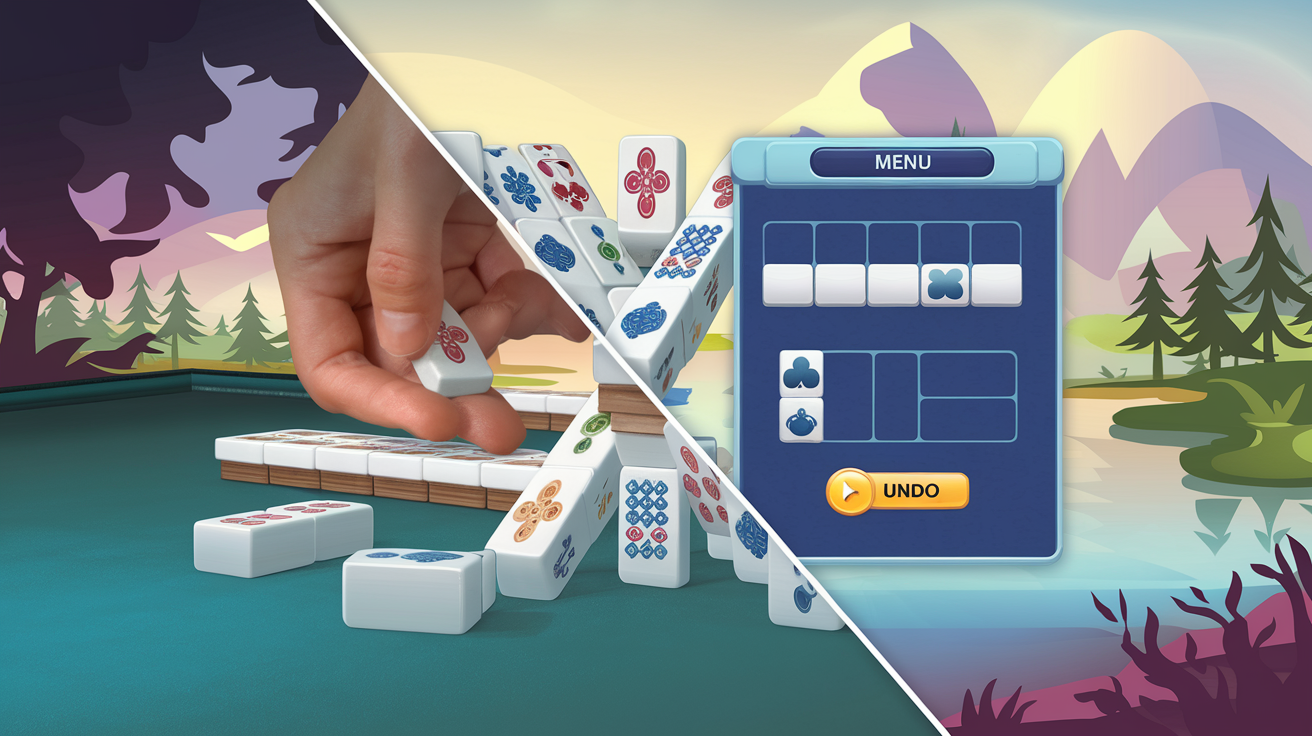
The Mahjong Solitaire Undo Debate: Essential Learning Tool or Game-Breaking Convenience?
For decades, mahjong solitaire players have engaged in a quiet but persistent debate that rarely breaks into formal discourse: Is the undo function a legitimate and necessary feature, or does it fundamentally compromise the game's integrity? This question sits at the intersection of game design philosophy, learning methodology, and personal gaming values—and the community remains genuinely divided.
Unlike debates about rule variations or scoring systems, the undo conversation happens mostly in forum comments, Discord servers, and between friends. Yet it touches on something deeper than mere mechanics. It asks: What is mahjong solitaire actually for? Is it primarily a puzzle to solve through strategic thinking, or an experience of recovery from mistakes? Should every decision carry permanent weight, or should learning from errors take precedence over consequence?
The Purist Position: Every Move Should Be Permanent
Traditional game enthusiasts argue that unlimited undo fundamentally alters what mahjong solitaire means as a game. Their reasoning is straightforward but compelling:
Consequence Creates Meaning. Purists contend that a move only matters psychologically when it's irreversible. The tension before selecting a pair, the regret after a poor decision, the relief of success despite challenges—these emotional beats define the experience. Undo flattens this landscape into consequence-free exploration.
Strategic Depth Requires Risk. When you can always undo, there's no genuine opportunity cost to any decision. Classic game design theory holds that meaningful choices require tradeoffs. Should you take the safe pair now or gamble on finding a better sequence? With unlimited undo, this question becomes academic. You simply try both paths and pick the one that works.
Wins Lose Their Value. Completing a difficult layout feels different when you've navigated actual constraints versus when you've essentially trial-and-errored your way to victory. Purists argue that unlimited undo converts genuine wins into mere puzzles solved through exhaustion, not strategy.
Comparison to Physical Tiles. Traditional mahjong solitaire with physical tiles doesn't offer undo. You place tiles, they stay placed. This constraint is part of the authentic experience, and digital versions that remove it drift further from the game's origins.
These arguments aren't strawman positions—they reflect genuine gaming philosophy shared by speedrunners, roguelike enthusiasts, and players who value permadeath mechanics as features, not bugs.
The Learning-Focused Position: Undo Is Essential
Conversely, many experienced players—including some competitive-minded strategists—argue that undo is not just legitimate but pedagogically necessary:
Mistakes Are Teaching Moments, Not Punishment. The learning camp emphasizes that mahjong solitaire is fundamentally a pattern-recognition and strategic puzzle game. When you make a suboptimal move, unlimited undo lets you immediately understand why it was suboptimal. This rapid feedback loop dramatically accelerates skill development. Forcing permanent consequences creates frustration, not learning—especially for novices.
Solving vs. Playing. Proponents argue there's a crucial distinction between solving a layout and playing against it. When you can undo, you're essentially in solve mode—exploring the puzzle systematically. This isn't "cheating" at the game; it's engaging with the game in its most intellectually rigorous form. The puzzle either has a solution or it doesn't. Undo helps you find it.
Accessibility and Enjoyment. Not everyone plays for the adrenaline rush of permanent stakes. Many players simply enjoy the meditative, puzzle-solving aspect. For them, undo removes frustration that stems from randomness or unfamiliar layouts, not from poor strategy. It makes the game more enjoyable without reducing its intellectual challenge.
Modern Game Design Trends. Contemporary puzzle game design (see: Slay the Spire, Inscryption, many roguelikes) often includes "rewind" mechanics precisely because they enable better decision-making without eliminating challenge. This reflects an evolution in how the industry thinks about consequence and player agency.
Comparative Difficulty Remains. Even with unlimited undo, some layouts are genuinely harder than others. The feature is a tool within the puzzle, not a solution generator. You still have to understand the optimal play.
How Different Platforms Handle Undo
The market's approach to this question is surprisingly varied:
themahjong.io implements unlimited undo with no penalties or restrictions. This represents an explicit design choice prioritizing exploration and learning. Players can move backward as many times as needed, making the platform ideal for those focused on strategy mastery and layout analysis.
Mobile Apps and Casual Platforms typically offer 1-3 undos per game, creating a middle ground. You can recover from obvious mistakes but not indefinitely reverse your strategy. This compromise attempts to preserve some consequence while remaining forgiving.
Speedrunning Communities and some hardcore implementations reject undo entirely or offer it only between sessions, enforcing a commitment to each run. These communities explicitly embrace consequence as part of the challenge.
Licensed Digital Mahjong (often tied to tournaments) varies significantly. Some competitive implementations offer no undo at all, while others provide limited undos to match the rules of physical play.
This diversity suggests no industry consensus exists—and there may not be a "correct" answer.
The Philosophical Resolution
After examining both positions seriously, the resolution isn't that one side is objectively right. Instead, it's that undo is a mode selection, not a moral question.
The key insight is this: mahjong solitaire can legitimately be engaged with in multiple modes. In puzzle mode, unlimited undo makes perfect sense—you're solving a spatial problem, and your tool helps you understand it fully. In challenge mode, the absence of undo creates different, equally valid engagement.
The question isn't whether undo is legitimate. Rather, it's whether the platform should allow players to choose their mode, or whether limiting undo should be the default.
Our Position: themahjong.io's unlimited undo approach is justified because:
- It serves learning. Players genuinely do improve faster by analyzing mistakes immediately.
- It respects player autonomy. Players can self-impose restrictions if they prefer them.
- It reduces frustration gatekeeping. Not every player has time for repeated failed runs; unlimited undo makes the game accessible without being trivial.
- Difficulty emerges naturally. Some layouts are genuinely hard. Undo doesn't eliminate this.
However, we'd argue that the "purist" position has merit too. Ideally, players should have the option to toggle permanent moves if they want that mode.
Conclusion
The undo debate persists because both camps are asking the right question: What should this game feel like? Rather than declaring one answer correct, we should recognize that different players legitimately want different experiences.
For casual learners and strategy enthusiasts, unlimited undo transforms mahjong solitaire into an intellectually engaging puzzle-solving experience. For players seeking tension and consequence, self-imposed restrictions create that dynamic. The feature itself is neutral—its value depends entirely on what the player seeks from the game.
What matters most is that players can make informed choices about how they want to engage with the game. In that spirit, unlimited undo isn't game-breaking—it's democratizing.
What's your position in this debate? Visit themahjong.io and tell us whether you play with undo as a safety net or treat each move as sacred.
