

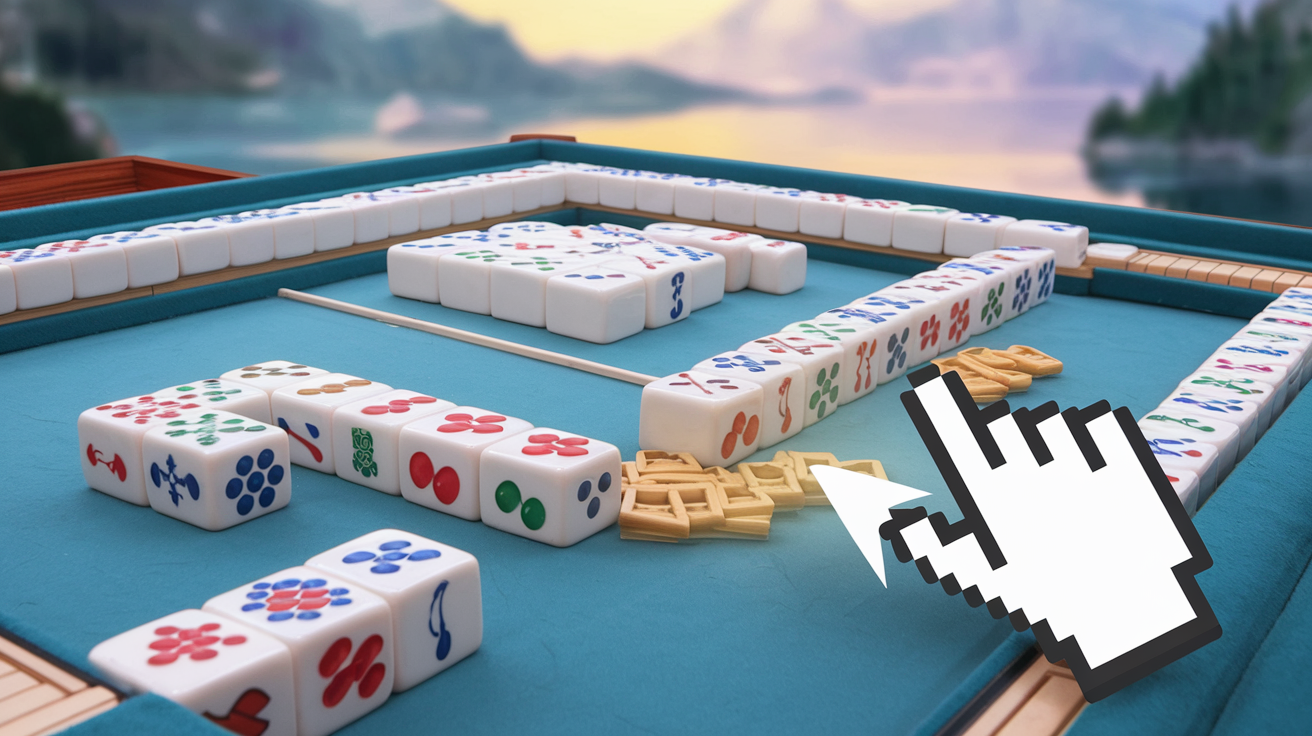
The Great Mahjong Solitaire Debate: Is Undo a Crutch or a Learning Tool?
Among mahjong solitaire players, few topics generate as much passionate discussion as the question of undo buttons. Should every move be permanent, forcing players to live with their mistakes? Or does the ability to reverse decisions create a more forgiving, educational experience that actually improves gameplay? This seemingly simple question has divided the community into two thoughtful camps, each with compelling arguments.
The Purist Position: Permanence as Integrity
Traditional mahjong players often argue that undo fundamentally changes the game's nature. In their view, mahjong solitaire is a game of consequence. Every tile you remove is gone forever, and this permanence creates meaningful strategy. When moves matter irrevocably, players must:
- Think before acting: Without undo, each decision carries weight. Players develop deliberate habits rather than making reflexive moves.
- Accept imperfection: Part of the skill involves recovering from mistakes, finding alternative paths when your preferred strategy doesn't work out.
- Experience genuine challenge: A win feels earned when every move counted, when one careless decision couldn't simply be erased.
Purists often reference traditional mahjong variants, where the rules are immutable and mistakes are learning experiences embedded in memory. They argue that unlimited undo transforms mahjong solitaire from a game of strategy and consequence into something closer to a puzzle, where trial-and-error replaces genuine skill development.
This perspective also emphasizes what's lost: the emotional resonance of your choices. A narrow victory achieved despite a near-disaster feels qualitatively different from a victory where you could simply rewind time whenever things looked uncertain.
The Learning Camp: Undo as Educational Bridge
Conversely, many players argue that undo is not just legitimate—it's essential to the game's educational value. Their reasoning goes:
- Mistakes reveal patterns: When players can undo and replay sequences, they begin to understand why a move didn't work. Without undo, the opportunity for immediate feedback and course-correction disappears.
- Accelerated improvement: Trial-and-error with undo allows players to test hypotheses rapidly. This compressed feedback loop helps newer players understand board dynamics they might otherwise miss.
- Accessibility matters: Not everyone approaches games the same way. Some players find permanent consequences paralyzing rather than motivating. Undo makes mahjong solitaire accessible to those with different learning styles or patience thresholds.
- Fun isn't diminished: Advocates point out that even with unlimited undo, the game remains challenging. Better players still win more consistently. Undo doesn't make victory trivial—it changes the nature of the challenge.
This camp often cites video game design theory, noting that undo buttons have been standard in puzzle games for decades because they improve the experience without reducing genuine challenge. They ask: would Portal or The Witness be worse games with save-states? Most would argue no.
How Different Platforms Choose
The variance in implementation across mahjong platforms reflects this ongoing debate:
TheMahjong.io implements unlimited undo with no move restrictions. Players can reverse any sequence of moves and replay sections freely. This reflects a design philosophy that prioritizes learning and player autonomy. The platform trusts that the inherent puzzle complexity—the combinatorial challenge of finding winning paths—remains engaging even without permanent consequences.
Traditional digital mahjong implementations (some mobile apps, older PC versions) often limit undo or disable it entirely after the first few moves. These versions lean toward the purist perspective, enforcing consequence while allowing minimal recovery.
Hybrid approaches exist as well. Some platforms offer "limited undo"—typically three to five reversals per game—forcing players to use them strategically. Others present undo as an optional challenge modifier: play with it enabled for relaxed learning, or disable it for purist scoring.
Competitive implementations almost universally forbid undo entirely, recognizing that tournament play requires absolute permanence to maintain integrity.
The Middle Ground: Context Matters
What becomes clear in examining this debate is that context determines appropriateness. A single answer likely doesn't serve all situations:
For learning: Unlimited undo seems optimal. New players benefit from immediate feedback loops and the ability to test strategic ideas.
For casual play: Players should choose their own preference. Some find unlimited undo relaxing; others find it removes stakes entirely.
For competitive play: Permanence is non-negotiable. Any form of undo would corrupt the competitive integrity.
For achievement-seeking: Perhaps a tiered system makes sense—easy difficulty allows unlimited undo, harder difficulties restrict it increasingly.
Our Position: Unlimited Undo as a Design Feature, Not a Compromise
After examining both perspectives, we believe unlimited undo is not a concession to weakness but an intentional design choice that actually expands rather than reduces the game's value.
Here's why: mahjong solitaire's core challenge isn't about consequence—it's about board visualization and strategic depth. The real skill is recognizing which tile sequences unlock winning paths, not remembering moves for an entire game without error. A player who can't execute their strategy due to a single misclick hasn't failed strategically; they've failed mechanistically.
Undo separates the actual puzzle (finding the solution) from the execution game (remembering moves). This separation has benefits:
Strategic purity: Players focus on mahjong logic, not move memorization or fear-based hesitation.
Replayability: With undo, a game becomes a space for exploration rather than a one-shot attempt. Players stay engaged longer, trying different approaches on the same board.
Genuine accessibility: Undo transforms mahjong from "experience this puzzle exactly right or restart" to "explore this puzzle at your own pace." This isn't less challenging; it's differently challenging.
Learning acceleration: The cognitive science is clear: immediate feedback and iteration drive learning faster than consequence-based trial-and-error.
Furthermore, we'd note that no one argues competitive chess would be improved by time pressure so severe that players can't think carefully. Context matters. In a context where players are learning and exploring (casual mahjong solitaire), unlimited undo removes artificial barriers to engagement.
Conclusion
The undo debate reflects something healthy: a community that cares about game design. But we believe the answer is clearer than the debate suggests. Unlimited undo isn't a feature for those who lack skill—it's a feature that reveals and develops skill by isolating strategic thinking from mechanical execution.
TheMahjong.io's implementation reflects this philosophy. We believe players improve faster, enjoy themselves more, and develop genuine mahjong intuition when they can focus entirely on board logic rather than managing irreversible consequences.
Ultimately, both camps care about mahjong solitaire's integrity. They simply disagree on what threatens or protects it. We land with the learning camp—not because we lack respect for consequences, but because we believe the real game is the puzzle, not the permanence.
