

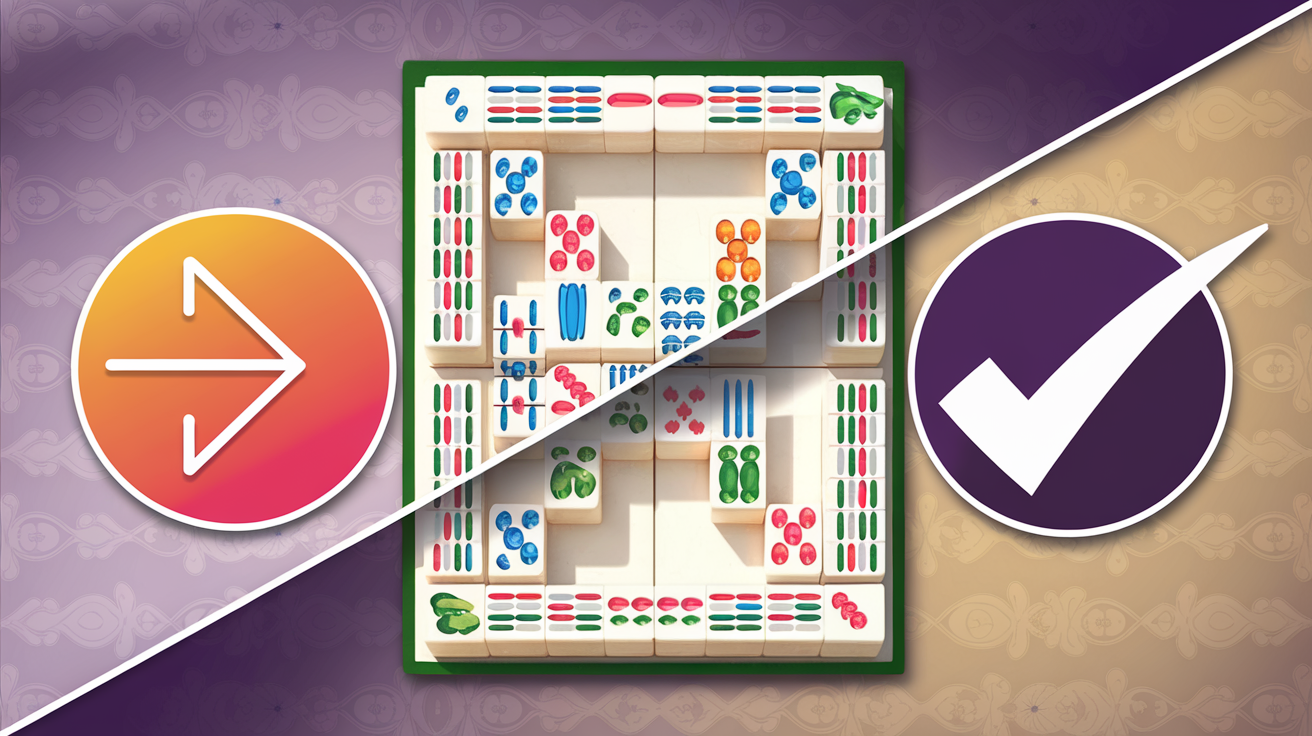
The Great Mahjong Solitaire Undo Debate: Learning Tool or Game-Breaking Crutch?
Walk into any mahjong solitaire forum, Discord server, or Reddit thread, and you'll eventually encounter a question that divides the community with surprising intensity: Is undo a legitimate feature that enhances learning, or does it fundamentally undermine the game's integrity?
This isn't a new debate, but it's rarely been examined seriously in long-form writing. Players are passionate about it—sometimes vehemently so. Yet the conversation remains scattered across forum posts and casual discussions. It's time to bring this important discussion into the light and understand both sides of what has become the great philosophical divide in mahjong solitaire.
The Case FOR Unlimited Undo: The Learning Advocates
Proponents of unlimited undo functionality argue that the feature is essential to how mahjong solitaire should be played, particularly for learning and improvement.
The Learning Argument The strongest case for undo centers on learning. Mahjong solitaire, unlike many digital games, has perfect information—you can see every tile on the board. This means wrong moves aren't due to hidden information or chance; they're due to miscalculation or poor pattern recognition. When a player makes a mistake and can't undo it, they don't learn much from the error. Instead, they're forced to restart the entire game.
Undo allows players to experiment with different tile combinations, test hypotheses about tile arrangements, and understand the consequences of their decisions. A player might think, "What if I take this tile instead?" Without undo, exploring these options requires starting fresh. With unlimited undo, players can efficiently learn optimal patterns through trial and refinement.
The Practical Reality Argument Undoing has always been part of physical mahjong solitaire. In tile-based versions, players simply pick up tiles they've removed. The feature is intuitive and mirrors how the game has been played for generations. Digital implementations, according to undo advocates, should preserve this accessibility.
Moreover, fatigue and careless mistakes happen. A player might misclick or make a decision without full consideration. Should an entire game be forfeit because of a single slip? For recreational players—which most solitaire players are—unlimited undo simply makes the experience more enjoyable and less frustrating.
The Accessibility Angle Undo also improves accessibility for players with cognitive challenges, vision impairments, or those who play casually. For these players, undo isn't a crutch; it's the difference between enjoying the game and finding it impossibly frustrating.
The Case AGAINST Unlimited Undo: The Purist Position
Opponents of unlimited undo argue that the feature guts the game of challenge and meaningful decision-making.
The Challenge and Consequence Argument Purists contend that consequence is what makes games meaningful. In mahjong solitaire, each move should matter. When undo is unlimited, there's no real risk to any decision. You can simply experiment until you find the winning path, which transforms the game from a puzzle of strategic thinking into a process of brute-force trial and error.
Without consequences, there's no tension. There's no real challenge. According to this view, allowing unlimited undos is equivalent to playing with unlimited retries in a roguelike game—it fundamentally changes the experience from one of meaningful choice to one of gradual optimization.
The True Learning Argument (The Purist Counterpoint) Interestingly, purists also claim their position supports better learning. They argue that permanent mistakes teach more effectively than reversible ones. When you make a bad move and can't take it back, you remember it. You develop pattern recognition and foresight more deeply because the stakes matter.
Additionally, unlimited undo allows players to solve games through brute force rather than understanding. A player might remove tiles randomly until they stumble upon a solution, learning nothing in the process. Permanent moves force genuine strategic thinking.
The Game Integrity Argument From this perspective, unlimited undo changes what game you're playing. It's no longer "Can you solve this puzzle?" but rather "Will you eventually solve this puzzle through enough attempts?" These are fundamentally different challenges. Purists argue that diluting the rules dilutes the achievement of actually solving a game fairly.
How Different Platforms Implement Undo
Different mahjong solitaire platforms have made different choices, reflecting the genuine controversy within the community.
The themahjong.io Approach Themahjong.io implements unlimited undo, positioning itself as a learning-friendly platform. This aligns with their philosophy that mahjong solitaire should be accessible and educational. Players can experiment freely, undo moves without penalty, and focus on pattern recognition and strategy without the anxiety of permanent mistakes. This approach acknowledges that most players are recreational and want an enjoyable, low-stress experience.
Competitive and Purist Platforms Other implementations restrict undo—some allowing only 1-3 undos, others offering none. These platforms target players who want a "true" mahjong solitaire experience with real consequences. Some even track and celebrate games completed without a single undo as a special achievement.
Hybrid Approaches Many platforms offer both modes, letting players choose. This pragmatic middle ground acknowledges that the debate has validity on both sides and that different players have different preferences.
The Middle Ground: Context Matters
Perhaps the truest insight is this: the role of undo depends entirely on what you're trying to accomplish.
If you're learning mahjong solitaire, unlimited undo is genuinely valuable. If you're competitive or seeking maximum challenge, restricted undo creates more meaningful gameplay. If you're playing casually to relax, unlimited undo reduces frustration.
The problem arises when one side insists their preference should apply universally. It simply shouldn't.
Our Position: Unlimited Undo Is the Right Default
After examining both perspectives, we believe unlimited undo—as implemented on themahjong.io—is the right default for a few reasons:
Perfect information games benefit from undo. Since mahjong solitaire features perfect information, mistakes aren't about luck—they're about miscalculation. Undo addresses this directly.
Accessibility matters. Creating inclusive experiences for all players, regardless of ability or casual engagement level, should be the priority.
Learning is actually superior with undo. While purists claim permanent mistakes create better learning, cognitive science suggests that spaced reflection—which undo enables—produces better pattern recognition than pure punishment.
Players can self-impose restrictions. If someone wants a no-undo challenge, they can simply not use the feature. Conversely, removing undo entirely restricts options for those who need or want it.
Engagement increases with undo. Games that are frustrating get abandoned. Games that allow experimentation and recovery maintain engagement. Higher engagement means more play, more learning, and more enjoyment.
The purist position has philosophical merit, but it shouldn't be imposed on recreational players. A platform that respects player autonomy by offering unlimited undo—while perhaps acknowledging that some seek the challenge of permanent moves—strikes the right balance.
What matters most isn't whether you undo; it's whether you're engaged, learning, and enjoying the game. Themahjong.io's approach trusts players to use undo thoughtfully, supporting their journey rather than dictating how they should play.
