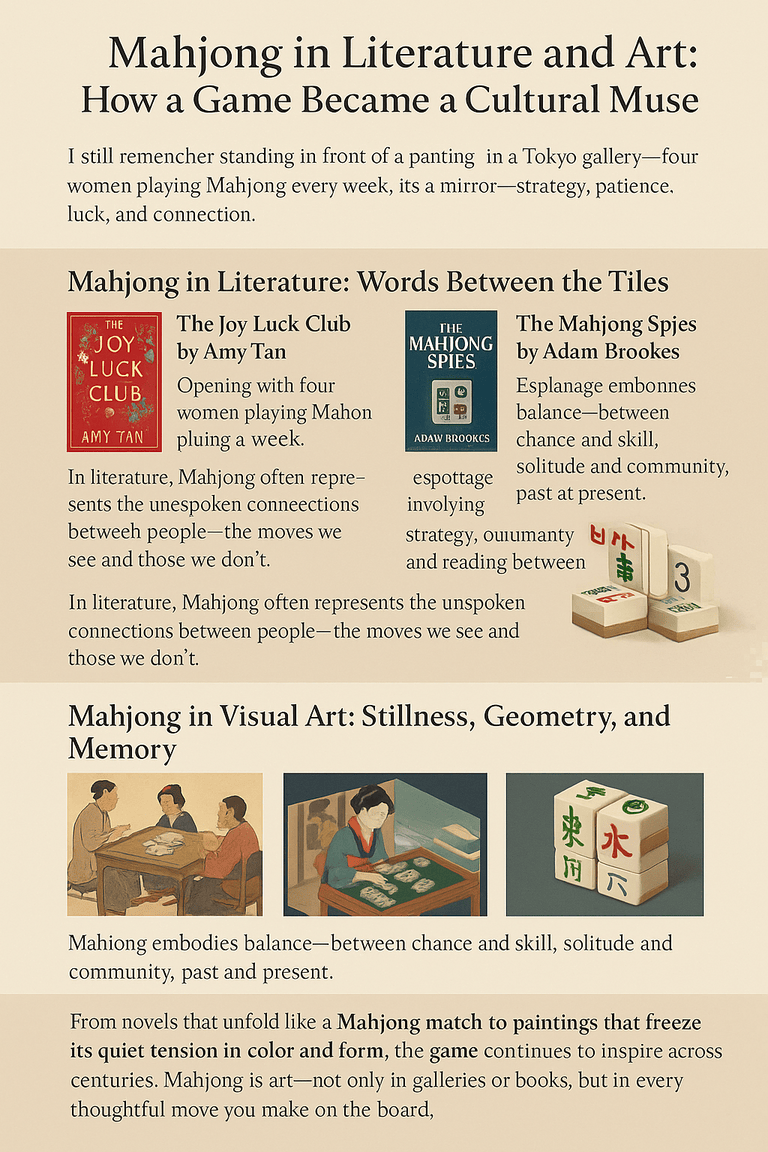
Mahjong in Literature and Art: How a Game Became a Cultural Muse
I still remember standing in front of a painting in a small Tokyo gallery — four women bent over a table, their faces calm but intense, their hands frozen mid-move. The artist had captured not just a game, but a world of emotion. Mahjong has always been more than a pastime; it’s a mirror of life itself — strategy, patience, luck, and connection.
Over the years, this ancient game has inspired writers, poets, and artists alike. From novels to paintings, Mahjong has evolved into a symbol of memory, community, and meaning.
Mahjong in Literature: Words Between the Tiles
Writers have long used Mahjong to explore family, identity, and fate.
The Joy Luck Club by Amy Tan
One of the most famous literary examples, Tan’s novel opens with four women playing Mahjong every week. The table becomes a storytelling space — where secrets are shared, losses processed, and cultural bridges built. The game symbolizes both tradition and resilience.
When you play a relaxing mahjong puzzle, you can almost feel the same quiet rhythm — every pair matched is like a story resolved.
The Mahjong Spies by Adam Brookes
This modern thriller uses the game as metaphor and motif. Just like Mahjong, espionage involves strategy, pattern recognition, and reading between the lines.
In literature, Mahjong often represents the unspoken connections between people — the moves we see and those we don’t.
Mahjong in Visual Art: Stillness, Geometry, and Memory
Artists have always been drawn to Mahjong’s visual elegance — the grid of tiles, the balance of color, the contrast between motion and stillness.
- Early Chinese scrolls depicted families gathered around Mahjong tables as symbols of unity and prosperity.
- Japanese woodblock prints from the 20th century showed Mahjong as modern leisure — a quiet rebellion against the rush of industrial life.
- Contemporary digital artists now recreate Mahjong boards in 3D installations and virtual reality, blending tradition with technology.
Try experiencing that artistic symmetry yourself with mahjong 3D online — the layered perspective feels like stepping into a living sculpture.
Mahjong as a Symbol of Harmony
In both art and writing, Mahjong embodies balance — between chance and skill, solitude and community, past and present.
This duality explains why the game fits so naturally into painting, poetry, and design. The same balance defines gameplay: knowing when to act and when to wait, when to risk and when to hold back. You’ll feel that harmony when you open a free mahjong game and settle into its steady rhythm.
Even the simplest layout, like Turtle Mahjong, carries that meditative quality artists chase — structure giving rise to freedom.
Mahjong in Modern Creative Culture
In today’s world, Mahjong imagery appears everywhere — on book covers, textiles, graphic design, even tattoos. For many, it’s not just a nod to heritage but a visual language of mindfulness and focus.
Modern designers often say the same thing gamers do: the beauty of Mahjong lies in its order within chaos. Maybe that’s why writers and painters keep returning to it — as a reminder that creativity, like a good hand, comes from both patience and play.
Final Thoughts
From novels that unfold like a Mahjong match to paintings that freeze its quiet tension in color and form, the game continues to inspire across centuries. Mahjong is art — not only in galleries or books, but in every thoughtful move you make on the board.
👉 Next time you start a free mahjong game you can play online, think of yourself as both player and artist — crafting patterns, finding harmony, and revealing beauty one tile at a time.
If your Mahjong board were a painting, what story would it tell?