

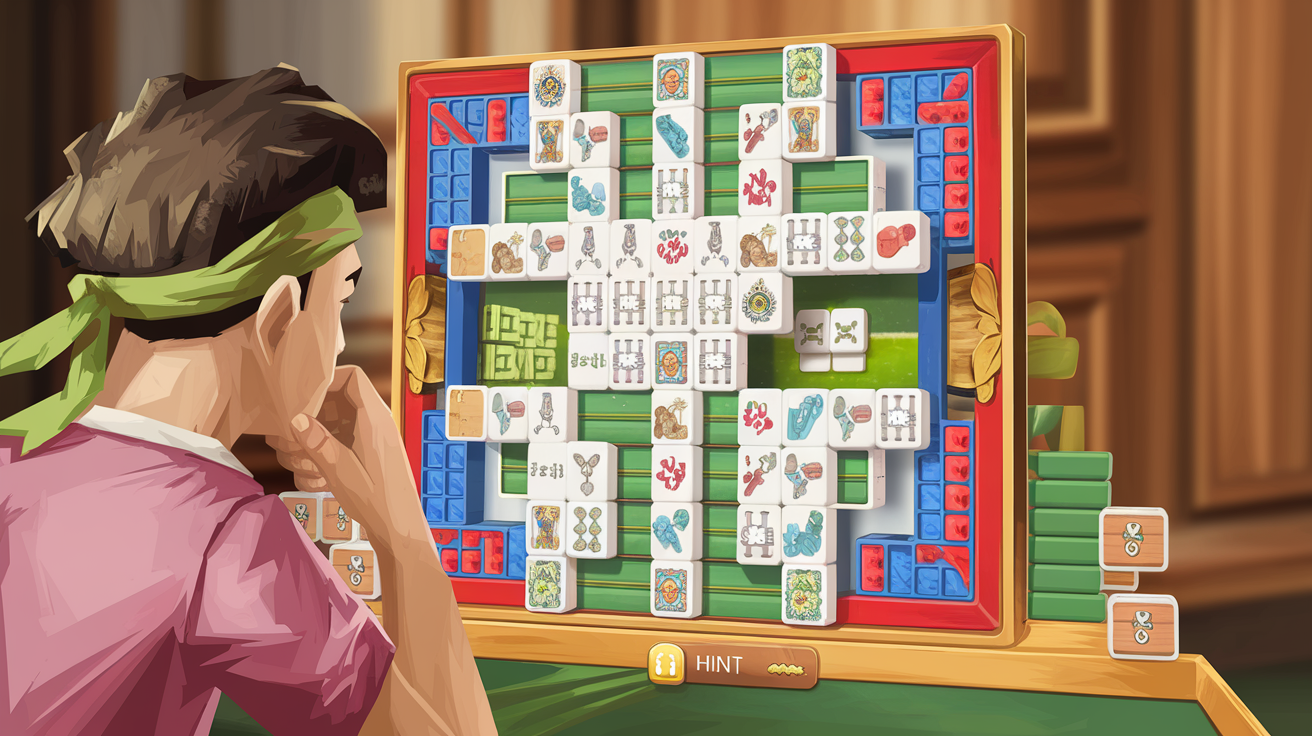
Mastering the Art of the Hint: Using Mahjong's Safety Net Without Becoming Dependent
When I first started playing online mahjong solitaire, I treated the hint button like a lifeline. Stuck on a move? Hit the hint. Unsure about tile removal strategy? Another hint. Within a few weeks, I could complete boards with impressive speed—as long as I had unlimited hints available. The moment I tried playing without them, I hit a wall. I wasn't actually learning; I was outsourcing my decision-making.
That experience taught me something crucial about skill development in mahjong: the hint system is powerful, but only if you understand when to use it and, more importantly, when to resist using it.
The Paradox of the Hint Button
The hint system in online mahjong serves a legitimate purpose. It removes frustration, prevents dead-end boards, and helps new players understand the logic of tile-matching. But here's where it becomes problematic: our brains are wired for efficiency. If a solution is instantly available, we'll take it—not because we're lazy, but because it's neurologically efficient. This efficiency, however, comes at a cost when learning complex pattern recognition.
When you use a hint, you're receiving someone else's analysis of the board state. You're not developing the neural pathways that would fire if you'd done that analysis yourself. It's like having someone point out the plot twist in a mystery novel before you reach it—the information is correct, but the discovery is gone.
The skilled mahjong players I know didn't get there by memorizing hint suggestions. They got there by spending enough time struggling with boards to develop intuition about tile visibility, corner strategy, and probability assessment.
When Hints Genuinely Help
That said, hints aren't inherently bad. They're tools with specific applications:
Learning the rules and basic mechanics: If you're new to mahjong and don't yet understand which tiles can match or why certain moves are illegal, hints are invaluable. They teach the grammar of the game.
Understanding complex board states: Some layouts have subtle tile cascades that aren't obvious at first glance. A hint here can reveal patterns you'd eventually find but might miss. This is educational.
Breaking genuine dead-ends: Some mahjong boards, if played poorly early on, become genuinely unwinnable. A hint that prevents wasting 20 minutes on an impossible position has real value.
Maintaining motivation: Occasional frustration builds skill. Constant frustration builds resentment. If you're close to quitting, a well-timed hint might keep you engaged long enough to improve.
The question isn't whether to use hints—it's whether you're using them to learn or to avoid learning.
The Hidden Cost of Hint Dependency
Over-relying on hints creates a specific kind of skill ceiling. You can become very fast at executing other people's decisions while remaining slow at making your own. This matters because:
You miss the decision-making process: Mahjong strategy involves prioritizing which tiles to expose, planning two or three moves ahead, and managing tile scarcity. Hints bypass this entirely.
Pattern recognition doesn't develop: The real skill in mahjong is learning to see matches before they're obvious. Hints teach you to wait for the game to point them out.
Adaptability suffers: Each mahjong variant has different mechanics (some tiles block others differently, some have special tiles, etc.). If you've learned through hints, switching variants is disorienting. But if you've learned through analysis, you can adapt quickly.
The plateau is sudden: For months, you improve. Then one day you don't. You're limited by your hint budget, or a harder variation removes hints entirely, and you realize you built your skill on sand.
I experienced this firsthand around my 300th game. I'd been using hints liberally, and my win rate was solid—around 75%. But then I challenged myself to a no-hint session for my 301st game. I lost badly, and not because the board was harder. I'd never learned to think through mahjong. I'd learned to react to suggestions.
The Hint Budget Framework: Learning With Intent
Instead of quitting hints cold turkey or using them endlessly, implement a tiered approach based on game difficulty and your skill stage:
Stage 1 (Games 1-20): Learning Mode
- Unlimited hints
- Your goal: Understand mechanics, see how matches work, learn that strategy exists
- Success metric: Completing boards consistently
Stage 2 (Games 21-50): Transition Mode
- 3 hints per game
- Your goal: Develop basic pattern recognition while having safety nets
- Success metric: Using all three before the end of the game
Stage 3 (Games 51-100): Challenge Mode
- 1 hint per game
- Your goal: Make most decisions independently; use the hint for genuinely stuck moments
- Success metric: Solving most boards without hints
Stage 4 (Games 100+): Mastery Mode
- No hints on standard boards
- Hints allowed only on harder variants as you learn them
- Success metric: Consistent wins on harder difficulty levels
This isn't about ego—it's about gradually shifting the cognitive load from the game to your own mind.
Implementing This at themahjong.io
A well-designed hint system, like the one available at themahjong.io, supports this progression. Rather than defaulting to unlimited hints or none, a good platform lets you:
- Track how many hints you've used
- Set personal limits before you play
- Review which moves you took hints on
- Gradually increase difficulty with hints fading away
The hint feature at themahjong.io exemplifies this approach—it's accessible when you need it but structured in a way that encourages independence. The platform doesn't hide hints from you, but it also doesn't make them your crutch. You have agency in deciding how much support you receive.
The Real Test: Playing Without Hints
Here's a practical challenge: play one game per week with zero hints. Not because hints are bad, but because you need to know what you can actually do independently. These games reveal your true skill level and expose the gaps in your pattern recognition.
The first few no-hint games will be harder. You'll make mistakes. You'll feel slower. This is the discomfort of actual learning—your brain rewiring itself to rely on its own analysis instead of external suggestions.
But around game five or six, something shifts. You start seeing matches before you consciously think about them. Your hands move faster because your eyes are training themselves to spot the patterns. You're developing intuition, and intuition is what separates casual players from skilled ones.
Conclusion: Intention Over Habit
The hint system isn't your enemy, and it isn't your friend. It's a tool, and like any tool, it's only useful if wielded with intention. The difference between a player who uses hints to learn and a player who uses hints to avoid learning is simple: one asks "How can I understand this?" and the other asks "How can I get past this?"
Start generous with hints. Learn the game. But build in specific transition points where you reduce your dependence. Use a hint budget. Track your progress. And most importantly, regularly challenge yourself to play without that safety net.
Your skill ceiling isn't set by the game's difficulty—it's set by how often you're willing to think instead of click.
